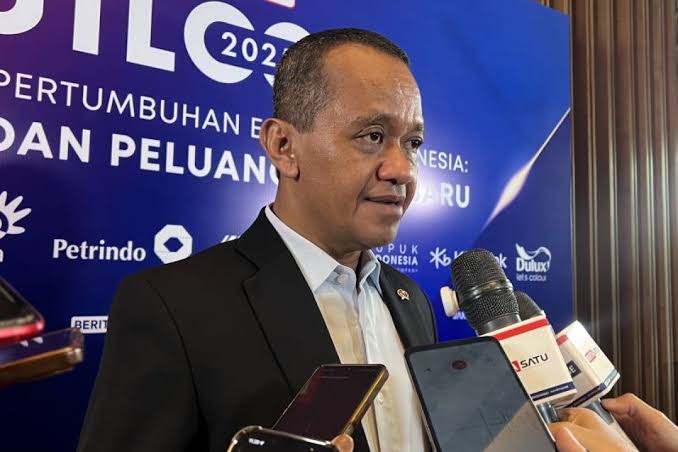
[Jakarta, 31 January 2025] The People’s Alliance for Climate Justice (ARUKI) considers Energy and Mineral Resources (ESDM) Minister Bahlil Lahadalia’s statement on the Paris Agreement—“Even the U.S. has withdrawn, why should we continue?” (30/1/2025)—as evidence of the government’s lack of commitment to climate justice and disregard for the suffering of people affected by the climate crisis.
The statement once again reflects a governmental attitude that ignores the public’s suffering due to climate change, as well as Indonesia’s legal and moral obligation to fulfill the right to a good and healthy environment. Instead of responding to the climate crisis threatening communities, economic priorities remain centered on extractivism and exploitation—the very root causes of the climate crisis.
The struggle to establish the Paris Agreement as a binding international accord, including Indonesia’s participation, was aimed at holding industrialized countries accountable for the climate crisis and safeguarding the rights of people in poor and developing nations. Bahlil Lahadalia’s assertion that the United States is the “driving motor” of the Paris Agreement is misguided. Any consideration of withdrawing from the Paris Agreement would represent a regressive and unwise step that would damage Indonesia’s credibility in the international community.
“This statement demonstrates the government’s lack of understanding and lack of concern regarding the urgency of the climate crisis and its reluctance to prioritize a climate justice agenda,” said Giorgio B. Indrarto, Deputy Director of MADANI Berkelanjutan.
A lack of seriousness in implementing commitments under the Paris Agreement would also constitute a breach of legal obligations. Indonesia ratified the Paris Agreement through Law No. 16 of 2016 and further regulated its implementation through Presidential Regulation No. 98 of 2021. In addition, Law No. 32 of 2009 clearly imposes legal obligations on the government to address the climate crisis. Ignoring these commitments because another country withdraws not only disregards the suffering of the people, but also deviates from the principle of common but differentiated responsibilities (CBDR), particularly the responsibility of industrialized nations.
Bahlil’s statement questioning Indonesia’s continued participation in the Paris Agreement turns a blind eye to the suffering, losses, and impacts experienced by communities and vulnerable groups. Ignoring the Paris Agreement means simultaneously ignoring the safety of the people—especially vulnerable groups—amid an increasingly unavoidable climate crisis. The European Climate Agency (Copernicus) has recorded that global temperatures have exceeded 1.5°C for the first time. In Indonesia, the National Disaster Management Agency (BNPB) recorded 6,827 climate- and weather-related disasters in 2023–2024, affecting more than 13 million people.
“Indonesia’s withdrawal from the Paris Agreement would have fatal consequences: loss of access to international climate finance, erosion of global trust in Indonesia’s sustainable development commitments, and setbacks for environmental advocacy by civil society. Weakening climate commitments also reflects disregard for millions of vulnerable communities who depend on nature and exacerbates energy poverty,” said Indira Hapsari from YAPPIKA.
ARUKI’s public consultations across 13 provinces revealed that vulnerable groups bear the heaviest burden of climate impacts. Youth, farmers, fishers, women, persons with disabilities, workers, the urban poor, informal workers, and Indigenous Peoples have directly experienced displacement, land loss, income loss, and even climate-induced migration.
Withdrawing from the Paris Agreement would also signal that the Indonesian government fails to recognize differentiated impacts on women, children, and vulnerable groups, as explicitly acknowledged in the Agreement.
“Bahlil’s statement shows that the government does not recognize the differentiated impacts of the climate crisis. Vulnerable groups are already facing the triple planetary crisis. Implementing the Paris Agreement based on climate justice principles can protect people from this crisis,” said Torry Kuswardono, Executive Director of Yayasan PIKUL.
The statement underscores the government’s continued prioritization of development and economic agendas centered on natural resource exploitation and extractive industries—particularly coal—over climate justice commitments that ensure environmental safety and public welfare.
Coal’s role in driving the climate crisis is undeniable. Rather than ambitiously phasing it out, the Indonesian government continues to prioritize coal as a primary energy source. Risma Umar, Executive Director of Aksi! for Gender, Social, and Ecological Justice, stated:
“Justifying continued reliance on coal as a main energy source ignores serious implications for climate justice and undermines industrialized countries’ obligations in terms of ecological debt and the CBDR-RC principle.”
Syaharani from the Indonesian Center for Environmental Law (ICEL) added:
“Framing energy sovereignty and security around coal is a flawed paradigm. Coal exploitation has increased community vulnerability, especially among women and children. Building energy sovereignty while allowing communities to bear coal’s negative impacts is tantamount to actively violating the right to a good and healthy environment.”
Renewable energy, she continued, offers a more sustainable and just pathway to energy sovereignty, particularly through community-based renewable energy development.
“Weakening climate commitments, combined with misguided justifications of ‘sovereignty,’ risks triggering forest exploitation through green energy claims such as bioenergy. Bioenergy expansion—through industrial tree plantations and oil palm estates—poses serious threats to Indonesia’s forests. The recent Food and Energy Reserve Forest program is evidence of this. The government must correct its understanding of energy sovereignty and embrace a just and sustainable energy transformation,” said Amalya Reza Oktaviani of Trend Asia.
ARUKI therefore calls on the Government of Indonesia to:
Implement the Paris Agreement through concrete actions, including setting a clear timeline for early retirement of coal-fired power plants (PLTUs);
Facilitate and promote an inclusive and just transition to renewable energy, while expanding access to clean energy for the people;
Prioritize climate justice and avoid sacrificing vulnerable groups’ interests in climate and development policies;
Immediately deliberate the Climate Justice Bill (RUU Keadilan Iklim), currently included in the National Legislative Program, with meaningful public participation—especially from vulnerable groups—to demonstrate Indonesia’s commitment to addressing the climate crisis and safeguarding both national and global communities from climate disasters.
About ARUKI
The People’s Alliance for Climate Justice (ARUKI) is a civil society coalition established on 20 November 2023, comprising organizations including WALHI, ICEL, Kemitraan, PIKUL, Madani Berkelanjutan, YAPPIKA, Yayasan Pusaka, Aksi! for Gender Social Ecological Justice, KRKP, Solidaritas Perempuan, TUK Indonesia, YLBHI, Koaksi Indonesia, 350.org Indonesia, AMAN, KPA, KNTI, KIARA, PJS, Himpunan Wanita Disabilitas Indonesia, XR Indonesia, Trend Asia, Celios, Perkumpulan HuMa, and others.
ARUKI aims to advance the enactment of a Climate Justice Law as the highest legal instrument to harmonize national efforts in addressing the climate crisis. Its vision is to drive systemic transformation toward climate justice in Indonesia grounded in justice, democracy, and sustainability.
Media Contact:
Omen Bagaskara (+62 85 314-451-953)