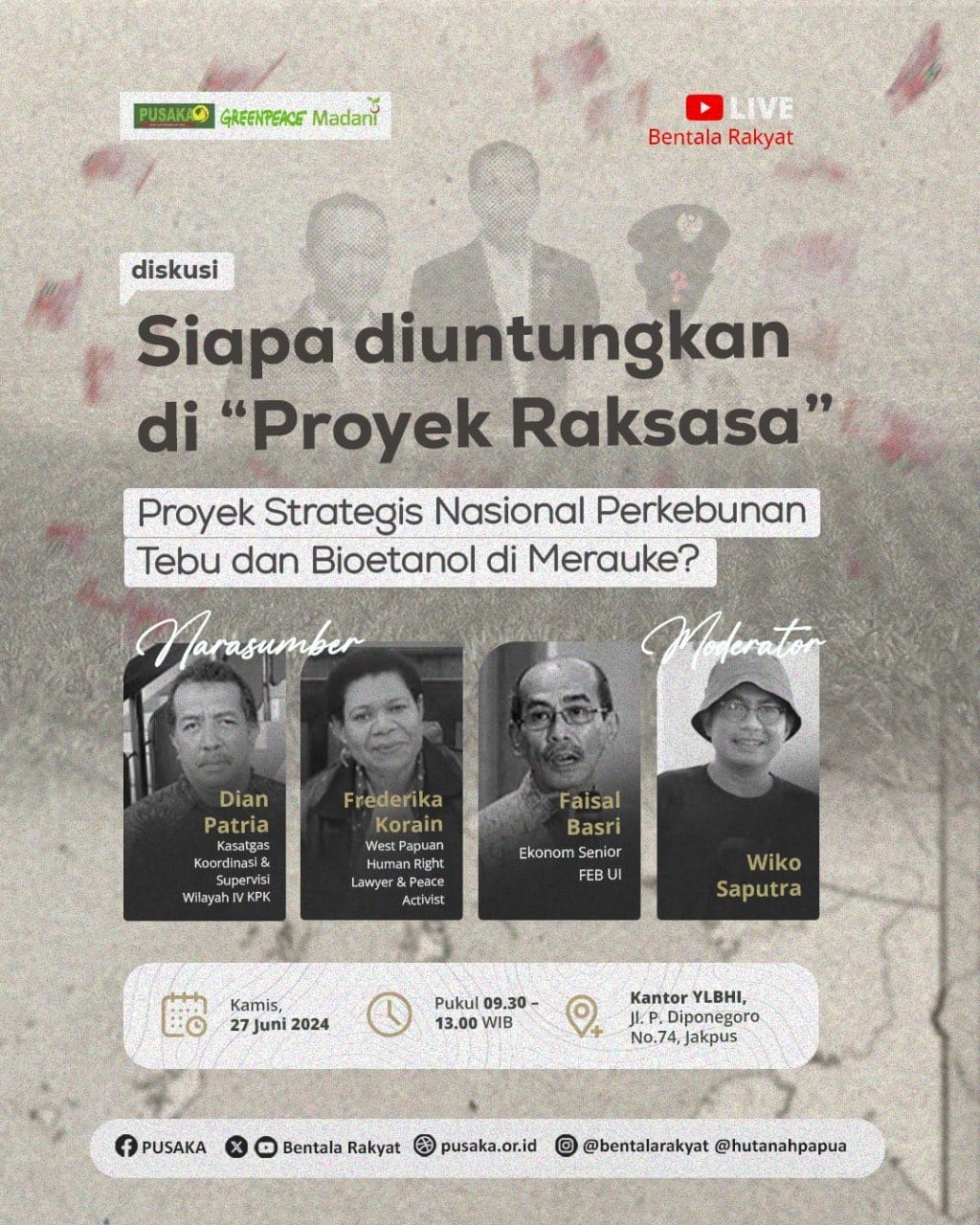
Discussion: Who Benefits from the "Giant Project" of the National Strategic Project of Sugarcane Plantations and Bioethanol in Merauke?

Discussion: Who Benefits from the "Giant Project" of the National Strategic Project of Sugarcane Plantations and Bioethanol in Merauke?

The article "Diskusi: Siapa Diuntungkan di Proyek Raksasa? Proyek Strategis Nasional Perkebunan Tebu dan Bioetanol di Merauke" examines the social, environmental, and economic implications of the National Strategic Project (PSN) for sugarcane plantations and bioethanol development in Merauke. Through a public discussion, experts, researchers, and civil society organizations assessed who stands to benefit from the large-scale project while raising concerns over its potential impacts on Indigenous Peoples, local communities, forests, biodiversity, and customary land rights. The discussion highlights the importance of transparent governance, meaningful public participation, and evidence-based policymaking to ensure that development objectives do not come at the expense of environmental sustainability and social justice. Participants also emphasized the need to balance food and energy security goals with the protection of ecosystems, human rights, and community livelihoods, particularly in ecologically sensitive areas such as Papua. By encouraging critical dialogue and independent assessment, the article calls for greater accountability in the planning and implementation of strategic development projects, ensuring they align with Indonesia's climate commitments, sustainable development objectives, and the long-term well-being of affected communities.

The article "Diskusi: Siapa Diuntungkan di Proyek Raksasa? Proyek Strategis Nasional Perkebunan Tebu dan Bioetanol di Merauke" examines the social, environmental, and economic implications of the National Strategic Project (PSN) for sugarcane plantations and bioethanol development in Merauke. Through a public discussion, experts, researchers, and civil society organizations assessed who stands to benefit from the large-scale project while raising concerns over its potential impacts on Indigenous Peoples, local communities, forests, biodiversity, and customary land rights. The discussion highlights the importance of transparent governance, meaningful public participation, and evidence-based policymaking to ensure that development objectives do not come at the expense of environmental sustainability and social justice. Participants also emphasized the need to balance food and energy security goals with the protection of ecosystems, human rights, and community livelihoods, particularly in ecologically sensitive areas such as Papua. By encouraging critical dialogue and independent assessment, the article calls for greater accountability in the planning and implementation of strategic development projects, ensuring they align with Indonesia's climate commitments, sustainable development objectives, and the long-term well-being of affected communities.

No headings found on page

In April 2024, President Joko Widodo issued Presidential Decree Number 15 of 2024, dated April 19, 2024, concerning the Task Force for the Acceleration of Sugar and Bioethanol Self-Sufficiency in Merauke Regency, South Papua Province. The Task Force was established to accelerate investment activities in sugarcane plantations integrated with the sugar, bioethanol, and biomass power generation industries.

Coordinating Minister for Economic Affairs Regulation (Permenko) Number 8 of 2023, dated November 14, 2023, concerning the Fourth Amendment to Permenko Number 7 of 2021 concerning Amendments to the National Strategic Project List, identified the Merauke Food and Energy Development Area in South Papua Province as a PSN.

The Minister of Investment/Head of the Investment Coordinating Board (BKPM), Bahlil Lahadalia, as Head of the Task Force, acted quickly and identified approximately two million hectares of land in Merauke, South Papua Province, to be allocated for sugarcane plantations to accelerate sugar self-sufficiency.

The two million hectares of land in question is significantly larger than the planned National Sugar Self-Sufficiency Acceleration Program and the Provision of Bioethanol as a biofuel, which includes the addition of 700,000 hectares of new sugarcane plantations sourced from plantations, smallholder sugarcane fields, and forest areas.

The roadmap for Presidential Regulation 20/2023 states that this large-scale mega-project aims to increase bioethanol production by 1,200,000 kiloliters. The Indonesian government is also targeting 5 million tons of sugar imports to meet demand and the growth of the food and beverage industry.

The Merauke National Strategic Project (PSN) is currently attracting public attention at both the local and national levels. The upcoming regional elections (Pilkada) are a political opportunity. The Madani Berkelanjutan Foundation, the Pusaka Bentala Rakyat Foundation, and Greenpeace Indonesia held a discussion: Who Benefits from the "Giant Project" of the National Strategic Project for Sugarcane Plantations and Bioethanol in Merauke? Held on:

Thursday, June 27, 2024

9:00 AM – 1:00 PM WIB

At the YLBHI office, Jl. Diponegoro No. 74, Central Jakarta

Live on the Bentala Rakyat YouTube channel

Speakers:

Dian Patria: Head of the KPK's Region IV Coordination & Supervision Task Force

Federika Korain, West Papuan Human Rights Lawyer & Peace Activist

Faisal Basri, Senior Economist, Faculty of Economics and Business, University of Indonesia

Moderator:

Wiko Saputra

Related to read