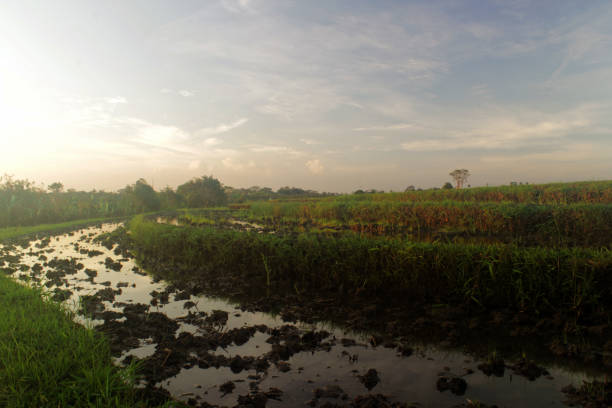
JAKARTA (13 February 2018) Two years have passed since President Joko Widodo issued Presidential Regulation No. 1/2016 establishing the Peatland Restoration Agency (BRG), marking the beginning of Indonesia’s commitment to restore 2 million hectares of degraded peatland ecosystems across seven priority provinces.
The Ministry of Environment and Forestry (MoEF), BRG, the National Development Planning Agency (Bappenas), the Ministry of Agrarian Affairs and Spatial Planning/National Land Agency (ATR/BPN), as well as several local governments, have issued policies and implemented programs to support this restoration target.
However, independent monitoring conducted by 19 civil society organizations (CSOs) across the seven priority provinces found that, while peatland restoration progress has been relatively positive, there is still significant room for improvement. Based on field monitoring findings, the 19 CSOs—working under the Pantau Gambut Network Hub—have submitted five recommendations to ensure the restoration target can be achieved, as outlined in the report titled:
“Voices from the Frontline of Peatland Protection in Seven Provinces: A Two-Year Evaluation of Peatland Restoration.”
Recommendation 1: Strengthen Cross-Institutional Coordination
Peatland restoration requires better coordination among ministries and agencies at both national and subnational levels. Restoration is not only the responsibility of BRG, but also of MoEF, the Ministry of Agriculture, provincial governments, and regional peatland restoration teams.
“Limited coordination can lead to overlapping work between institutions. For example, Pantau Gambut found that the Peat Ecosystem Protection and Management Plan (RPPEG), which must be developed by MoEF, risks duplicating the Peat Ecosystem Restoration Plan (RREG) currently implemented by BRG. These two planning frameworks must be coordinated so they reinforce rather than operate separately,” said Teguh Surya, Executive Director of Yayasan Madani Berkelanjutan.
Yohanes Akwan, Coordinator of the Pantau Gambut Papua Hub, added:
“The Ministry of Agriculture and local governments must also work in synergy with MoEF and BRG, particularly in enforcing peatland restoration regulations in cultivation areas, which make up 87% of the total priority restoration zone.”
Recommendation 2: Improve Data Transparency
Peatland restoration requires transparent data to enable meaningful public participation and oversight.
“Although Law No. 32/2009 on Environmental Protection guarantees equal rights and opportunities for public participation, Pantau Gambut still faces difficulties accessing detailed information on peatland restoration. For instance, we need precise locations of BRG interventions to verify restoration impacts. MoEF must also provide public data on companies obligated to restore peatlands and those that have submitted revised Business Work Plans (RKU),” said Sarah Agustiorini, Campaigner at Kaoem Telapak.
Recommendation 3: Enhance Community Capacity and Participation
Peatland restoration must include programs that strengthen community understanding and capacity to ensure long-term sustainability beyond 2020.
“BRG has attempted to address this through the establishment of Peatland Care Villages (Desa Peduli Gambut). However, Pantau Gambut found that some villages affected by the 2015 fires and restoration interventions have not yet been included, such as Guntung Payung Village in South Kalimantan,” said Kisworo Dwi Cahyono, Executive Director of WALHI South Kalimantan.
Romesh Irawan, Executive Director of Kaliptra Andalas, explained:
“Interviews with local residents show restoration activities often fail to fully involve affected communities. For example, borewell construction involved only village authorities, not directly impacted residents, meaning communities do not understand the benefits or how to use the facilities.”
Almo Pradana, Peatland Restoration Project Manager at WRI Indonesia, added:
“The capacity of Peatland Restoration Management Units (UPRG), composed of local agencies (OPD), businesses, and communities, must be strengthened so they can independently develop and implement restoration plans and manage restoration funding in an integrated way.”
Recommendation 4: Strengthen Oversight of Corporate Restoration Obligations
The fourth recommendation calls for stronger supervision of peatland restoration activities conducted by companies.
Around 60% of the 2.4 million hectares of priority restoration areas lie within concession territories. Under Government Regulation No. 57/2016 and MoEF Regulation No. 14/2017, companies are obligated to restore degraded peatlands caused by corporate activities, both inside and outside concession boundaries.
“However, based on regional hub observations, peatland restoration has been more visible in community-managed areas than in corporate concession areas. In South Sumatra, for example, corporate restoration targets cover around 458,430 hectares out of a total target of 594,230 hectares. Yet until now, we have not received detailed data or information on follow-up actions by concession holders,” said Hadi Jatmiko, Executive Director of WALHI South Sumatra.
Hadi urged that corporate commitments must be accelerated and enforced, for example by setting clear deadlines for submitting revised Business Work Plans and imposing sanctions for non-compliance.
Recommendation 5: Integrate Local Knowledge into Sustainable Peat Management
The final recommendation highlights the importance of incorporating local wisdom and traditional practices into peatland restoration methods.
“In Mantangai Hulu Village, Central Kalimantan, we identified community economic activities that support restoration, such as fish farming, purun cultivation for handicrafts, and jelutung agroforestry. These are forms of local knowledge passed down for generations. Restoration plans must therefore consider local wisdom in each region,” said Dimas Hartono, Executive Director of WALHI Central Kalimantan.
A Shared Responsibility
These recommendations are directed to relevant government institutions—including MoEF, BRG, local governments in the seven priority provinces, the Ministry of Agriculture, Bappenas, and ATR/BPN—because Pantau Gambut believes peatland restoration is a shared task, not the responsibility of a single organization.
“Peatland restoration is a long journey that cannot be completed in just five years, nor should it rest solely on an ad hoc institution. Restoration efforts must be institutionalized across all ministries and agencies at national and local levels,” said Almo.
This report was developed based on field observations conducted by Pantau Gambut hubs at both national and regional levels. It can be accessed freely at pantaugambut.id/laporan-tahunan, a public platform monitoring peatland restoration progress.
The platform also features regular monitoring of restoration commitments, maps of restoration activities by government, businesses, and CSOs, story-sharing spaces for lessons learned, and educational resources on peatlands.
About Pantau Gambut
Pantau Gambut is an independent initiative of civil society organizations in Indonesia that utilizes technology, data collaboration, and grassroots networks to provide information and increase public participation in ensuring the success of peatland ecosystem restoration commitments by all stakeholders.
Pantaugambut.id features:
Commitment Monitoring
Restoration Activity Maps
Story Sharing
Learning Resources
The platform is freely accessible to the public.