The Sustainable Madani Foundation summarizes several important events related to the economic-political conditions that occurred in the past week (July 13, 2021 – July 19, 2021). Here are the excerpts:
1. Emergency PPKM Extended, PEN Budget Increases to Rp 744.75 Trillion
The government has decided to increase funding for the National Economic Recovery (PEN) and Covid-19 Handling programs amidst the Emergency Community Activity Restrictions (PPKM) which have been extended until the end of July 2021. Finance Minister Sri Mulyani Indrawati explained that the PEN and Covid-19 handling funds have increased from Rp 699.43 trillion to Rp 744.75 trillion.
Specifically, social protection funds increased from Rp 153.86 trillion to Rp 187.84 trillion. Health funds increased from Rp 193.93 trillion to Rp 214.95 trillion. Business incentives remained at Rp 62.83 trillion. Priority programs increased from Rp 117.04 trillion to Rp 117.94 trillion. Support for MSMEs and corporations decreased from Rp 171.77 trillion to Rp 161.20 trillion.
2. Economy Slows, S&P Warns of Indonesia's Debt Burden
S&P Global Ratings Asia-Pacific economist Vishrut Rana estimates a general government deficit of 6% of GDP in 2021 due to weaker economic conditions amid the severe virus outbreak. The projected 6%-of-GDP state budget deficit stems from Indonesia's projected economic growth of only 2.3%–3.4% this year. S&P Global Ratings' projected 2021 state budget deficit falls short of the government's target of 5.7% of GDP.
Vishrut stated that the widening 2021 state budget deficit will significantly impact Indonesia's medium-term fiscal framework, given that Indonesia's debt rating is currently at BBB/Negative/A-2. He urged the government to exercise caution, as a protracted economic recovery would further worsen Indonesia's overall fiscal situation, particularly its debt burden.
3. LSI: Public Satisfaction with Jokowi's Work Against the Pandemic Has Declined
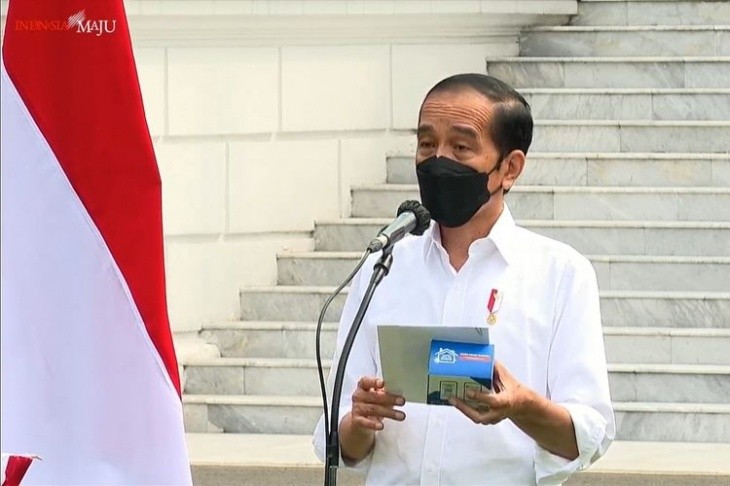
A survey by the Indonesian Survey Institute (LSI) found that public satisfaction with President Jokowi's performance in handling the coronavirus (COVID-19) outbreak has tended to decline over the past six months. LSI Executive Director Djayadi Hanan stated that public satisfaction with President Jokowi's performance remained quite high in June 2021, at 59.6 percent. However, this figure decreased compared to December 2020, when it reached 68.9 percent.
This is evident from the results of a survey conducted by his office on June 22-25, 2021, with 1,200 respondents from 34 provinces. The survey used a simple random sampling method with a margin of error of around 2.8 percent. Furthermore, according to Djayadi, the level of public dissatisfaction tends to be higher in communities implementing Emergency PPKM. He stated that the survey results showed that 49.4 percent of those who expressed dissatisfaction were residents of DKI Jakarta. Next, the level of dissatisfaction with Jokowi's performance in West Java was 43.7 percent; Central Java 40.9 percent; and Sulawesi 44.7 percent.
4. Ratification of the Papua Special Autonomy Bill
The House of Representatives (DPR) officially ratified the Papua Special Autonomy Bill into law during a Plenary Session at the Parliament Complex, Senayan, Jakarta, on Thursday (July 15th). Komarudin Watubun, Chairman of the House's Special Committee (Pansus) on the Revision of the Papua Special Autonomy Law, revealed seven important changes to the law. He said the revised Papua Special Autonomy Law has amended or revised 18 articles, consisting of three proposed by the government and 15 articles not proposed by the government. In addition to these 18 articles, the Pansus and the government also agreed to add two additional articles to the Papua Special Autonomy Bill. This brings the total number of articles in the bill to 20.
First , this bill accommodates the need for special arrangements for Indigenous Papuans in the fields of politics, education, health, employment, and the economy, as well as providing support for the development of indigenous communities. Specifically for indigenous communities, Article 36 paragraph (2) letter (d) stipulates that 10 percent of the revenue-sharing funds are allocated for expenditure on assistance for empowering indigenous communities.
Second , regarding the Papuan People's Assembly (MRP) and the Papuan People's Representative Council (DPRP). This bill is claimed to provide legal certainty that the MRP and DPRP will be based in their respective provincial capitals and will provide clarification regarding the names of each institution.
Third , regarding local political parties. The Papua Special Autonomy Bill removes two paragraphs from Article 28 of the Papua Special Autonomy Law. The Special Committee and the government have previously assessed that Article 28 has led to misunderstandings between regional and central governments regarding local political parties. Therefore, to avoid differences of opinion, this bill adopts Constitutional Court Decision Number 41/PUU-XVII/2019 by removing the provisions in paragraphs (1) and (2) of Article 28.
Fourth , regarding the Special Autonomy Fund, which was changed from 2 percent to 2.25 percent. Fifth , the establishment of a Special Agency for the Acceleration of Papuan Development (BK-P3). The BK-P3 is chaired directly by the Vice President and includes the Minister of Home Affairs, the Minister of National Development Planning, and the Minister of Finance, as well as representatives from each province in Papua.
Sixth , regarding the expansion of the province in Papua. The Special Committee and the government agreed that provincial expansion in Papua can be carried out not only with the approval of the People's Consultative Assembly (MRP) and the Regional People's Representative Council (DPRP), but also by the government and the House of Representatives (DPR). The government and DPR can also carry out the expansion of the province without going through the preparatory regional stage. Seventh, regarding the acceleration of implementing regulations for the latest Papua Special Autonomy Law.
Several articles in the revision were described as "ghost articles," one of which was cited by Yan Christian Warunussy, Executive Director of the Manokwari Institute for Research, Assessment, and Development of Legal Aid (LP3BH). Yan stated that the Papua Special Autonomy Bill only contained three articles when it was submitted to the Indonesian House of Representatives (DPR RI). However, 17 new articles were added to the revised law before it was passed. Furthermore, 714,066 Papuans and 112 organizations, members of the Papuan People's Petition (PRP), are claimed to reject the ratification of the revised Law (RUU) Number 21 of 2001.
5. The Deputy Governor of Riau's Commitment to the Presidential Instruction on a Palm Oil Moratorium
Riau Deputy Governor Edy Natar Nasution stated that there will be no new permits for entrepreneurs seeking to open oil palm plantations in the country. He stated that this is in accordance with President Joko Widodo's (Jokowi) instructions, specifically Presidential Instruction (Inpres) Number 8 of 2018, which regulates the postponement and evaluation of oil palm plantation permits and increases in productivity.
Furthermore, Edy hopes that Law Number 11 of 2020 concerning Job Creation will provide clearer direction regarding forestry and land use, particularly in resolving cases related to forests being converted into plantations.
Gulat Manurung, Chairman of the Indonesian Palm Oil Farmers Association (Apkasindo), agreed with Edy Natar's statement. He believes Riau should receive more than its 4.17 million hectares of oil palm plantations, which he described as the largest in Indonesia.