The Sustainable Madani Foundation summarizes several important events related to the economic-political conditions that occurred in the past week (June 21 – June 29, 2021). Here are the excerpts:
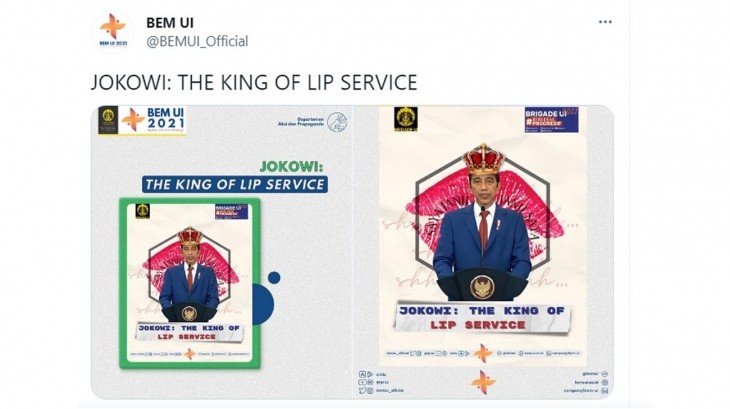
1. Criticism of President Jokowi The King of Lip Service
The University of Indonesia's Student Executive Board (BEM UI) criticized and dubbed President Jokowi "The King of Lip Service" for frequently making empty promises that often go unfulfilled.
The UI Rectorate responded by summoning several BEM UI administrators through letter number 915/UN2.RI.KMHS/PDP.00.04.00/ 2021, signed by the Director of Student Affairs, Tito Latif Indra.
Forty-four student executive boards (BEM) and civil society organizations, including the All-Indonesian Student Executive Board Alliance, Greenpeace Indonesia, and the Pusako Faculty of Law at Andalas University, accused the UI Rectorate of undermining civil liberties.
Student Executive Board (BEM) and civil society groups assess the content published by BEM UI as in line with the current state of civil liberties and freedom of expression in Indonesia. They believe civil liberties are being suppressed through repressive actions by authorities against demonstrators, freedom of expression is being silenced through the flexible provisions of the ITE Law, the KPK is being systematically weakened, and the president is interfering with the rule of law. Reflecting on these incidents, BEM and civil society groups condemn and urge the government to guarantee freedom of expression based on applicable regulations.
Several political party elites also condemned the move. Fahri Hamzah, Deputy Chairman of the Indonesian People's Wave Party (Gelora), stated that the New Order (Orba) mentality had shifted to the UI Rectorate by calling for critical students. He argued that the campus should be free from restrictions.
Democratic Party Deputy Secretary General Irwan stated that campuses should not be used as a tool to silence students' freedom of expression. He also urged universities not to stifle students' critical thinking.
Meanwhile, Gerindra Party Deputy Chairman Fadli Zon stated that the UI Rectorate's response to the Student Executive Board's (BEM UI) labeling President Jokowi "The King of Lip Service" was shameful. He argued that the UI Rectorate should examine the substance and arguments behind the BEM UI's actions.
Shortly after criticizing President Jokowi, four social media accounts and WhatsApp accounts belonging to four University of Indonesia Student Executive Board (BEM) administrators were hacked. BEM UI Chair Leon Alvinda Putra explained that on June 27 and 28, 2021, several BEM UI 2021 administrators had their social media accounts hacked. Following this incident, Leon strongly condemned the hacking attempt experienced by BEM UI activists.
2. The palm oil farmers association asked the government to continue the palm oil moratorium.
The oil palm farmers association, which is part of the Indonesian Jaya Palm Oil Forum (POPSI), has asked President Jokowi to extend Presidential Instruction Number 8 of 2018 concerning permit evaluation and productivity improvement, or the oil palm moratorium.
POPSI Chairman Pahala Sibuea stated that Indonesia currently has a total oil palm plantation area of 16.38 million hectares (ha). Crude palm oil (CPO) production experiences an annual overstock of around 4.5 million to 5 million tons.
POPSI is urging the government to focus on increasing the productivity of oil palm farmers. One way to do this is through the smallholder oil palm replanting (PSR) program, which is considered an appropriate initiative. After PSR, farmers are expected to achieve annual productivity of 20 to 25 tons per fresh fruit bunch (FFB). Previously, farmers' productivity was only around 10 to 15 tons per year. This means there will be a significant increase in Indonesian palm oil production from smallholders.
In addition to requesting an extension of Presidential Instruction No. 8 of 2018 concerning the moratorium, POPSI asked the government to clarify several things in continuing the palm oil moratorium.
First , collectively stop deforestation and optimize collaboration with independent smallholder farmers by increasing their productivity and purchasing directly from them. Second , address low selling prices by eliminating high economic costs in the field and making independent smallholder farmers a transparent and sustainable source of supply for government programs like B30.
Third , assist independent oil palm farmers with mapping, institutional revitalization, and land legalization. Through these efforts, farmers will obtain ISPO certification, and Indonesian smallholder palm oil will have legal certainty, ensuring its continued participation in sustainable palm oil production.
Fourth , clarity and certainty of data, institutions, and legality will make it easier for farmers to access funding from both financial institutions and the Oil Palm Plantation Fund Management Agency (BPDPKS). Fifth , relevant ministries/institutions should assist independent farmers in taking part in the revitalization of oil palm plantations. As an illustration, BPDPKS assists with funding and the Ministry of Agrarian and Spatial Planning/National Land Agency (ATR/BPN) assists with certification (as part of the agrarian reform program). Then, the Ministry of Environment and Forestry (KLHK) resolves overlapping land claims between independent farmers and forest areas. The Ministry of Agriculture also conducts data collection with the Regency Plantation Office and strengthens the human resources of oil palm farmers extensively.
Sixth , the parties provide support for collaboration with Indonesian independent smallholders based on the principles of fair and sustainable partnerships that promote farmer welfare. Seventh , reconsider the palm oil levy regulated by the Indonesian Ministry of Finance and managed by the BPDPKS (Farm and Plantation Development Agency) to prevent eroding fresh fruit bunch (FFB) prices for both plasma and independent smallholders.
Eighth , funding for the rejuvenation of smallholder oil palm plantations to increase plantation productivity must be 100% supported by BPDPKS with easy and transparent funding bureaucratic procedures.
3. Indonesia's Carbon Tax of IDR 75/kg Far from World Bank Recommendations
Institute For Essential Services Reform (IESR) Executive Director Fabby Tumiwa assessed that the proposed minimum carbon tax of IDR 75 per kg is still far from the recommendations of the World Bank and the International Monetary Fund (IMF). The World Bank and IMF recommend a carbon tax for developing countries ranging from US$ 35 – US$ 100 per ton or around IDR 507,500 – IDR 1.4 million (assuming an exchange rate of IDR 14,500 per US$) per ton.
Fabby suggested that carbon pricing be adjusted to Indonesia's target of achieving net zero emissions by 2050 and the investment needed to transform the energy system towards net zero emissions.
Indonesia itself consistently faces funding shortages in its climate change mitigation efforts. This is reflected in the gap between required funding and the annual budget allocated in the state budget. In 2016, the government's allocated spending in the state budget was 19.7%, with a funding shortfall of 80.3%.
In 2019, available funding was only 31.4%, with a funding shortfall of approximately 68.6% of the total required climate change management budget. Therefore, carbon tax revenue is crucial for the government to address climate change.
4. Tax Amnesty II to Begin July 1st.
The government plans to offer another tax amnesty next year. The rates imposed in this second tax amnesty will be higher than the first, ranging from 12.5% to 30%.
According to the draft General Provisions and Tax Procedures Bill, the tax amnesty will be divided into two categories. First, the recognition of assets acquired by taxpayers between January 1, 1985, and December 31, 2015, that were under- or undeclared during the first tax amnesty . Second, the recognition of assets acquired between January 1, 2016, and December 31, 2019, that were under- or undeclared in their annual tax returns.
Taxpayers (WP) who wish to disclose net assets acquired before or after the first tax amnesty can submit this through an asset disclosure notification letter and submit it to the Directorate General of Taxes for the period of July 1, 2021 to December 31, 2021. Taxpayers who are allowed to participate in the asset disclosure must meet the requirements, namely, not being subject to an audit, not being subject to preliminary evidence examination, not being subject to an investigation into a tax crime, not being under trial or serving a tax criminal sentence.
5. Indonesia's debt reaches Rp 6,000 trillion
The Ministry of Finance (Kemenkeu) recorded government debt at IDR 6,418.15 trillion at the end of May 2021. This debt position is equivalent to 40.49 percent of Gross Domestic Product (GDP).
According to the Our State Budget (APBN Kita) book, government debt is dominated by Government Securities (SBN) at 86.94 percent and loans at 13.06 percent. Specifically, SBN debt is recorded at IDR 5,580.02 trillion, consisting of IDR 4,353.56 trillion in domestic SBN and IDR 1,226.45 trillion in foreign currency.
Meanwhile, debt through loans was recorded at IDR 838.13 trillion. This consisted of IDR 12.32 trillion in domestic loans and IDR 825.81 trillion in foreign loans. This foreign debt comprised IDR 316.83 trillion in bilateral loans, IDR 465.52 trillion in multilateral loans, and IDR 43.46 trillion in loans from commercial banks.
The magnitude of the national debt has raised concerns. The Supreme Audit Agency (BPK) expressed concern in its release of the 2020 Central Government Financial Report (LKPP) that the Indonesian government's debt has reached over Rp 6,000 trillion.
In detail, the Supreme Audit Agency (BPK) stated that Indonesia's debt ratio exceeded the IMF's recommended limit, namely a debt-to-revenue ratio of 46.77 percent, exceeding the IMF's recommendation of 25 to 35 percent. The COVID-19 pandemic has increased the debt deficit and surplus. This could also increase fiscal management risks.
According to Supreme Audit Agency (BPK) Chairman Agung Firman Sampurna, the ratio of debt interest payments to state revenues has also reached 19.06 percent. This is considered to exceed the International Debt Relief (IDR) recommendation of 4.6 to 6.8 percent. Meanwhile, the debt-to-state revenue ratio, which has reached 369 percent, is also considered to exceed the IDR (92%-167%) and IMF (90-150%) recommendations.