JAKARTA, October 23, 2025 – The government, through the Ministry of Environment, held the Consultation on Indonesia’s Second Nationally Determined Contribution (SNDC) on Thursday, October 23, 2025, in Jakarta. The event would be more accurately described as a socialization session for Indonesia's SNDC rather than a consultation, as the public was not given a fair and meaningful opportunity to participate in drafting the SNDC, which will be submitted ahead of the Conference of the Parties (COP) 30 - United Nations Framework Convention on Climate Change (UNFCCC) event on November 10–21, 2025.
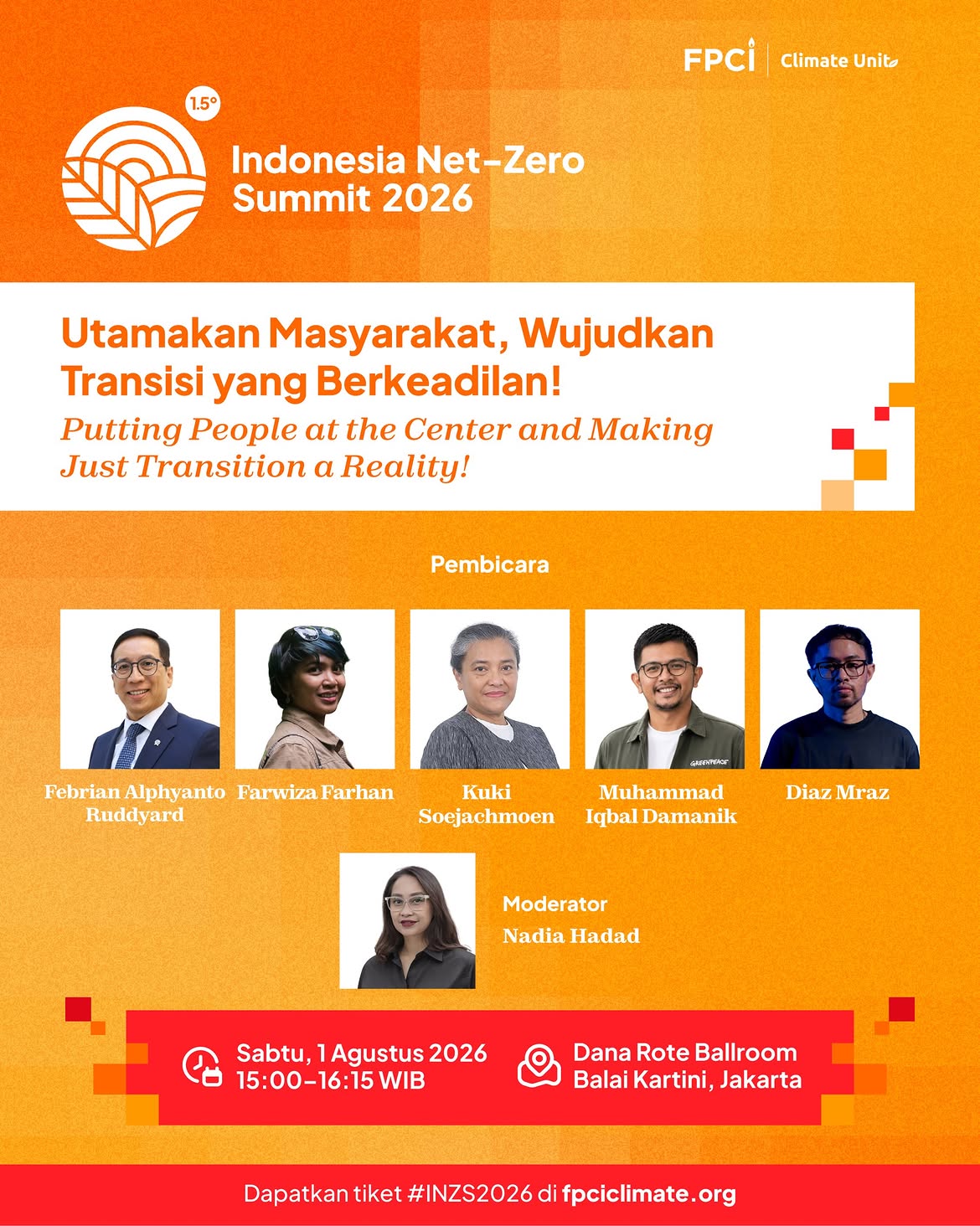
"Public aspirations cannot be represented if the public isn't even granted access to the document. A participatory process should take place before decisions are made, not merely during a formal consultation," said Nadia Hadad, Lobby Team Coordinator for the JustCOP Coalition and Executive Director of MADANI Berkelanjutan.
The JustCOP Coalition noted that the public faced difficulties accessing the SNDC document up until the event took place. The government should have provided access and engaged the public from the beginning of the discussion and drafting phases of the SNDC document as a demonstration of commitment and responsibility in addressing the climate crisis. Public participation is crucial to ensuring social and ecological justice for the broader society, rather than just a select group.
Substantively, the SNDC document presented by the Ministry of Environment contains several weaknesses. In the energy sector, although Indonesia claims specific emission reduction targets, electricity development plans still indicate the construction of 6.3 Gigawatts (GW) of on-grid coal-fired power plants and 20 GW of off-grid coal power plants, along with an additional 10.3 GW from gas-fired power plants. This demonstrates that even under the most ambitious renewable energy development schemes, Indonesia's emission reduction targets will be difficult to achieve.
"Consequently, the presented SNDC can be seen more as a formal gesture and PR exercise, likely serving as little more than a placeholder at international forums like the Climate COP in Brazil in mid-November," said Iqbal Damanik, a member of the JustCOP Coalition and Climate and Energy Manager at Greenpeace Indonesia.
The SNDC document reveals that the government exempts the nickel downstreaming sector and hard-to-abate industries, such as steel, from decarbonization mandates. This approach demonstrates that emission reduction targets have not been fully integrated into the development strategy, but rather compromised to chase an 8% economic growth ambition. In reality, these sectors contribute significantly to aggregate national emissions and are pivotal in defining the direction of a just energy transition. This step signals that the Indonesian government has virtually no alternative path to reducing carbon emissions while simultaneously fostering high-quality economic growth.
Bhima Yudhistira, a member of the JustCOP Coalition and Executive Director of the Center of Economic and Law Studies (CELIOS), considers the government to have failed in understanding the concept of economic development. According to him, synergizing industrial decarbonization, the growth of a restorative economy, and the energy transition could lower carbon emissions while generating employment, controlling inflation, and driving value creation across various sectors. "Unfortunately, the government still relies on economic growth supported by extractive sectors. Therefore, it is quite absurd to project a sharp drop in carbon emissions after 2030. That is an impossible roadmap to execute," Bhima explained.