
Continuous Principle, Key to Palm Oil Industry Improvement
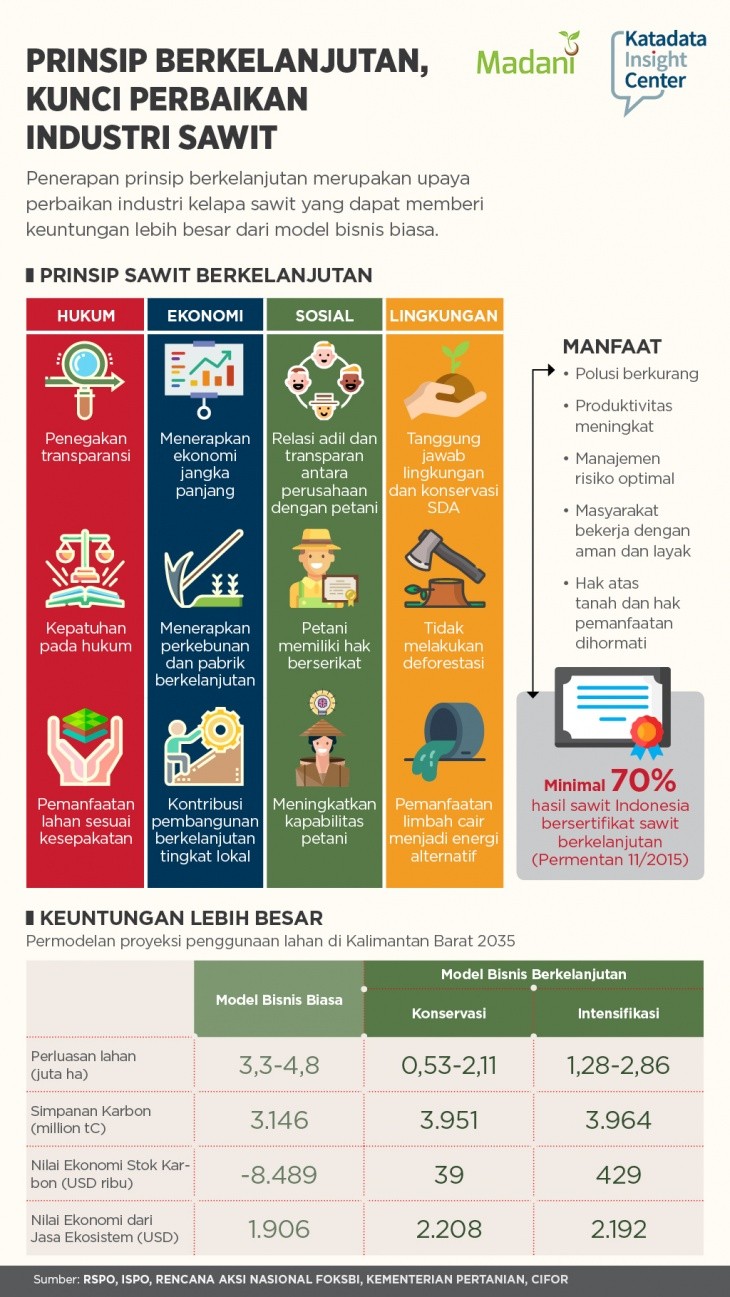
“The implementation of the sustainable principle is an effort to improve the palm oil industry. This business model provides greater advantages than the usual .”
Problems that arise in the palm oil industry, ranging from environmental damage, land conflicts, and the dynamics of international trade, spurring plantations and palm oil mills in Indonesia to apply the principle of sustainable palm oil.
Indonesia has a certification system called Indonesia Sustainable Palm Oil (ISPO), while the international level certification system is Roundtable on Sustainable Palm Oil (RSPO). Both have a variety of principles and criteria that can strengthen each other in the application of sustainable palm oil.
There are four classifications of the various principles and criteria that ISPO and RSPO have. First, the legal aspect that requires palm oil industry to enforce transparency, including on supply chains. Industry actors must comply with the applicable law, as well as land use in accordance with the agreement with the local community, so that there is no longer a land conflict. Next is the economic aspect.
In this aspect, palm oil industry players must implement a long-term economy. The principle of sustainable is also not only applied in plantations, but also in factories that process palm oil produce. Plus, there must be a contribution to the area where plantations and factories stand in sustainable development.
Meanwhile, there are social aspects that emphasize the application of fair and transparent relationships between companies and farmers. There should be no ban on palm oil farmers’ unions, because farmers have the right to association. In addition, what is not less important is also the ability of farmers must be improved, so that palm oil yields can be optimal.
From the environmental aspect, maintaining the environment and carrying out environmental resource conservation is absolutely done. For the sake of safeguarding the forest, there should no longer be a deforestation action. In addition, the issue of waste is one of the important things in the palm oil industry.
The Indonesian Sustainable Palm Oil Forum proposed the use of liquid waste into alternative energy. If all the principles of sustainable palm oil are applied to all palm oil industry players, various benefits can be enjoyed. Pollution will decrease, productivity increases, optimal risk management, society works safely and appropriately, land rights and utilization rights are respected.
The Ministry of Agriculture in the Regulation of the Minister of Agriculture No. 11 of 2015 targets 70% of Indonesian palm oil yields must be certified sustainable in 2020. In 2017, the Centre for International Forestry Research (CIFOR) modeled the impact of oil palm plantation use in West Kalimantan in 2035. This modeling shows that sustainable business models have a greater advantage over regular business models. The sustainable business model will save 1.94-2.77 million ha of land, saving carbon 805-818 million tC more, carbon stock economy value of USD 8,918-8,528 thousand more, and the economic value of the USD 286-302 more ecosystem services.
This research is a cooperation between the Sustainable Madani and Katadata Insight