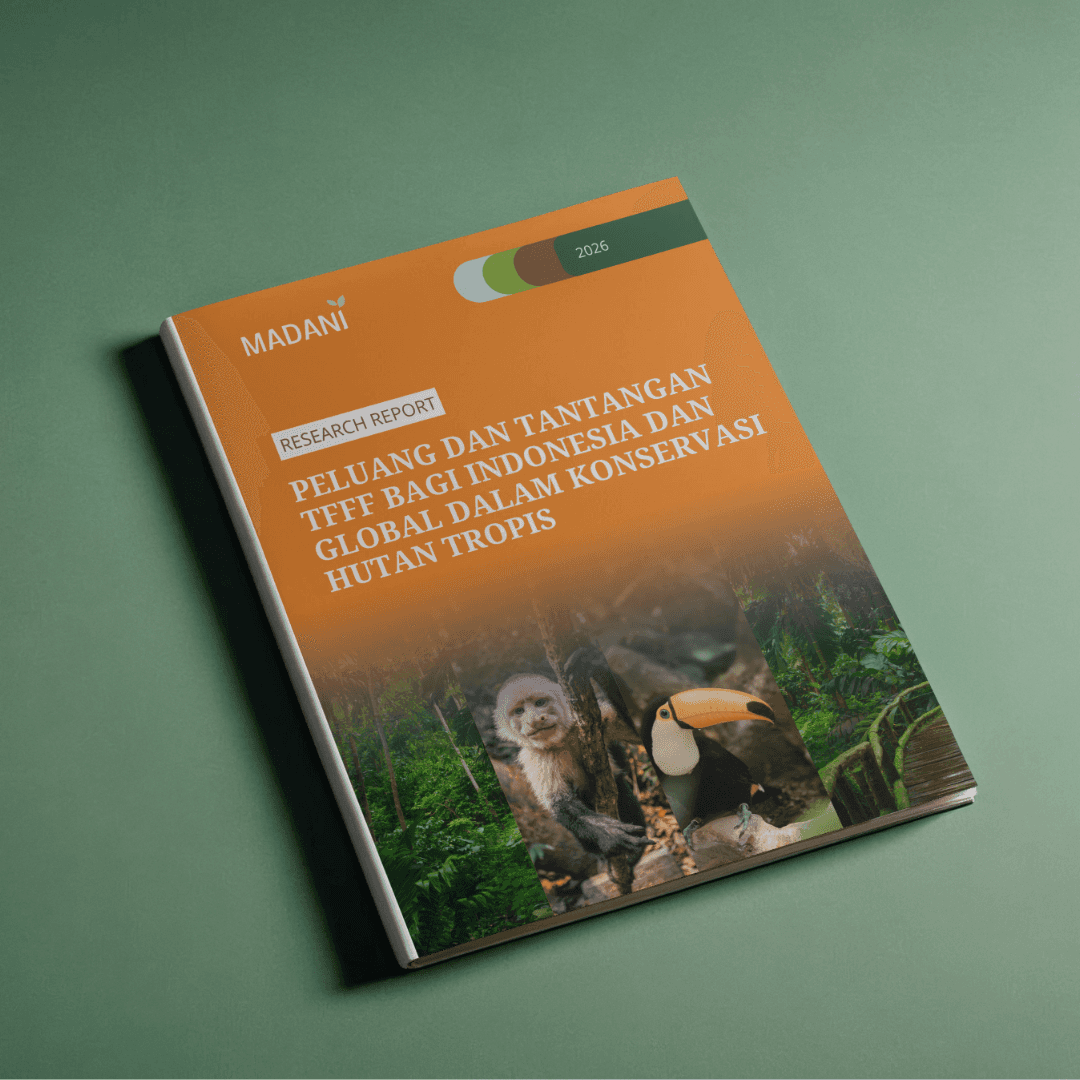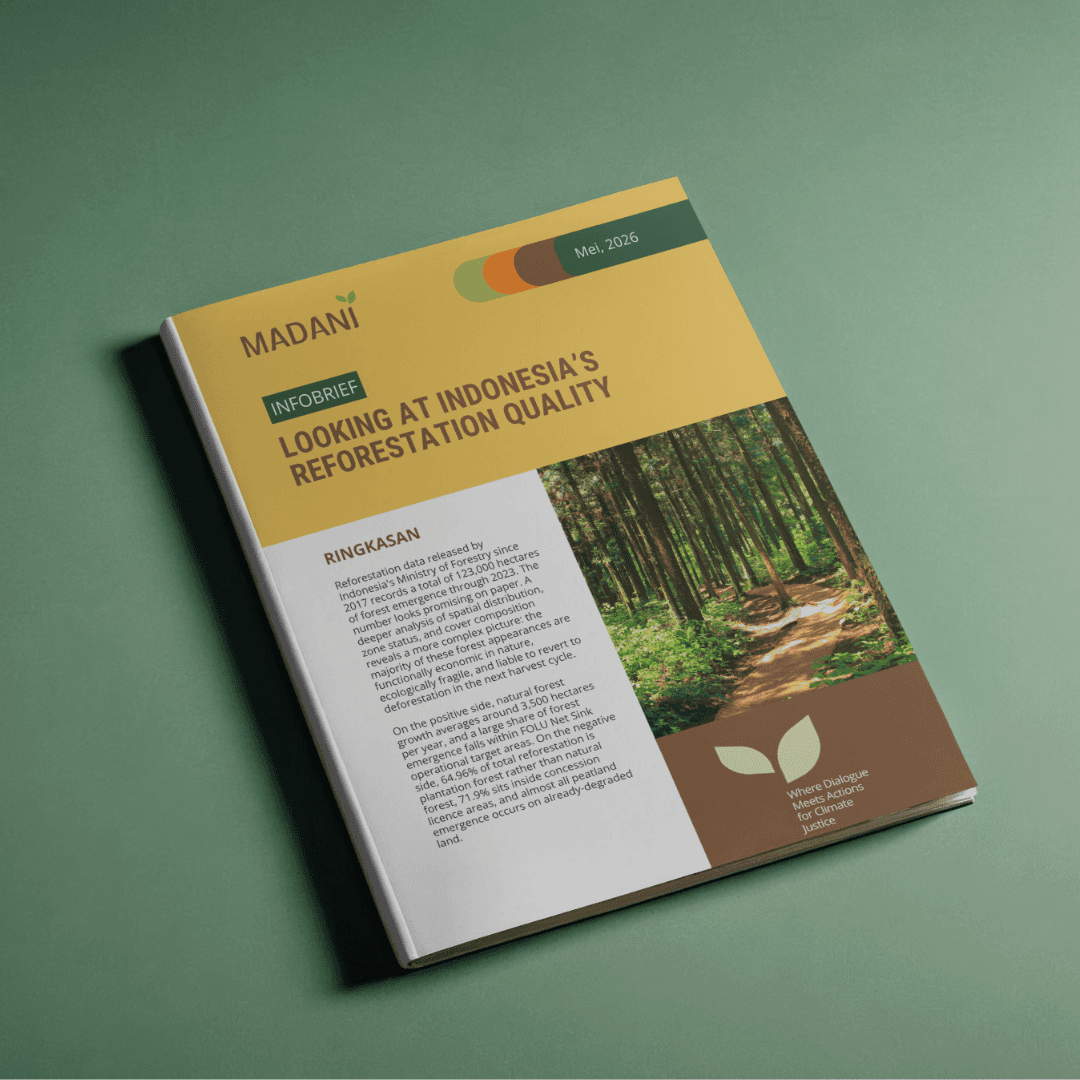

Madani Insight: Unravel the Disheveled Thread of Deforestation
In this study, Madani juxtaposed the definition of forests, deforestation, degradation, deforestation calculation methodology, and deforestation figures from several institutions, namely the Food and Agriculture Organization (FAO), the Ministry of Environment and Forestry (MoEF), and several civil society institutions (CSOs) and highlighted the points of conflict (Contraryment Points) from various institutions.
In defining forests, one of the main points of opposition is the minimum limit of header cover to be said to be a forest, which is between 10% and 30%. Another point of opposition is the categorization of Plantation Forest into the category of forest land class. Some CSOs in this study are of the view that Plant Forests should not enter into the forest land class because of its monoculture and more like timber plantations. The entry of Plant Forests into the forest land class is also feared to cover the deforestation of natural forests converted into Plant Forests, especially Industrial Plant Forests, which is one of the drivers of natural forest loss in Indonesia.
Another point of opposition is the dichotomy of natural forests into primary and secondary natural forests where secondary natural forest protection is weaker than primary natural forests. Some civil society institutions in this study encourage the protection of natural forests as a whole, especially in the context of stopping the provision of new permits, without dichotomizing them into primary and secondary natural forests.
The next point of opposition is the definition of primary forest that differs between KLHK and GFW (Global Forest Watch), where GFW uses the term primary forest whose definition is broader than the KLHK with deforestation value that is close to the total natural forest deforestation value.
In defining deforestation, some civil society institutions oppose the use of the term net deforestation that is an emphasis in government public communication. In addition to the loss of forests in one place cannot be replaced with forest planting elsewhere, this definition is also feared to cover the deforestation of nature to be converted into plant forests, especially industrial plant forests.
Regarding deforestation rates, the KLHK version of natural forest deforestation rates from 2006-2018 is much lower than the natural forest deforestation rate published by FWI (Forest Watch Indonesia). The KLHK data shows that the trend of gross deforestation and natural forest deforestation decreased in the period 2006-2018. Instead, FWI data showed a trend of increasing the rate of natural forest loss in the same period.
For 3 periods (2011-2012, 2012-2013, and 2013-2014), the natural forest deforestation rate of KLHK is almost the same as the Primary forest loss number proposed by GFW. Both the KLHK and GFW data showed a trend of declining natural forest deforestation rates in the period 2006-2018. However, if the KLHK data shows a declining gross deforestation trend in 2006-2018, the Tree Cover Loss data from GFW actually showed an increasing trend in the period 2006-2018. However, it should be noted that the definition of Tree Cover Loss and deforestation is inexorable.
In a cross-test between the spatial data and statistics published by the KLHK, Madani's analysis confirmed the match of gross deforestation value, but was unable to confirm the match of the value of natural forest deforestation and net deforestation due to limited data on natural forest loss and reforestation data.
Finally, there is an unanswered question of the differences in the definition of natural forest deforestation used in the Deforestation Book with the definition used to compile FREL for REDD+. There is a considerable difference between the natural forest deforestation rate from KLHK rectal with natural forest deforestation figures used to compile FREL for REDD+ where the natural forest deforestation rate for FREL is higher than the natural forest deforestation rate contained in the Dugestasi KLHK Book in a period whose data is available and intersected, namely 2006-2009, .2009-2011, and 2011-2012.
Some institutions that have attention on this issue and have different data and conclusions need to sit together and open a selection panel of their respective data and data sources so that the public can get clearer information related to the status and condition of the latest Indonesian forests and can assess Indonesia's success in reducing deforestation more objectively.
Get more information related to Madani Insight: Unravel Deforestation Knitted Thread by downloading the attachments available below. Good luck.