No headings found on page
This partnership platform between the Ministry of National Development Planning/Bappenas and GGGI positions the green economy as a new engine of growth. Financing emerged as the most discussed challenge throughout the event.
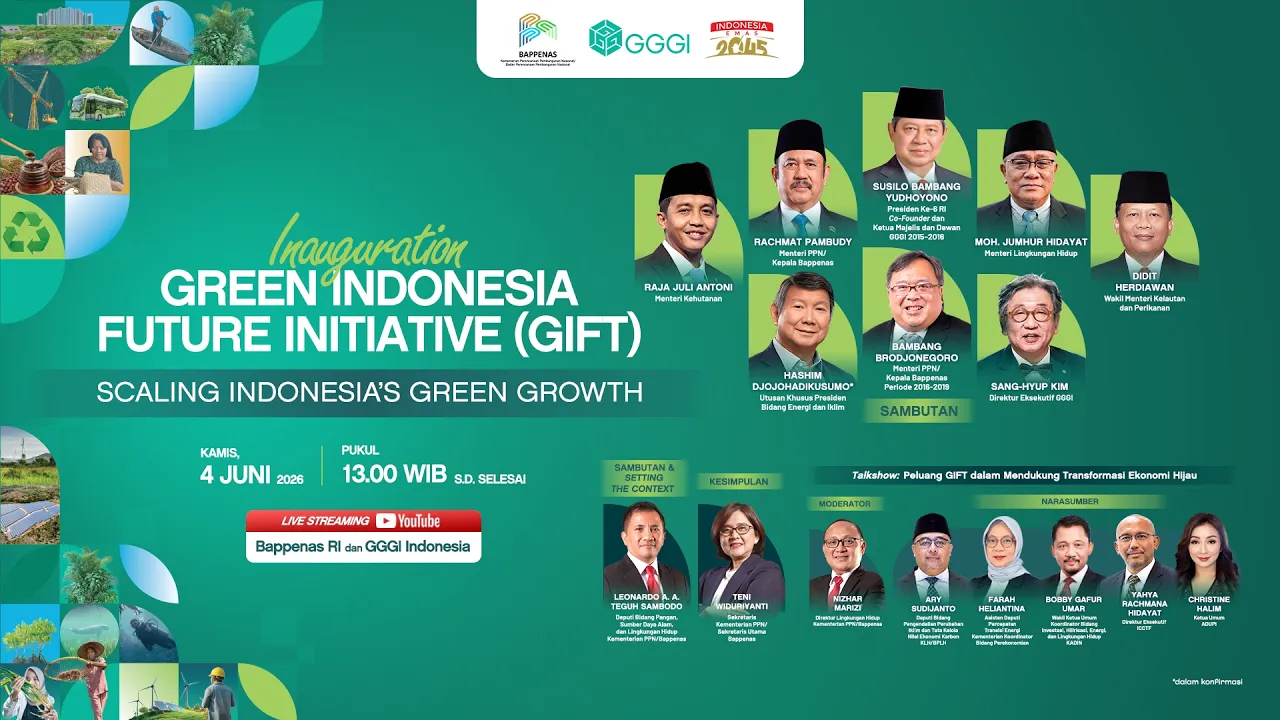
Green Indonesia Future Initiative (GIFT) was officially launched at the Ministry of National Development Planning/Bappenas office in Jakarta on Thursday, 4 June 2026. This partnership platform between the Ministry of National Development Planning/Bappenas and the Global Green Growth Institute (GGGI) aims to mobilize USD 2 billion in green investment from 2026 to 2030, double the total investment achieved across all previous phases of the cooperation.
The inauguration, themed "Scaling Indonesia's Green Growth," was carried out jointly by the Minister of National Development Planning/Head of Bappenas, the Executive Director of GGGI, the Minister of Environment, the Minister of Forestry, and the Minister of Marine Affairs and Fisheries. The event was also attended by the sixth President of Indonesia, Susilo Bambang Yudhoyono, and the Special Presidential Envoy for Energy and Climate, Hashim Djojohadikusumo, and was broadcast live on the Ministry of National Development Planning/Bappenas YouTube channel.
Positioning the Green Economy as an Engine of Growth
Opening the proceedings, the Deputy for Food, Natural Resources, and Environmental Affairs at the Ministry of National Development Planning/Bappenas, Leonardo A. A. Teguh Sambodo, defined the green economy as a model for developing an economic ecosystem that balances national welfare with environmental sustainability. Its focus spans investment, infrastructure, jobs, and skills development, guided by the principle of growing the economy while lowering emission intensity.
He mapped out four main challenges: the need for investment and the mobilization of financing, transition risks and potential stranded assets, the readiness of green projects and investment, and the readiness of human resources for workforce transformation.
Indonesia's progress so far was described as pointing in a positive direction. The National Green Economy Index rose from 2011 to 2024, with an average annual growth rate of 2.15 percent. The largest contribution came from forest cover relative to land area, with an index value of 89.05.
In the Ministry of National Development Planning/Bappenas presentation, the adoption of the green economy is projected to support economic growth of up to 8 percent while leading Indonesia toward Net Zero Emissions by 2060 or sooner. The projected benefits include 1.2 million new green jobs per year and a reduction in greenhouse gas emissions of up to 33 million tons of CO2 equivalent over the 2025 to 2045 period.
Closing the Financing Gap Beyond the State Budget
Financing ran as a common thread through the talk show titled "GIFT's Opportunities in Supporting the Green Economy Transformation." The discussion opened with a moderator's assertion: the green economy is already being implemented, and the central question now is how to accelerate the steps already underway. The Executive Director of the Indonesia Climate Change Trust Fund (ICCTF) named investment and climate financing as the biggest obstacle. The financing needed for the green transition is seen as exceeding the capacity of the state budget (APBN), with around 50 percent of it needing to come from outside state funds. To close that gap, ICCTF promotes instruments such as carbon finance, blended finance, and climate guarantees.
One highlighted breakthrough is a biogas guarantee facility drawing on palm oil waste. The scheme produces compressed natural gas (CNG) as a power source while reducing dependence on imported LPG. ICCTF also positions itself as a climate finance hub through blue finance schemes for coastal and fisheries management, samurai bonds, and blue-carbon financing.
Driving Investment through Carbon Economic Value
On the policy side, the Deputy for Climate Change Control and Carbon Economic Value Governance at the Ministry of Environment explained that the Carbon Economic Value (NEK), regulated under Presidential Regulation Number 110 of 2025, covers results-based payment, carbon funding, and carbon tax.
NEK does not stop at carbon credit transactions. The larger goal is to shift Indonesia's economic structure toward lower carbon, while recognizing environmental protection efforts that have often gone uncounted for in economic terms. Within this framework, GIFT is seen as a tangible showcase for global financing.
Representing the Coordinating Ministry for Economic Affairs, the Deputy for Energy and Mineral Resources Coordination identified three factors deemed most decisive in expanding investment for a just energy transition. First, policy certainty and ease of doing business, including clarity on Nationally Determined Contribution (NDC) targets, Net Zero Emission, and the energy transition roadmap. Managing critical minerals for clean energy can also be seen as an opportunity to strengthen supply chains and open new jobs. Second, broader participation, including women's involvement in the energy transition. Third, strong financing and institutional support.
Reading the Potential of Renewable Energy and the Circular Economy
The Chair of the Indonesian Chamber of Commerce and Industry (KADIN) highlighted the appeal of the green economy from a business perspective. He pointed to 11 new business lines across Asia that together record revenue of up to USD 5.8 trillion per year. Indonesia itself holds renewable energy potential of 3,687 gigawatts, with the largest distribution in Sumatra (1,240.64 GW), Kalimantan (517.53 GW), and Sulawesi (257.36 GW).
From the recycling industry, the Chair of the Indonesian Plastic Recycling Association (ADUPI) described how the sector has grown into a major export-oriented industry since the early 1970s. With national plastic consumption reaching 7 million tons per year, recycling is an important part of the urban circular economy approach, offering opportunities for technology transfer.
Affirming Collaboration, Not a Donor-Recipient Relationship
Joining online, the Minister of National Development Planning/Head of Bappenas for the 2016 to 2019 period, Bambang Brodjonegoro, said the fundamental development question today is how Indonesia can continue to grow without sacrificing the environment. He stressed that cooperation with GGGI is a joint initiative, not a donor-and-recipient relationship. In his view, GIFT's target of attracting USD 2 billion in investment is ambitious and marks a new chapter in the partnership.
The sixth President of Indonesia, Susilo Bambang Yudhoyono, recalled that cooperation between Indonesia and GGGI has run since 2013. He highlighted the Bali Roadmap as a historic milestone that paved the way for the Paris Agreement. SBY also assessed that multilateral cooperation to address climate change had stalled amid tensions and global geopolitical dynamics. He affirmed that saving the planet is a necessity, not a choice, and that maintaining business as usual will only end in failure.
Preparing a Just Transition
The Minister of Environment, Moh. Jumhur Hidayat stated that Indonesia has a chance to reach Net Zero Emission and a Golden Indonesia 2045 if the green economy is applied holistically. He underlined that Indonesia's climate financing needs are too large to be met by public funding alone.
From the marine sector, the Ministry of Marine Affairs and Fisheries presented five policy directions: marine conservation, quota-based fishing, the development of sustainable aquaculture, the supervision and control of coastal areas and small islands, and the cleanup of marine plastic waste through a movement of fishers' participation.
The Ministry of National Development Planning/Bappenas closed the series by emphasizing the readiness of micro, small, and medium enterprises (MSMEs) to enter the green economy. The development direction is placed within a framework of sustainable economic growth, poverty reduction, and quality governance.
The launch of GIFT places financing, policy certainty, and human resource readiness as the three nodes that will determine how quickly Indonesia's green economy moves from commitment to implementation on the ground.
Bringing Green Investment Closer to the Ground
MADANI welcomes the GIFT initiative as a long-awaited strategic milestone by many stakeholders. The platform underscores the urgency of cross-sector collaboration to accelerate the economic transition, while also addressing the financing mobilization challenge that has long been a primary obstacle. From MADANI's perspective, as an organization that works actively at the site level, this progressive national commitment offers fresh momentum for widening the space for synergy with regional governments and local communities.
Even so, it is worth weighing that GIFT's larger ambition will be determined largely by how far green investment genuinely reaches the subnational level and communities that stand on the front line and bear the burden of the climate crisis. Our field experience, particularly in supporting regional governments, shows that national commitments often stall at the planning-document stage due to limited regional capacity and the still-suboptimal participation of the public, including Indigenous communities, women, and young people, in decision-making processes. Financing instruments need to be designed with care so they do not erode the rights of communities and the land and forests they have long safeguarded. In the end, GIFT will be truly meaningful not only in the scale of investment it manages to mobilize, but also in how fairly its benefits are felt by those who bear the heaviest burden of the climate crisis.