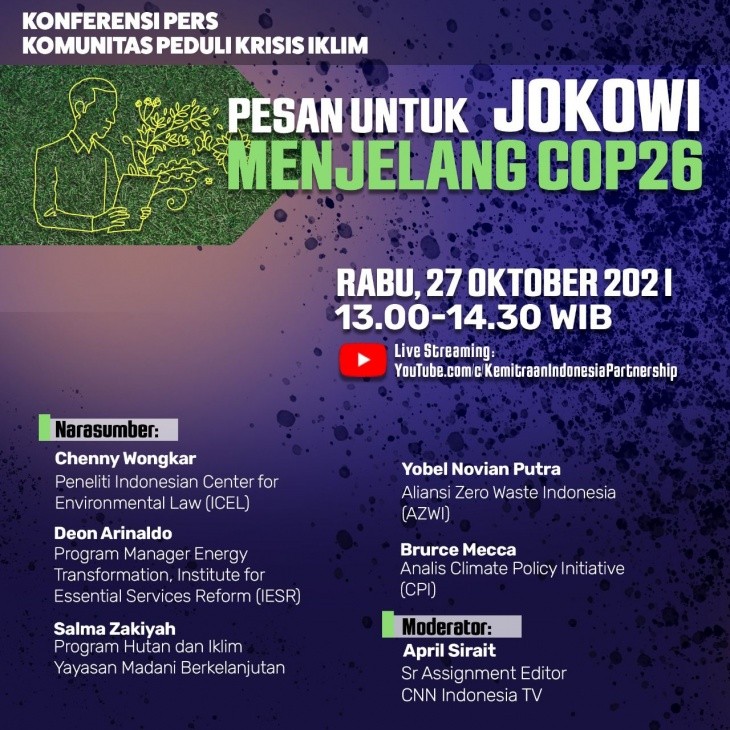
Jakarta, October 27, 2021. The climate crisis is imminent. Last year, extreme weather and the COVID-19 pandemic dealt a double blow to millions of people across continents. According to the World Meteorological Organization (WMO), 2020 was one of the three warmest years on record, despite the ongoing cold La Niña. More than 30 million people were displaced by weather-triggered disasters. And in Indonesia, around 6.3 million people were displaced due to the impact of hydrometeorological disasters such as rain, floods, or landslides.
Last year's global average temperature was 1.2 degrees Celsius higher than in the pre-industrial era (1850–1900). This is despite the shared global target of avoiding a temperature rise of 1.5 degrees Celsius while aiming for Net Zero Emissions (NZE) by 2060 to mitigate the impacts of climate change.
In this context, Indonesia plays a crucial role in helping to curb global temperature rise. As a country with extensive tropical forest cover, Indonesia has the potential to become a superpower that will determine the direction of addressing the climate crisis.
Such a mission could be initiated on October 31–November 12, 2021, at the 26th UN Climate Change Conference of the Parties (COP26), to be held in Glasgow, Scotland. COP26, as part of the United Nations Framework Convention on Climate Change (UNFCCC), is a significant high-level forum for 197 countries to discuss global climate change and plans to avert a climate crisis. President Joko Widodo is scheduled to attend.
However, contributing to such a significant role is no easy feat. Indonesia needs to innovate in economic development to achieve these targets, commented Chenny Wongkar, a researcher at the Indonesian Center for Environmental Law (ICEL). Development plans must be green, fair, and balanced. They must not only pursue growth but also be based on shared prosperity and environmental awareness.
" This kind of development must prioritize ensuring that environmental conditions are maintained, support community welfare, and increase capacity to face the climate crisis ," Chenny said.
To demonstrate the success of such development, several indicators can be examined. Among the most important are that communities have clean, pollution-free air, that development does not exploit essential resources and damage the environment, and that basic needs such as energy, food, health, and sanitation are guaranteed. Chenny believes that Indonesia needs to end its extractive economic model, which focuses on short-term profits, and shift to a green economy with long-term benefits.
One step that can be taken is to immediately shift from fossil-based energy sources—such as coal and its derivatives—to renewable energy. The energy sector must be the focus of Indonesia's increased climate policy ambitions.
According to Deon Arinaldo, Program Manager Energy Transformation, Institute for Essential Services Reform (IESR), citing guidelines in the implementation of climate change mitigation and adaptation 2050 (LTS-LCCR 2050/Long-Term Strategy on Low Carbon and Climate Resilient Development), the energy sector in 2030 is estimated to produce emissions of more than 1,100 million tons of CO2e. Meanwhile, by that time, Indonesia is expected to have reduced emissions to achieve NZE before 2060. On the other hand, 91% of domestic transportation is currently still dominated by fossil fuels.
The impacts of these practices are detrimental to the environment, society, and the country's finances. These include forest destruction, victims of mining pits, and large fuel imports. If the energy transition is limited to non-renewable energy sources like liquefied coal or gas, the transition to renewable energy will actually be hampered. " Indonesia needs a comprehensive transition from fossil-based energy sources to clean and renewable energy ," said Deon.
One thing is linked to another. To achieve the NZE target, forests are needed as emission absorbers. Meanwhile, the fossil-based energy industry has proven to be damaging. In the fight against the climate crisis, the key to victory is protecting and restoring natural ecosystems, argues Salma Zakiyah, from the Forest and Climate Program at the Madani Berkelanjutan Foundation. " Peat, forest, mangrove, and marine ecosystems are extraordinary carbon sinks and vital in protecting communities from the impacts of the climate crisis ," she said.
In the past four years, Indonesia has managed to curb its deforestation rate. However, not all of Indonesia's remaining natural forest and peat ecosystems are protected. This means that approximately 9.6 million hectares of Indonesia's natural forests and 2.8 million hectares of peat ecosystems are still at risk of deforestation.
The government must also realize the target of 12.7 million hectares of social forestry, so that indigenous communities and local residents can participate in forest protection. Furthermore, damaged and burned forests also need to be rehabilitated.
The NZE (zero emissions) target also needs to be pushed from the waste sector. Waste management should be carried out comprehensively, from production to consumption. According to Yobel Novian Putra, Coordinator of the Zero Waste Indonesia Alliance, there has been a misfocus on waste management in Indonesia. Instead, waste management should be focused from the upstream, namely the producer, by enforcing Extended Producer Responsibility (EPR), which requires producers to change packaging designs from single-use to refillable. All packaging produced must be recyclable, or free from hazardous materials.
On the downstream or consumer side, strict sanctions must be imposed on those who fail to separate their waste. Consumers also need to be facilitated in recycling their waste. " Focusing only on the downstream will not solve the problem ," said Yobel.
The government also needs to phase out waste incineration technology (thermal incinerators). This method produces serious greenhouse gas emissions and ash. Steps that need to be taken are to encourage domestic waste composting. By implementing this method, waste volume can be reduced. Sanitary landfills and controlled landfills also need to be optimized to reduce methane gas release from waste. Currently, there are 514 municipal and district waste disposal sites (TPA) that still use an open dumping system and are projected to release 296 MT CO2e of methane gas by 2030.
If the above measures are ineffective, the government can promote financing schemes that stimulate the green economy. Bruce Mecca, an analyst at the Climate Policy Initiative (CPI), said much of the budget has shifted to the health sector and economic recovery during the COVID-19 pandemic. As a result, climate funding has fallen short of priority. " The challenge is to prevent this shift from occurring long-term. The long-term budget remains focused on the green economy ," he said.
The government needs to create policies that attract green investment. For example, by providing incentives for green investment and disincentives for investment in dirty sectors. These incentives can be implemented by local governments, for example, by encouraging the General Allocation Fund or Special Allocation Fund for green energy budgeting. This policy is expected to attract green investment from the private sector and abroad.
Therefore, we, the Climate Crisis Care Community, ask the Joko Widodo government:
Ensuring the direction of green economic development that is inclusive, equitable, oriented towards welfare growth, and responsive to the Climate Crisis, by fulfilling the Net Zero Emission ambition sooner than 2060 through a clear and measurable roadmap;
Ensure an immediate transition from fossil-based energy sources such as coal and its derivatives to renewable energy, with an inclusive, decentralized, measurable and equitable energy transition policy;
Ensuring the strengthening of natural ecosystem protection efforts, including stopping land use changes that are not in line with Indonesia's aspirations to achieve Net Zero Emissions sooner than 2060.
Ensuring comprehensive waste management, starting from sustainable production and consumption patterns.
Ensuring Indonesia becomes an inclusive, equitable, and sustainable green investment destination by increasing incentives for green financing flows and disincentivizing dirty financing.
* * * *
About the Community
The Climate Crisis Care Community is a civil society group committed to addressing the threat of the climate crisis. This community aims to encourage the government to enact policies that support environmental sustainability and sustainable public access to environmental rights.
Contact persons:
Chenny Wongkar, Indonesian Center for Environmental Law (ICEL)
Chenny@icel.or.id +62 857 2801 1697Deon Arinaldo, Institute for Essential Services Reform (IESR)
deon@iesr.or.id , +62 813 1853 5687Salma Zakiyah, Madani Berkelanjutan Foundation
salma@arsip.madaniberkelanjutan.id , +62 821 1631 4868Yobel Novian Putra, Zero Waste Alliance Indonesia
yobelnovianputra@gmail.com +62 821 2818 4440Brurce Mecca, Climate Policy Initiative (CPI)
Brurce.Mecca@cpiglobal.org +62 812 8554 8670