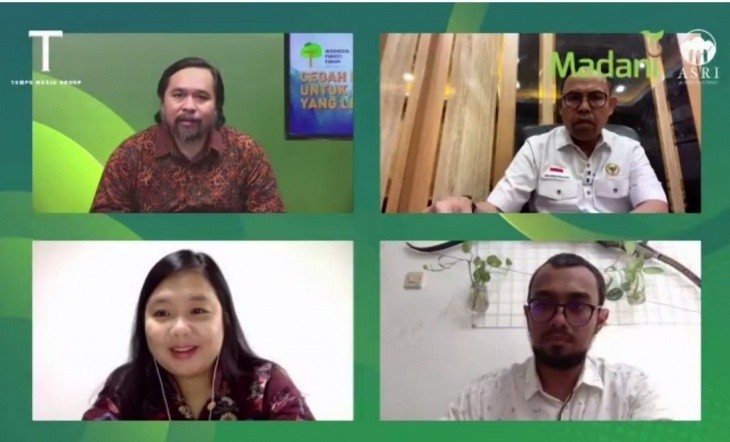
Jakarta, September 24, 2020 – An open letter to the President of the Republic of Indonesia, Joko Widodo, signed by more than 500 Indonesian health professionals was read by Dr. Arif Wicaksono, M.Biomed (Lecturer at the Faculty of Medicine, Tanjungpura University) in a Webinar entitled “Prevent Deforestation for a Healthier Indonesia” organized by Tempo Media Group in collaboration with the Madani Berkelanjutan Foundation and the Alam Sehat Lestari Foundation on Thursday, September 24, 2020. Also present as speakers were Drg. Monica Nirmala, MPH (Senior Public Health Advisor of the ASRI Foundation), Muhammad Teguh Surya (Executive Director of the Madani Berkelanjutan Foundation), Dr. H. Andi Akmal Pasluddin, MM (Commission IV of the Indonesian House of Representatives), and General TNI Doni Monardo (Chairman of the Covid-19 Task Force/Head of the BNPB), moderated by Wahyu Dyatmika (Editor-in-Chief of Tempo Magazine). The event was opened by Prof. DR. dr. Nila Moeloek, Sp. M (K) (Minister of Health of the Republic of Indonesia 2014-2019) as Keynote Speaker .
The webinar, attended by 234 participants, was held as part of an effort to respond to the potential dual disaster of COVID-19 and forest and land fires. It involved a call from Indonesian health professionals to prevent forest and land fires during the pandemic. This initiative was supported by the Alam Sehat Lestari Foundation (ASRI) through an open letter addressed to President Joko Widodo. As of the event, more than 500 health professionals had supported and signed the letter.
"I am very grateful to my colleagues who have taken the time to support me by signing this open letter amidst their busy schedules battling the Covid-19 pandemic. Public health issues must be addressed from start to finish. Preventing forest and land fires and deforestation in general is an integrated effort to maintain and improve the health of the Indonesian and global public. We must not allow the current complex Covid-19 situation to burden public health further with the haze from forest and land fires. We can be said to be fortunate that the dry season is not as dry and long as usual. Moving forward, let us continue to protect our forests for a healthier Indonesia," said Drg. Monica Nirmala.
What's particularly concerning is if the spread of the COVID-19 virus coincides with forest and land fires, both of which could have devastating consequences for public health. Hospitals are already under significant strain due to COVID-19, and the situation could worsen if the number of patients increases due to forest and land fires. The focus of local governments on disaster management will also be divided, resulting in suboptimal outcomes.
Prof. Nila Moeloek echoed this sentiment in her opening speech at the webinar, stating, "This smoke, whether from cigarettes or forest fires, ultimately damages the lungs. And the lungs take in oxygen. We expect oxygen to easily enter the lungs for breathing, but it turns out the virus (COVID-19) poses a greater risk when the lungs are compromised by forest fires."
According to government data, approximately 64,600 hectares of fires burned between January and July 2020. Analysis by MADANI Berkelanjutan also shows that the potential fire area (APT) expanded from 18,000 hectares in July to 84,000 hectares in August. In September 2020, as the dry season transitioned to the rainy season, hotspots began to decrease.
Despite the fact that weather conditions have been often unpredictable this year, resulting in temperatures that are not as hot as usual, the data on the increase in APT areas demonstrates the need for government vigilance and maximum effort to avoid a worse disaster. This situation could worsen if public awareness of environmental and forest protection is minimal, law enforcement for corporations is inadequate, and monitoring is inadequate.
Muhammad Teguh Surya, (Executive Director of the Madani Berkelanjutan Foundation) believes that the current case of forest fires in Indonesia should not be taken lightly because there are still many factors causing forest and land fires besides the weather which are actually more worrying and must be watched out for, such as changes in land cover and damage to forests and peat.
"In MADANI's analysis over the past five years, from 2015 to 2019, 5.4 million hectares of forest and land burned. Three factors influence the increase and decrease in forest and land fires in a given area. First, changes in land cover. Second, the availability of permits, and third, damage to the peat ecosystem. Therefore, appropriate mitigation and anticipation are needed to deal with forest and land fires, including protecting forests and restoring peatlands, as well as ensuring compliance from permit holders to prevent forest and land fires," said Teguh Surya.
Furthermore, the connection between forest fires and this year's pandemic must be further compounded by the Job Creation Bill (Omnibus Law), which has drawn public opposition. This bill is strongly opposed because it has the potential to destroy and eliminate vast areas of Indonesia's forests, which are a source of livelihood for communities living in and around forests, as well as their biodiversity.
The government, representatives of the people, and relevant ministries/agencies involved in formulating the Job Creation Bill need to halt its deliberations for the public good. It would be highly detrimental if the bill is passed. A MADANI study explains that natural forests will disappear more rapidly if the Job Creation Bill is passed. Five provinces are at risk of losing all their natural forests due to deforestation if the bill is passed: Central Java, Bangka Belitung, South Sumatra, Jambi, and Riau. Meanwhile, several provinces outside the PIPPIB area are at risk of losing all their natural forests due to deforestation: Central Kalimantan, Aceh, West Husa Tenggara, West Kalimantan, West Sumatra, South Kalimantan, and Jambi. Not only will forests and natural sustainability be negatively impacted, but several sectors in this country will also feel the impact, such as the maritime sector, fisheries, the economy, and so on.
Forest preservation, health, and government regulations are closely linked to the sustainability of our lives. If any of these three factors fail to work together, it can have significant negative impacts not only on the environment but also on human life, even leading to a pandemic. Therefore, ongoing efforts to prevent deforestation and public education to promote environmental stewardship are essential to create a healthier Indonesia.
—###—
For further information contact me:
Image Dynamics
Ayunda Putri
08122001411
ayundapputri@gmail.com