MadaniNews The Indonesian government, through the Ministry of Environment and Forestry (KLHK), has stated that the document on net carbon absorption (net sink) in the forestry and land use (Forestry and Other Land Use or FoLU) sector will lead Indonesia towards achieving its nationally determined emission reduction contribution (NDC) commitment by 2030.
The FoLU net sink is part of Indonesia's strategy to ensure the achievement of the Paris Agreement's goal of keeping global temperature rise below 1.5 degrees Celsius and serves as a guide for Indonesia in implementing climate change mitigation and adaptation actions. Implementing the FoLU 2030 net sink agenda is also part of Indonesia's aspiration towards a Long-term Strategy on Low Carbon and Climate Resilience (LTS-LCCR) by 2050.
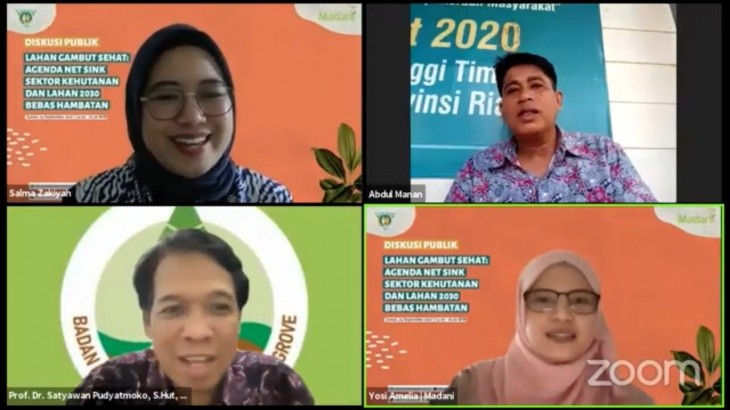
One thing is certain, if the Indonesian government envisions achieving a net sink by 2030, the contribution of improved peatland governance is a crucial supporting element that must be considered. This was conveyed by Nadia Hadad, Executive Director of the Madani Berkelanjutan Foundation, in a public discussion "Healthy Peatlands: A Barrier-Free 2030 Agenda for the Forestry and Land Sector Net Sink," held virtually by the Madani Berkelanjutan Foundation on Friday, September 24, 2021.
" There are several priorities in the FOLU sector, such as peat restoration and forest fire control. Peat restoration should be the mainstay of achieving Indonesia's net sink ," Nadia said.
Meanwhile, Yosi Amelia, Program Officer for Forests and Climate at the Madani Berkelanjutan Foundation, stated that there are two key actions that can be taken to strengthen peatland protection in Indonesia. According to her, these two keys are: first , the urgency of expanding the 2021-2024 restoration target to crucial areas such as burned areas, permit/concession areas, including overlapping areas, and protected peatlands.
Second, the importance of optimizing restoration implementation from 2021 to 2024, particularly in the PIPPIB, PIAPS, and AOI Food Estate areas. The Food Estate presents a unique challenge in current peatland restoration efforts.
" To strengthen this protection, there are two options: prevent food estates from entering peatlands, and extend the oil palm moratorium to resolve overlapping issues, " Yosi added.
In this discussion, several keynote speakers were present, such as the Governor of Riau, Drs. H. Syamsuar, M.Si, Deputy for Planning and Evaluation of the Peat and Mangrove Restoration Agency, Prof. Dr. Satyawan Pudyatmoko, S.Hut, M.Sc, GIS Specialist Greenpeace Indonesia, Sapta Ananda, and Riau Peatland Rescue Activist, Abdul Manan.
Watch the rebroadcast of the Healthy Peatland Public Discussion: The 2030 Forestry and Land Sector Net Sink Agenda, Free of Obstacles, on the Madani Berkelanjutan Foundation YouTube channel.
Get the presentation materials from the resource persons for the Healthy Peatland Public Discussion: 2030 Forestry and Land Sector Net Sink Agenda without Obstacles in the attachments available below.
Material – Governor of Riau – Drs. H. Syamsuar
Madani-KSDA-Suitability-of-strategy-to-achieve-targets-of-RPJMN-2020-2024-between-Energy-and-Environment-sectors