Reintegrating ecology and economics is crucial, as they are interconnected and interconnected. The goal of policies that no longer focus on the conventional economic model, namely economic growth, is to solve all problems. Gross Domestic Product (GDP) is no longer sufficient because it does not reflect development that involves environmental sustainability, happiness, and well-being. Changing this mindset requires significant collaboration across multiple sectors, including public policy, communities, the private sector, academia, research, and community service.
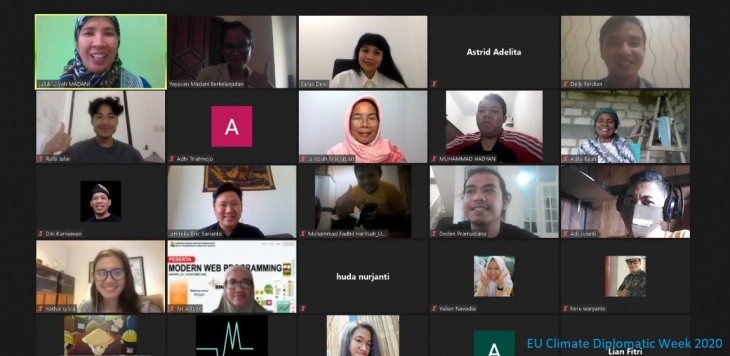
This was conveyed by Dr. Luh Gede Saraswati Putri, M.Hum., or commonly known as Saras Dewi, Lecturer of Philosophy at the University of Indonesia in the MADANI Dialogue Series #1000Economic Ideas for Development Without Damaging the Environment in the EU Climate Diplomacy Week 2020 series of events, “ Act Today for Our Tomorrow ”, November 2, 2020. This Madani discussion raised the theme “The Future of Nature for Indonesia’s Economic Resilience”.
In addition to Saras Dewi, other speakers included Aleta Baun, an indigenous woman from Molo, East Nusa Tenggara, who has persistently defended her ancestral territory from the onslaught of the extractive mining industry. Rafa Jafar, a young man who initiated the eWasteRJ Community, a community that cares about electronic waste management. And Delly Ferdian, a Digital Media Specialist at the Madani Berkelanjutan Foundation. The dialogue was moderated by Luluk Uliyah, Senior Media Communications Officer at the Madani Berkelanjutan Foundation.
Saras Dewi added that economics that leads to prosperity has actually been widely discussed by experts, such as EF Schumacher, Manfred Max-Neef, Amartya Sen, Elinor Ostrom, Kate Raworth, Robert Costanza, and Indonesian economists like Mohammad Hatta and Mubyarto. They also discuss food and the participation of local and indigenous communities in their relationships with their environment. This is what is called the economy of life. This economy of life leads to sustainability.
Meanwhile, Aleta Baun explained that the Mollo Indigenous Community has a principle that, " We will only sell what we make and we will not sell what we cannot make ." So the Indigenous Community in Tiga Batu Tungku is still persistent in defending its customary territory. "What we sell is what we make, such as woven cloth, agricultural products, herbal medicines, handicrafts and local food. Indigenous women also have an important role because indigenous women are guardians of nature as well as mother earth. The philosophy of the Mollo Community is Oel Fani On Na', Na'a Fani On Nafus, Afu Fani On Nesa, Fatu Fani On Nuif. Which means, water is blood, trees are hair, soil is flesh and stones are bones. " Therefore, how can development be carried out without destroying the environment, because the environment is the community's capital for prosperity that has been provided by nature ," said Aleta Baun.
Meanwhile, Rafa Jafar, the young founder of the eWasteRJ Community, encouraged young people to be wise consumers of electronics by recycling used electronics first. This is because a significant amount of electronic waste has not been properly recycled. " Of the 53.6 million metric tons of electronic waste generated in 2019, only 17.4 percent was properly recycled ," he explained.
Delly Ferdian, Digital Media Specialist at the Madani Berkelanjutan Foundation, invites young people to share their ideas on Economic Development Without Environmental Damage on the platform provided at www.arsip.madaniberkelanjutan.id. Ideas can be in the form of writings, videos, and infographics. These writings will be alongside those of economists such as Prof. Emil Salim, Prof. Hariadi Kartodihardjo, Rimawan Pradiptyo, Ismid Hadad, and others.
Complete material from the speakers can be downloaded below.
PPT EwasteRJ (Rafa Jafar)
Presentation by Mama Aleta
Green Millennialnomic
Ecological Economy (Mbak Saras Dewi)