Indonesia's climate commitment is currently at a crossroads. Amid global economic pressure, the weakening rupiah, massive government spending, and the threat of fiscal stress, the environmental protection agenda is facing increasingly serious challenges. This situation is worsened by a development direction that still relies on the expansion of extractive industries, ranging from nickel mining to clearing forest areas for energy investment and downstream processing. In these conditions, the climate issue no longer stands as a purely environmental agenda but has become part of an increasingly complex economic political struggle.
At the same time, the state's need for large financing to support economic growth is actually encouraging spending and development patterns that are wasteful of natural resources. Various National Strategic Projects (Proyek Strategis Nasional) and large-scale infrastructure development still rely on land extraction and fossil fuels. As a result, emission reduction targets often directly clash with short term development orientation that pursues economic stability and investment.
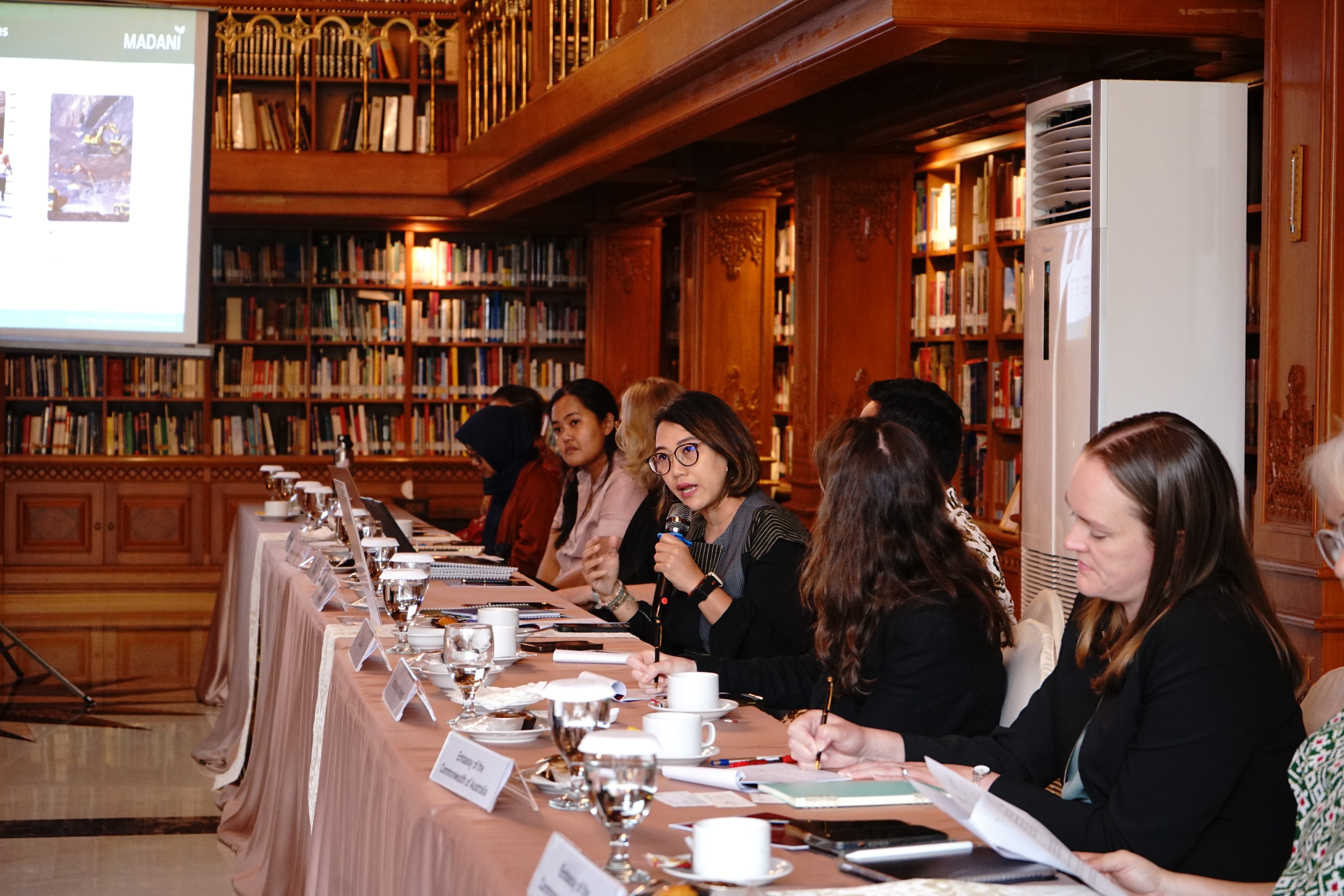
Nadia Hadad, Director of MADANI Berkelanjutan, in a Diplomatic Dialogue organized by MADANI Berkelanjutan on Tuesday (19/6/2026), assessed that Indonesia is facing multilayered pressures that are not easy to overcome simultaneously. "Today Indonesia faces economic challenges, the threat of El Nino, and fiscal pressure at the same time. However, concurrently, democratic space is narrowing and threats to civil liberties are increasing. This situation makes the agenda for environmental protection and community rights increasingly vulnerable," she said. Nadia emphasized that the climate crisis cannot be separated from the quality of democracy and the protection of civil rights, especially for Indigenous Peoples and local communities who are on the frontline of forest protection.
The discussion on climate funding also revealed a fundamental problem. Current green financing schemes are considered unable to compete with the economic attractiveness of extractive industries, which offer quick profits and strong political support. On the other hand, the carbon market and carbon trading still harbor various governance issues, ranging from the risk of greenwashing, weak transparency, to the lack of adequate protection for the rights of Indigenous Peoples and local communities.
Deputy Director of MADANI Berkelanjutan, Giorgio Budi Indrarto, asserted that the challenge of protecting the earth today stands on at least three main lenses. "First is the geopolitical dynamics and climate security of global investment. Second, the expansion of extractive industries which continues to create new social and ecological risks. Third, the legal framework for climate and carbon governance, which to this day still lacks sufficient integrity," he stated. According to him, without a strong legal foundation and clear protection of community rights, various green transition instruments have the potential to turn into a new form of carbon colonialism.
The latest data from MADANI Berkelanjutan shows that the pressure on Indonesia's forests is becoming increasingly structural. Throughout 2021-2025, Indonesia lost approximately 646 thousand hectares of natural forest, while in 2025 alone, an estimated 150 thousand hectares of primary forest were lost. Meanwhile, as much as 106 thousand hectares of deforestation were recorded in concession areas, especially oil palm plantations and logging. Even areas that should be bulwarks of environmental protection, such as the FOLU Net Sink 2030 area, peatlands, and forest moratorium areas, are experiencing large scale forest loss.
MADANI also noted that the expansion of the extractive economy has triggered an increase in social conflicts and human rights crises. In 2025, at least 341 large scale agrarian conflicts occurred, affecting more than 123 thousand families in 428 villages, an increase of 15 percent compared to the previous year. In Papua, national strategic projects and large scale plantation expansion are considered a serious threat to Indonesia's last forest landscapes. At the same time, the national oil palm plantation area has even exceeded the safe environmental carrying capacity limit, indicating that new expansion no longer has adequate ecological space.
Ultimately, protecting the climate is not just about adding green projects or expanding carbon trading. The biggest challenge lies precisely in the political courage to build governance that is fair, transparent, and favors environmental protection and community rights. Without a change in the direction of development and the strengthening of the legal foundation, a development regime that is wasteful of budgets and resources will only accelerate the ecological crisis that is now right before our eyes.
Link to Speaker Materials
Materi Diplomatic Dialogue
Link to Meeting Brief
MEETING BRIEF DIPLOMATIC DIALOGUE
No headings found on page