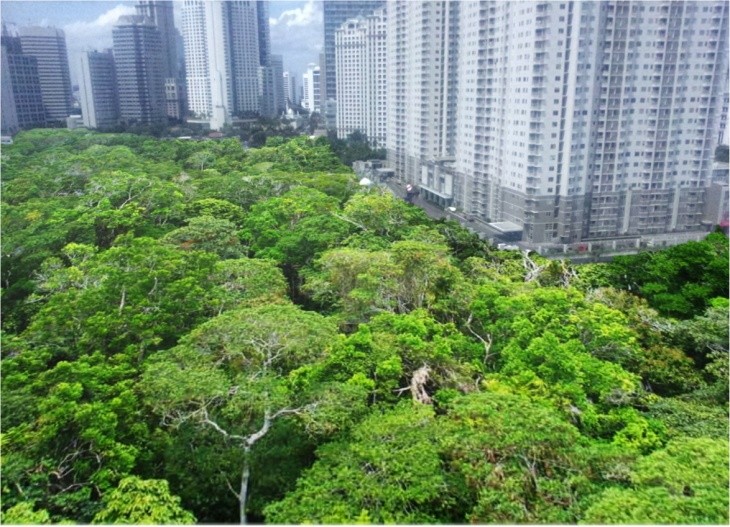
The above statement seems naive when faced with the reality that everywhere, especially in Indonesia, development also produces negative, even destructive, impacts. Floods, landslides, droughts, and forest and land fires in many places across the country have become almost an annual occurrence. They are so "routine" that a number of development planning documents in several provinces and districts present these events as a kind of " disaster profile ." Such impacts, no matter how small, especially those that destroy the landscape through deforestation and forest degradation, for example, are certainly undesirable. But the fact is, they are unavoidable. This means that building with zero damage is nearly impossible.
The more naive the question, the less clear and firm the boundaries regarding at least two things and the link between them: the targeted development's success and the tolerable damage as an inevitable consequence of achieving that development target. It's also necessary to understand whose preferences those boundaries are, and how consciously they are agreed upon as a necessity and a compromise of shared reason among development stakeholders. The process of drawing these boundaries is inevitable, so that the question isn't too naive and logical to attempt to answer.
READ ALSO: Sustainable Development by Prof. Emil Salim
This paper attempts to explore and elaborate on the substantive dialectic above. The goal is simple: to qualitatively understand how much damage can be tolerated for a set of development targets that have (ideally) been agreed upon by the parties. Then, to draw relevant implications for answering this question, particularly regarding the necessary approach. This exploration is crucial, especially if the basis of development still relies on the extraction of natural resources and the environment.
DEVELOPMENT NARRATIVE
Understanding the above limitations can be approached at least from a number of discourses and narratives related to the direction and orientation of development. Economic growth is necessary to build public welfare and reduce poverty. Therefore, investment is needed to create job opportunities, increase community income, local revenue (PAD), and boost tax and foreign exchange earnings. The increasing role of investment indicates a shift toward a more productive economic growth structure. Investment then becomes a new driver of growth. Therefore, investment is crucial, and obstacles that hinder it need to be addressed. Increased investment requires security stability, in addition to legal certainty and enforcement.
Such is the narrative of development that we often hear and witness. The impression is positive and ideal, even noble: alleviating poverty while building public welfare. However, missing from this discourse are, among other things, the limitations of the "compromising" framework for the allocation of natural resources to be "extracted" and the tolerance for their depletion, including the potential for environmental damage. This reinforces the suggestion of Prof. Emil Salim, who has frequently lamented on numerous occasions that the mainstream of Indonesian development, up to and including now (2020), is still focused on economic growth.
In the 2020-2024 RPJMN document, among other things, the development targets are stated, namely realizing an independent, advanced, just, and prosperous Indonesian society through accelerated development in various fields with an emphasis on a solid economic structure based on competitive advantages in various regions, supported by quality and competitive human resources.
READ ALSO: Stopping Deforestation by Preventing Forest and Land Fires Through Improving the Incentive System
This development plan mainstreams the Sustainable Development Goals (SDGs) with 17 targets and indicators. This has become part of Indonesia's future development agenda. This development plan serves as a starting point for achieving Indonesia's Vision 2045: Advanced Indonesia. Therefore, strengthening the economic transformation process9 in order to achieve the 2045 development goals is a primary focus, aimed at achieving better infrastructure, human resource quality, public services, and public welfare. This is another development narrative, as officially outlined in the formal document under the legal umbrella of Presidential Decree 18/2020.
THE NARRATIVE OF DAMAGE
At the paradigmatic level, at least in terms of rules in form, the development plan above demonstrates relatively clear and comprehensive targets, objectives, starting points, and goals. Sustainable development has even become mainstream. This development definition reflects a degree of optimism: with the SDGs mainstream, development is believed to be sustainable. This optimism, however, does not clearly outline the narrative and extent of damage to natural resources and the environment resulting from the planned development.
The new "damage" narrative is found in the deeper sections of the document in question. Given its nature, the emerging damage narrative can be categorized as Ex-Ante and Ex-Post. In the early chapters, it is stated that the damage has been ongoing for a long time. This includes, among other things, what is meant by Table 1. Further steps in this narrative focus more on mitigation, recovery, and the like (Ex-Post). The same table also shows another damage narrative, potentially hindering. The next step is anticipatory, starting with " what will be built " (Ex-Ante).
Read more about Azis Khan's "Building Without Destroying, Is It Possible?" in 1000 Ideas for Economic Development Without Destroying the Environment by downloading the written document available below.
By: Azis Khan
Senior Research Fellow – Conservation Strategy Fund (CSF)
Please download the related files below: