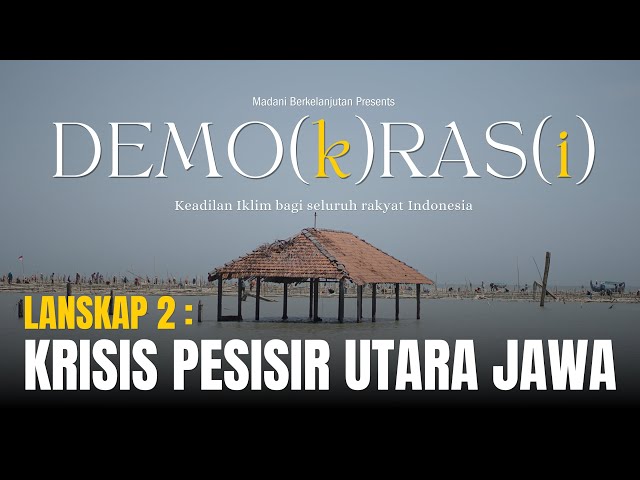
Imagine a peaceful coastal village, with lush green rice fields stretching across the landscape, children running and playing, and the gentle sound of waves forming the backdrop to everyday life. That was once the reality of Loireng Village in Demak, Central Java. Today, it exists only in memory. Tidal flooding (rob) has arrived, coastal erosion has relentlessly advanced, and the village has been transformed forever.
At the regional level, a 2021 Geomatika Journal study published by Indonesia's Geospatial Information Agency (BIG) shows that coastal erosion along the Central Java coastline has increased significantly. Since 2015, seawater has steadily claimed more land. Productive rice fields have turned into stagnant, brackish ponds that can no longer support agriculture. Farmers have been forced to become fishers or aquaculture farmers—not by choice, but out of necessity. This transformation is about more than changing occupations; it represents the loss of a way of life that had been passed down through generations.
This shift is an act of survival in the face of worsening conditions. For agrarian communities whose livelihoods have always depended on the land, adapting to a maritime way of life is far from easy. They must rebuild their lives from scratch, confront constant uncertainty, and continue struggling despite an increasingly uncertain future.
Development That Comes at a High Cost
The Sayung–Semarang Toll Road project, which is only around 30 percent complete, has already blocked natural river flows, making flooding a recurring reality for communities across Demak. Yet guidelines issued by Indonesia's Ministry of Public Works and Public Housing (PUPR) in 2016 clearly state that major infrastructure projects such as toll roads can significantly increase flood risk if changes to drainage systems are not planned using sustainable drainage principles.
Loireng Village, for example, is now frequently inundated for months at a time. Flooding has become part of daily life. Water that once flowed naturally is now trapped, turning the village into what residents describe as a giant bowl filled with water. Even during celebrations such as Eid al-Fitr, residents often spend the holiday standing ankle-deep in floodwaters.
Industrial waste from factories surrounding the village has further worsened the situation. Untreated waste is discharged into nearby rivers, degrading water quality and intensifying an already critical environmental crisis. Data from the Central Java SDGs Metadata Service indicate that hazardous waste management remains a major challenge in the region. Instead of being empowered as environmental stewards, local communities have become victims of a system that prioritizes large-scale commercial interests.
Meanwhile, mangrove forests—the coastline's natural defense against erosion—have been cleared to make way for the toll road. A total of 42.6 hectares of mangroves have disappeared, leaving coastal areas increasingly vulnerable to erosion. According to the International Union for Conservation of Nature (IUCN), mangroves play a vital role in climate change mitigation and coastal protection.
Ironically, despite the enormous impacts, affected residents have received no compensation. Limited access to information and inadequate public consultation have left communities with little understanding of how the project will affect their future. A 2022 study by Gadjah Mada University (UGM) had already emphasized the importance of meaningful community participation in sustainable development planning to prevent inequality and social conflict.
The Remaining Hope Along the Coast
Despite the climate crisis and mounting ecological disasters, hope has not disappeared entirely. Local communities still believe that development can be more equitable and inclusive. Infrastructure is important, but it must be designed with consideration for environmental carrying capacity and the needs of local communities. Without those safeguards, development becomes a ticking time bomb that ultimately harms everyone.
The central question remains:
"Who is this coastline really for?"
Is it for a small number of investors with substantial financial resources, or for the communities that have protected and depended on these coastal ecosystems for generations?
This question extends beyond Loireng—it speaks to the future of Indonesia's coastal regions as a whole.
Building without destroying the environment is a challenge, but it is also the only path toward a sustainable future. Coastal ecosystems should not exist solely for those with economic power; they must also sustain the people who have cared for them and whose lives depend upon them. A 2023 report by the United Nations Environment Programme (UNEP) highlights the critical role of ecosystem restoration in ensuring food security and community well-being.
The situation in Demak illustrates that the climate crisis is not only an environmental issue—it is also a matter of social justice, economic equity, and moral responsibility. When infrastructure development ignores ecological systems, the consequences become disasters borne by those who are already the most vulnerable. The Intergovernmental Panel on Climate Change (IPCC) has identified Southeast Asia's coastal regions as among those most vulnerable to climate change without urgent and meaningful action.
The story of Demak's coastline reminds us that every decision carries consequences, and the choices we make today will shape the future we leave behind.
Watch the documentary DEMO(k)RAS(i) – Landscape 2 on MADANI's YouTube channel to witness firsthand the struggles of the people of Demak.
Together, we can become part of the solution to the climate crisis.