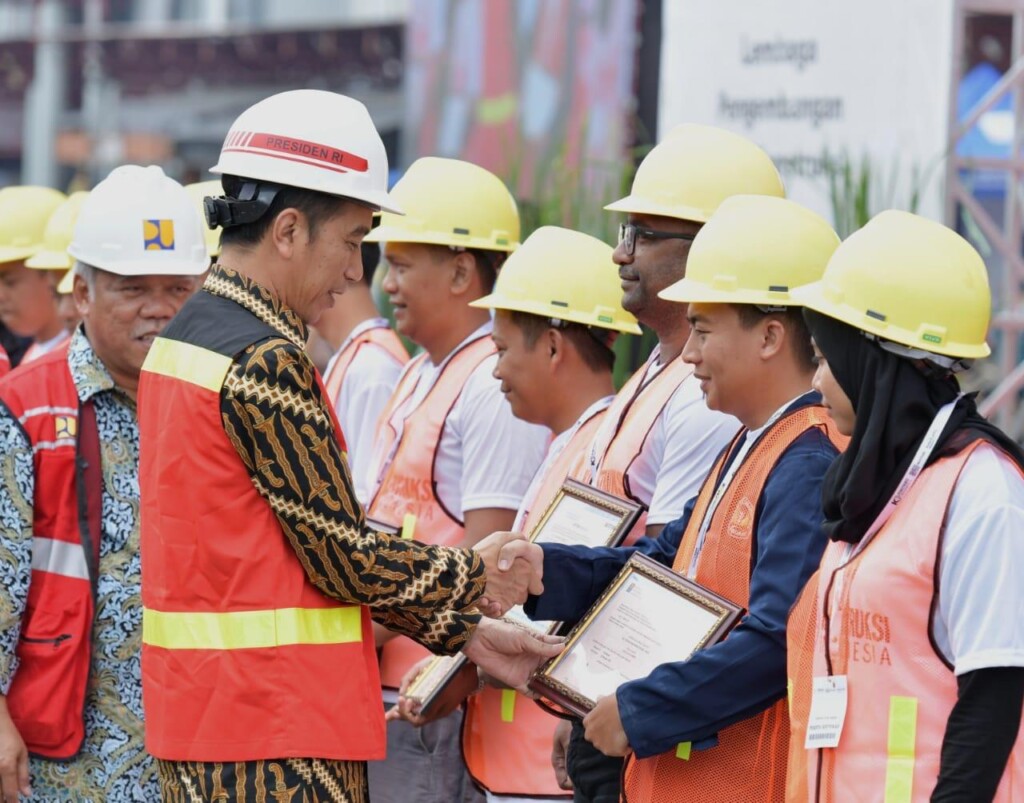
Over the course of a decade leading Indonesia, President Joko Widodo (Jokowi) demonstrated an ambitious commitment to infrastructure development. However, amid this rapid expansion, justice—particularly climate justice—was often overlooked.
By the numbers, Jokowi's administration achieved significant milestones, including the construction of 1,677 kilometers of toll roads and 124 new ports. Major initiatives such as the development of the new capital city, Nusantara (IKN), were also launched to replace Jakarta as Indonesia's capital. Yet behind these widely promoted success stories lies a more complex reality. The slogan "Building Indonesia from the Periphery" has not been without controversy, particularly when viewed through the lens of the worsening climate crisis.
In practice, many infrastructure projects have been implemented without adequately considering their environmental impacts or the public's capacity to cope with climate change. Rather than strengthening climate resilience, these developments have contributed to deforestation, pollution, biodiversity loss, and rising carbon emissions.
Even more concerning, many infrastructure projects have been perceived as serving the interests of political and business elites rather than the broader public. Environmental degradation and agrarian conflicts associated with National Strategic Projects illustrate how large-scale development can leave significant ecological and social costs for future generations. Examples include the Jakarta–Bawen Toll Road project, which allegedly used illegally sourced fill material that cleared protected green areas; the Kertajati International Airport project, which displaced agricultural land across five villages; and the Rempang Eco-City project, which has been widely criticized for displacing local communities from their ancestral lands.
Justice Left Behind
Amid Indonesia's aggressive development agenda, climate justice has remained largely neglected. The impacts of climate change are not experienced equally across society. Instead, the burden falls disproportionately on vulnerable groups, including low-income communities, smallholder farmers, traditional fishers, persons with disabilities, women, children, older persons, Indigenous Peoples, laborers, and informal workers.
A fundamental issue facing these communities is the lack of formal recognition of their rights to their living spaces, including customary territories, agricultural land, and traditional fishing grounds. Their specific needs are often ignored, while unequal access to economic, social, and political resources further deepens their vulnerability. Moreover, little effort has been made to restore rights that have been undermined by past development projects. These marginalized communities remain excluded from decision-making processes related to both development planning and climate policy, making climate injustice one of the most enduring challenges of Jokowi's ten-year administration.
Although President Jokowi has repeatedly expressed Indonesia's commitment to addressing the global climate crisis—through policies such as the Net Zero Emissions target, the Nationally Determined Contribution (NDC), and Carbon Economic Value (Nilai Ekonomi Karbon)—these initiatives have yet to address the country's more fundamental climate justice challenges.
Over the past decade, the administration has effectively rolled out the red carpet for the expansion of extractive natural resource industries, including projects promoted under the banner of climate action and energy transition. One notable example is the rapid expansion of nickel mining concessions, which increased by approximately 680,000 hectares between 2014 and 2024. This represents around 70% of all registered nickel mining permits and has accelerated forest loss, particularly across Sulawesi, Maluku, and Papua—regions that contain some of Indonesia's last remaining intact forests.
The rapid expansion of the nickel industry has also occurred with insufficient regard for Indigenous communities. The Tobelo Dalam Indigenous community in Halmahera, for instance, has seen its forests and coastal ecosystems—essential to its way of life—threatened by mining activities, further undermining its livelihoods and cultural heritage.
Similarly, under the justification of addressing food and energy insecurity linked to climate change, the government has promoted large-scale Food and Energy Estate projects instead of strengthening the resilience of smallholder farmers and traditional fishers. One example is the plan to expand sugarcane plantations in Merauke by between 700,000 and 2 million hectares to support sugar self-sufficiency and bioethanol production. The project risks driving further deforestation while creating new conflicts with Indigenous communities in Papua. At the same time, carbon trading initiatives continue to expand despite the continued lack of formal recognition of Indigenous rights and customary territories.
Dismantling Injustice
American sociologist and environmental justice advocate Robert D. Bullard, widely recognized as the father of the environmental justice movement, argues in his book Dumping in Dixie: Race, Class, and Environmental Quality that unjust development inevitably produces communities that bear a disproportionate share of environmental harm.
According to Bullard, addressing these injustices requires comprehensive policy reform and stronger advocacy to protect communities most vulnerable to environmental injustice. Political institutions, therefore, must serve as the frontline in advancing justice through policies that prioritize vulnerable groups, who are often the first to suffer when environmental degradation occurs.
Although President Jokowi frequently highlights the achievements of his administration, climate justice remains an unresolved issue. This challenge will become a significant responsibility for the incoming administration under President Prabowo Subianto and Vice President Gibran Rakabuming Raka. If the demands of civil society for greater climate justice continue to be ignored, social inequality is likely to widen while the climate crisis becomes increasingly difficult to manage. As a result, the social and economic costs of development will continue to rise, making future development less sustainable.
The new administration must be willing to take bold and progressive steps to address these challenges. Climate justice should be integrated into every aspect of development policy by recognizing the rights of vulnerable communities and ensuring their meaningful participation in decision-making processes. Only then can climate justice move beyond political rhetoric and become a tangible principle reflected in public policy and real action, allowing all Indonesians to benefit fairly and equitably.
Photo: State Secretariat of the Republic of Indonesia