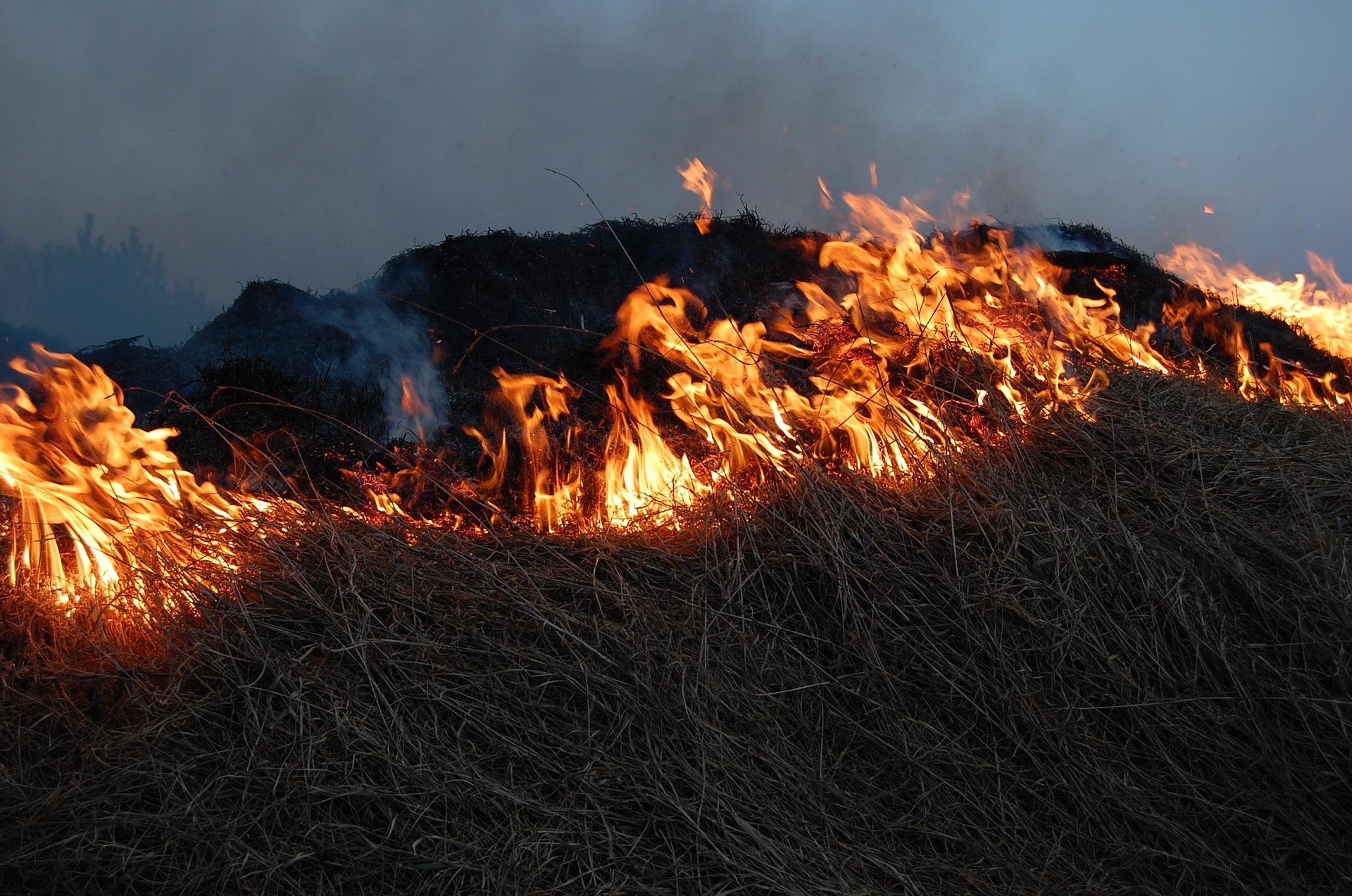
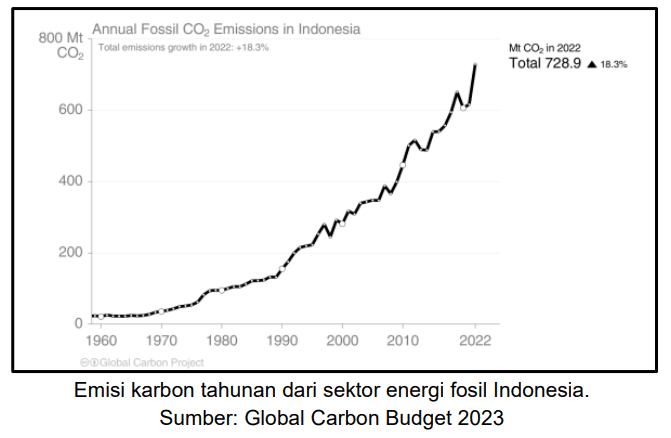
The latest report from the Global Carbon Project also shows that Indonesia ranks among the world’s top ten carbon-emitting countries. Indonesia’s carbon emissions increased by 18.3 percent in 2022, the largest rise among all countries. This increase was driven by fossil fuel use—particularly coal—as well as land-use change and high rates of deforestation.
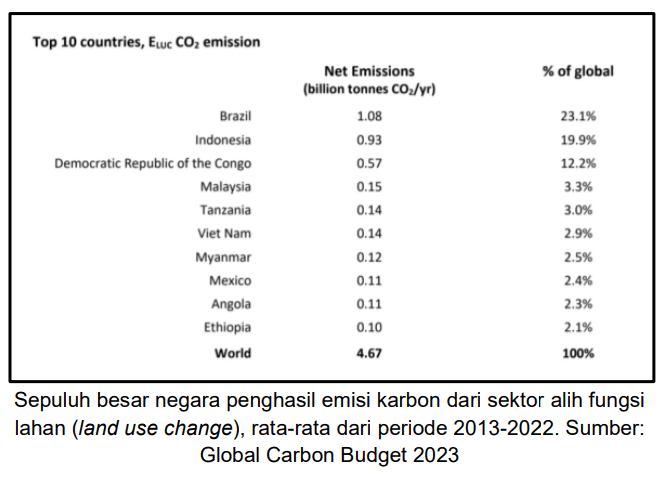
In the land-use sector, Indonesia ranks as the second-largest emitter globally. Between 2013 and 2022, Indonesia’s average land-use emissions reached 930 million tons per year, accounting for 19.9 percent of global land-use change emissions. Together with Brazil and the Democratic Republic of the Congo, Indonesia contributes 55 percent of global land-use emissions. Indonesia’s emissions peaked in 1997 due to extensive peatland fires.
In 2023, the global share of fossil CO₂ emissions is estimated to come from coal (41 percent), oil (32 percent), gas (21 percent), cement (4 percent), and flaring and other sources (2 percent). The 2023 projections are based on preliminary data and modeling.
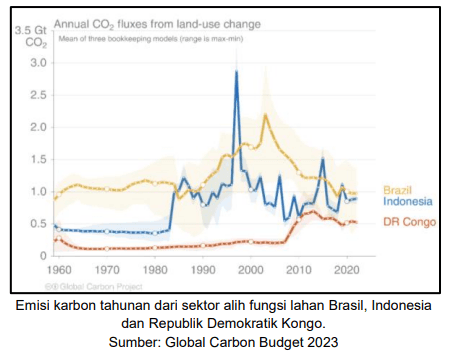
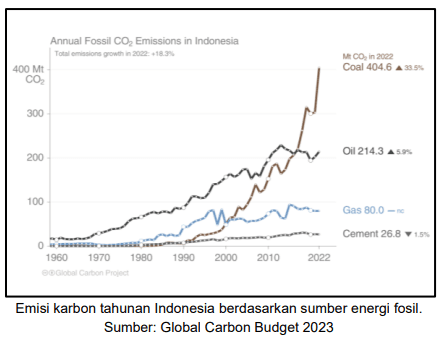
These findings were presented in the Global Carbon Budget Report, compiled by more than 120 international scientists and reviewed through a peer-review process. The scientists conclude that global actions to reduce fossil fuel use are not moving fast enough or at the scale required to prevent dangerous climate change.
Without stronger efforts to cut emissions, there is a 50 percent chance that global temperatures will exceed 1.5°C above pre-industrial levels within the next seven years, several years earlier than projected in IPCC reports.
“Indonesia’s position as one of the world’s largest emitters is a warning that the country must take greater responsibility in reducing carbon emissions, particularly from the energy and land-use sectors,” said Iqbal Damanik, Forest Campaigner at Greenpeace Indonesia. “As one of the countries most vulnerable to climate change, it is crucial for this archipelagic nation to reduce emissions, slow the climate crisis, and prevent its worst impacts for the survival of future generations.”
“The Global Carbon Budget Report reveals contradictions between government data and scientific findings,” said Nadia Hadad, Executive Director of Madani Berkelanjutan. “Therefore, there is an urgent need for transparency in government data, aligned with findings from global scientific assessments and civil society data.”
“Deforestation is still occurring, in part because Indonesia’s Enhanced NDC still allows a so-called ‘deforestation quota’ of 300,000 hectares per year until 2030. Of the 128,700 hectares of natural forest loss recorded in 2020–2021, 62 percent occurred within licensed and concession areas. Law enforcement must be strengthened to further reduce deforestation. Indonesia must also reinforce its commitment to halting and reversing forest loss, as pledged in the Glasgow Leaders’ Declaration on Forests and Land Use,” she added.
“Indonesia remains addicted to coal—it is no surprise that we rank among the world’s top ten emitters,” said Novita Indri, Energy Campaigner at Trend Asia. “In 2023, we broke another record when coal production reached 703.14 million tons by early December, exceeding the official target of 694.5 million tons. This figure does not even account for biomass co-firing using wood, which—according to Trend Asia data—could worsen emissions by 155.9 million tons, driven by deforestation of 240,622 hectares of natural forest.”
“Meanwhile, 43.59 percent of Indonesia’s emissions come from the land and forest sector, indicating weak forest protection. As a result, climate impacts in Indonesia will only intensify. This is particularly alarming given Indonesia’s high vulnerability to climate change, which will further worsen hydrometeorological disasters that are already affecting the country,” Novita added.
“It is very clear in Indonesia’s National Energy Plan (RUEN) that up to at least 2040, the country will remain dependent on fossil energy, particularly coal,” said Firdaus Cahyadi, Communication Specialist at 350.org Indonesia. “Even worse, while coal exports are projected to decline, domestic coal consumption is expected to continue rising. Today, coal use is increasing year after year not only for PLN’s electricity grid but also for captive power plants, particularly in the mineral processing industry.”
Carbon Emission Reduction Commitments at COP28
The world’s largest climate summit, the 28th Conference of the Parties (COP28), is currently taking place in Dubai, United Arab Emirates, and represents a crucial moment to secure stronger commitments, financing, and deployment of clean technologies.
However, during a She Changes Climate discussion on November 21, COP28 President Sultan Al Jaber, who is presiding over the summit, stated that phasing out fossil fuels to achieve global climate targets is “not grounded in science.” He even claimed that eliminating fossil fuels would send the world “back into caves.”
Al Jaber’s denial—while he also leads the UAE’s national oil company—highlights the reluctance and conflicts of interest within the fossil fuel industry, which continue to obstruct meaningful climate action.
Findings from the IPCC AR6 Synthesis Report, released in March 2023, show that to keep the 1.5°C target within reach, global CO₂ emissions must be reduced by 48 percent by 2030 and 99 percent by 2050 to prevent severe climate impacts.
“Global emissions at current levels are rapidly increasing CO₂ concentrations in the atmosphere, driving further climate change and increasingly severe impacts,” said Professor Corinne Le Quéré, Royal Society Research Professor at the School of Environmental Sciences, University of East Anglia. “All countries need to decarbonize their economies much faster than they are currently doing to avoid the worst impacts of climate change.”
“COP28 President Sultan Al Jaber—who should be leading the fight against climate change—is instead denying science when it conflicts with fossil fuel interests,” Novita concluded. “As a country highly vulnerable to climate change, Indonesia must base its decisions on science, reduce its excessive coal production targets, commit firmly to cutting emissions, and urgently implement a just energy transition.”
Media Contacts
Global Carbon Project | Pierre Friedlingstein, Corinne Le Quéré, Julia Pongratz, Mike O’Sullivan, Glen Peters, Philippe Ciais
Email: pressoffice@exeter.ac.uk | Phone: +44 7825 770679Greenpeace Indonesia | Iqbal Damanik, Forest Campaigner
Email: muhammad.damanik@greenpeace.orgMadani Berkelanjutan | Nadia Hadad, Executive Director
Email: nadia@madaniberkelanjutan.idTrend Asia | Novita Indri, Energy Campaigner
Email: novita.pratiwi@trendasia.org
Firman Imaduddin, Communications Officer
Email: firman.imaduddin@trendasia.org350.org Indonesia | Firdaus Cahyadi, Communication Specialist
Email: firdaus.cahyadi@350.orgYayasan Indonesia Cerah | Rafaela, Climate Associate
Email: rafaela@cerah.or.id