Dokumen Indonesia:
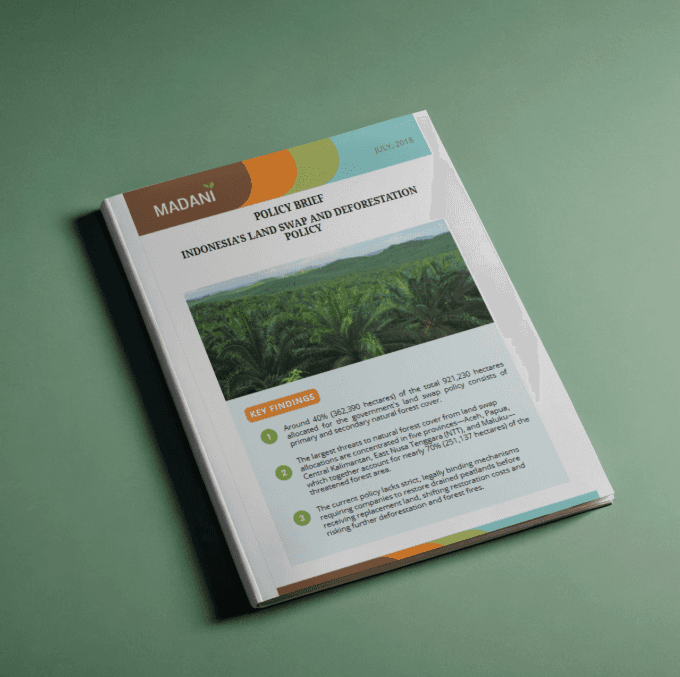
Indonesia's Land Swap and Deforestation Policy
The Indonesian government seems to be planning a global deforestation in the name of peat protection. This is seen after the Anti-Mafia Forest Coalition analyzed in depth the map of the land swap published by the Ministry of Environment and Forestry (KLHK). Land swap policy is a government response to plant forest concessions (HTI) affected by peat protection policies to prevent the recurrence of forest and land fires. As stipulated by the Regulation of the Minister of Environment and Forestry No. P.40/2017 About Government Facilitation In Industrial Plantation Forest Business In the Framework of Protection and Management of Peat Ecosystems, land swaps are given to holders of HTI permits that 40 percent or more of their work areas are designated as peat ecosystems with protected functions. Of the total 12.94 million hectares of peat restoration priority carried out by the Peatland Restoration Agency (BRG), covering an area of 2.15 million ha of which (or equivalent to 16 percent) is in the HTI concession. A total of 216,044 ha of the region suffered tremendous fires in 2015. The Anti-Mafia Forest Coalition seeks to analyze it spatially and found that of the total allocation of 921,230 ha for land swaps, 362,390 ha or 40 percent of which is primary and secondary forest cover. The allocation of land swaps is spread almost throughout the major islands of Indonesia except Java, namely stretch from Sumatra, Kalimantan, Sulawesi, Maluku, Nusa Tenggara, to Papua.
What about the details of the spread? Why is it problematic for forest resilience? And what are the recommendations for the government to improve this policy? This report was compiled jointly by the Anti-Mafia Forest Coalition: Auriga, Papuan Bite, Iflahari, Elsam, WWF-Indonesia, Gemapala, Peat Monitor Papua, Walhi Central Kalimantan, Forest Kita Institute (IPR), Heritage, Papua Forest Watch, Partnership, and SOS for the Land of Papua.