Climate policies and actions will never be truly just if formulated without involving those who face the impacts of the climate crisis with distinct risks and barriers. Yet, three distinct movements the environmental movement, the women's rights movement, and the disability rights movement still often operate in separate advocacy spaces.
To strengthen the connections among the three, MADANI Berkelanjutan hosted the In-Climate Connect: Connecting, Sharing, and Acting for Climate Justice workshop on October 12–14, 2026, at Hotel Aryaduta Menteng, Jakarta. This gathering was designed to deepen understanding and build a collective advocacy agenda, ensuring that GEDSI (Gender Equality, Disability, and Social Inclusion) and climate justice perspectives are integrated into climate policy and decision-making.
A total of 27 young women and women with disabilities from Jakarta and West Kalimantan attended the event. Over the course of three days, individuals who had previously worked within their own respective spheres were brought together in a single shared space.
Not Weak, but Impacted First
Giorgio Budi Indrarto from the Board of Management of MADANI Berkelanjutan opened the workshop with an emphatic assertion: young women and women with disabilities are indeed vulnerable groups, but they are not weak. They are simply the first to be impacted compared to other groups.

Opening remarks by Giorgio Budi Indrarto from the Board of Management of MADANI Berkelanjutan at the In-Climate Connect: Connecting, Sharing, and Acting for Climate Justice workshop at Hotel Aryaduta Menteng, Jakarta. Photo: MADANI Berkelanjutan
“Climate justice is about the safety of all human beings about ensuring everyone has an equal chance to survive. Those of us in this room have far fewer chances than others, and that is unfair. It does not mean we are powerless, but specific measures are needed so that justice is truly equitable,” said Giorgio.
The numbers support this reality. Of the approximately 23.3 million persons with disabilities in Indonesia, around 9.9 million belong to the poorest 40 percent of the population. Their risk of mortality during disasters can be up to four times higher.
Three Participants, Three Stories
Leni Tria: Standing with Women Palm Oil Workers
On a daily basis, Leni Tria from the Teraju Foundation advocates for female palm oil plantation workers across Sanggau, Kubu Raya, Sekadau, and Pontianak in West Kalimantan. During forest and land fires (karhutla), female sprayers work amidst thick smoke with incomplete personal protective equipment, lacking adequate occupational health protections from their employers.
This workshop marked Teraju’s first experience collaborating with women with disabilities. The session on gender equality resonated most deeply with Leni, serving as a reminder that the rights of women and women with disabilities are equally vital. “We cannot achieve our goals alone,” she said.
Upon returning from Jakarta, Leni plans to confer with her colleagues at Teraju to build a public campaign addressing climate issues and persons with disabilities. She calls on the government to deliver more equitable disaster management across regions, as well as greater attention to women in West Kalimantan.
Arniyati: From Multiple Burdens to a Collective Movement
Arniyati, Coordinator of the Training & Learning Center at Gemawan, highlighted that women in West Kalimantan currently shoulder multiple burdens. Smoke haze from wildfires disrupts the menstrual cycles of several peers, saline tap water in Pontianak complicates reproductive hygiene, and mothers bear the financial strain of purchasing scarce masks during fire episodes alongside internet data for their children's remote schooling.
Arniyati’s most profound realization came when learning about reasonable accommodation. She had previously assumed accommodation referred only to lodging, unaware of its far broader meaning for persons with disabilities. Regarding climate adaptation, she observed that vulnerable groups are repeatedly forced to shoulder the burden of adapting on their own a reality she finds infuriating.
Arniyati plans to adapt the workshop materials for approximately 200 community groups mentored by Gemawan through over 30 community organizers, as well as youth classes. She called on the government to engage directly at the grassroots level and move away from top-down policymaking. “We need a government that is proactive, not reactive.”
Shahifa Birru: Reading the Climate Crisis through Layers of Identity
Shahifa Birru, a Deaf woman from Feminist Themis in Jakarta, shared that she has not personally experienced a climate disaster. However, she sees its intersecting layers of impact: women who use wheelchairs struggle to access clean water alongside facing restricted mobility, while emergency alerts lacking captions or audio fail to reach everyone.
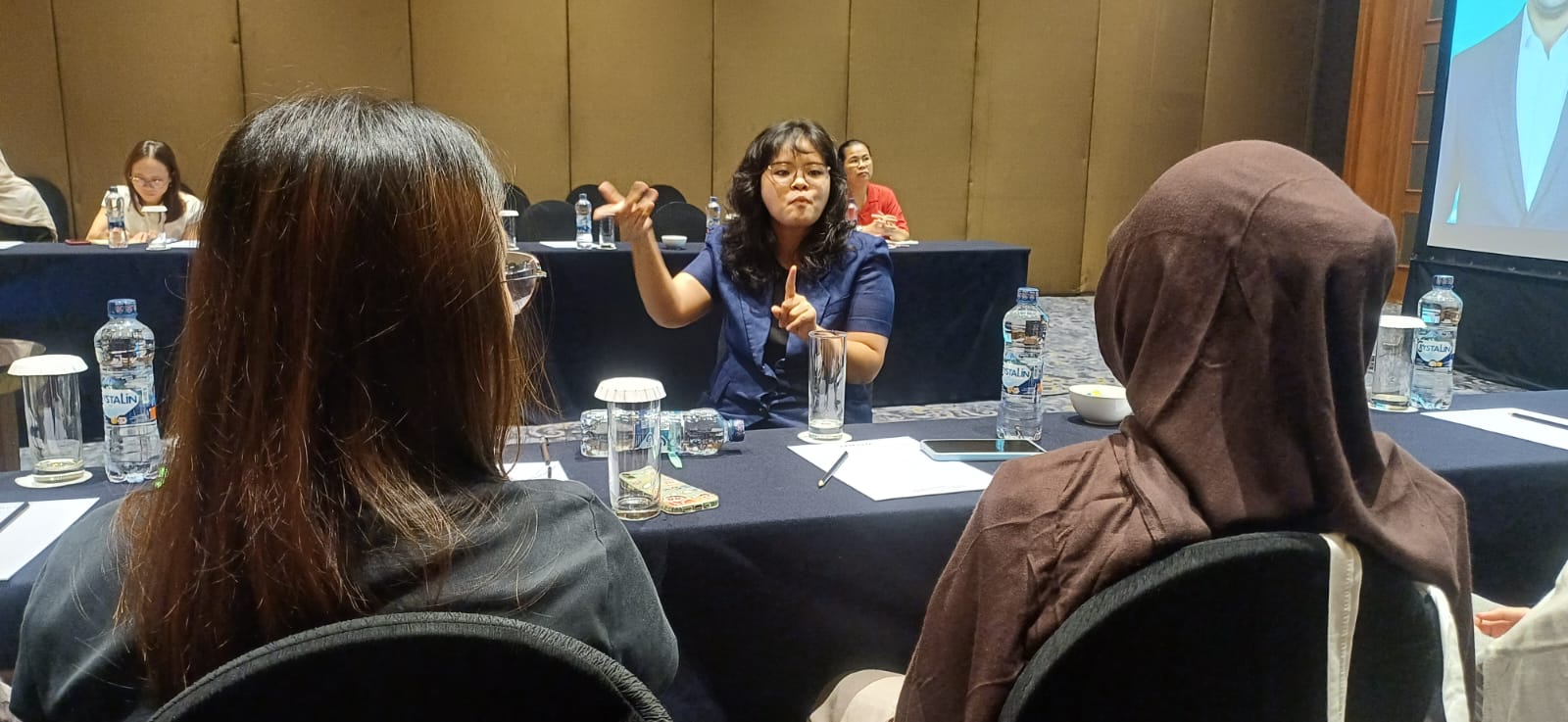
A sign language interpreter interprets communication into sign language to assist several Deaf participants at the In-Climate Connect Workshop. Photo: MADANI Berkelanjutan
For Shahifa, affectionately known as Birru, the GEDSI perspective was an eye-opener, showing that the climate crisis is not merely an environmental issue, but one of unequal access to resources and social inequality. She also emphasizes that persons with disabilities possess the capacity to formulate solutions; without their meaningful involvement, policies risk becoming ableist and discriminatory.
Birru plans to launch a campaign on Feminist Themis’s Instagram account focusing on intersectionality and climate disasters. Her message to the government is that the participation of vulnerable groups must be genuinely equitable, not a mere formality. “Planning and decision-making must never take place while we are excluded and left behind.”
Insights from the Resource Persons
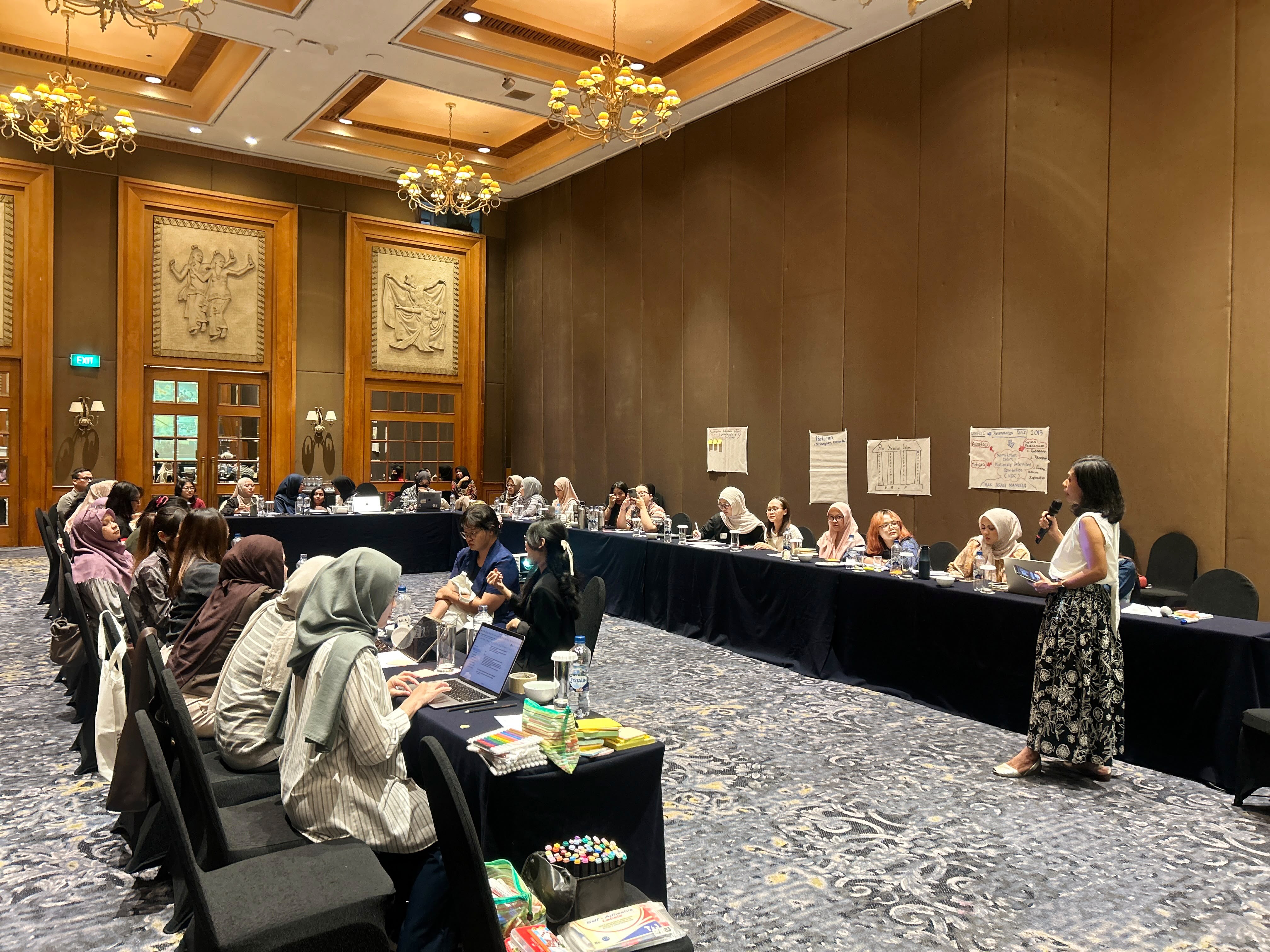
Participants of the In-Climate Connect: Connecting, Sharing, and Acting for Climate Justice workshop listen to the speakers' presentations to equip their future climate justice advocacy. Photo: MADANI Berkelanjutan
The workshop was designed not as a one-way lecture, but as an interactive space. Each topic began with a session for participants to connect with one another, followed by conceptual deepening, policy and stakeholder mapping, and advocacy experience sharing. Five key themes were addressed: the climate crisis and GEDSI-based climate justice, just adaptation, loss and damage, just mitigation, and public communication and campaign strategies. Testimonies from the ground flowed throughout the discussions, demonstrating how distributive, recognitional, procedural, and restorative justice have persistently been overlooked in climate policy formulation.
To this end, MADANI Berkelanjutan brought together speakers from various civil society organizations offering complementary perspectives. Representing the Indonesian Women’s Coalition (KPI), Linarti urged participants to return to the root of the problem. “Gender is not merely biological sex, but a role constructed by society. Gender injustice is perpetuated through culture, law, and the media, which is why GEDSI must serve as an analytical tool to determine who requires affirmative support the most,” she noted. For Linarti, GEDSI is not an ornamental label in climate policy, but a lens to identify who needs to be prioritized.
From the Indonesian Association of Women with Disabilities (HWDI), Mahretta Maha emphasized that the involvement of persons with disabilities must never be ceremonial. “Barriers do not stem from the diversity of disabilities, but from inaccessible environments, regulations, and attitudes. Persons with disabilities must be engaged from planning through to the evaluation of climate action, not merely sought after when event organizers need participants,” she stated. That message resonated deeply within the room. The workshop participants themselves included people with physical disabilities, low vision, Deaf individuals, and psychosocial disabilities, spanning ages 18 to 45.
Additional perspectives were brought by the Women Research Institute (WRI), the People’s Alliance for Climate Justice (ARUKI), Wahana Lingkungan Hidup Indonesia (WALHI), Yayasan PIKUL, Solidaritas Perempuan, the Movement for Disability and the Elderly (DILANS) Indonesia, JALA PRT, Xtreme Impact, and Prosper Global (formerly Mercy Corps). They shared experiences spanning gender commitments in national climate policy, adaptation and mitigation strategies, creative campaigning tactics, and advocacy for the Climate Justice Bill.
From the Workshop Room, A Call to Us All
Giorgio concluded with a hope that served as the common thread of the workshop: “Through In-Climate Connect, we want the environmental, women's rights, and disability rights movements to connect with one another, ensuring that climate policy and action become truly just and inclusive,” he said.

The In-Climate Connect: Connecting, Sharing, and Acting for Climate Justice workshop organized by MADANI Berkelanjutan, bringing together 27 young women and women with disabilities from Jakarta and West Kalimantan. Photo: MADANI Berkelanjutan
That vision is now being carried home by the participants as a collective advocacy action plan. Yet this movement cannot be driven by 27 people alone. MADANI Berkelanjutan calls on the public, civil society organizations, the media, and policymakers to take part.
Support the passage of the Climate Justice Bill as a legal umbrella safeguarding the rights of all groups. Advance the implementation of the National Action Plan on Gender and Climate Change (RAN-GPI) down to the subnational level. Meaningfully engage young women and persons with disabilities in every climate decision-making space, from planning through evaluation. Ensure disaster-related information is accessible to all, available in text, audio, and sign language formats. And for anyone working on environmental, women's, or disability issues, begin connecting with the allied movements that have long been walking the parallel path alongside you.
Because, as Arniyati noted, simply coming together and talking about the climate crisis as one already constitutes a movement. The hope is simple: that this gathering does not end as a workshop, but grows into a collective movement that leaves no one behind. (***)


