Climate change is not merely a series of temperature figures on paper or technical debates in conference rooms. On the ground, the climate crisis is a lived reality of submerged homes, drying springs, biodiversity loss, and stripped livelihoods.
To voice this reality, Yayasan Madani Berkelanjutan, in collaboration with Sebumi and The Asia Foundation IN-CLIMATE, organized the Earth Storyteller Fellowship 3.0: “Voices of the Ground: Community, Climate, and Our Shared Future.” Carrying the theme “Her Roots & Her Voice for Climate Justice,” this program was designed to amplify the voices of women and communities historically underrepresented in public discussions on the environment and climate change.
The reason is clear: the impacts of climate change are deeply unequal. Grassroots communities, whose contribution to the crisis is minimal, often bear far greater impacts on their living spaces, health, food security, and livelihoods. In fact, women and local communities possess vital experiences essential for understanding environmental challenges and shaping solutions. Unfortunately, their stories have yet to receive the space they deserve. This is where storytelling serves as a bridge between local lived experiences and broader public discourse.
From hundreds of applicants across 38 provinces, the committee selected 16 young women to be equipped with storytelling skills from their respective regions. Two of them bring profound narratives from their home regions: Wahyu Majiah from Aceh and Wardah Bagis from West Nusa Tenggara (NTB).
Stories from the Edge of the Leuser Forest
Wahyu Majiah, affectionately known as Ayu, was born in South Aceh and currently resides in Banda Aceh. She works as a journalist, photographer, and videographer, writing for local media outlets while contributing to national publications.

Her interest in environmental issues took root during her university years in 2019. Growing up in the buffer zone of the Leuser Ecosystem, she witnessed firsthand the continuous forest encroachment and recurring natural disasters. Through these experiences, she realized that women bear the heaviest burden. She recalls a disaster in Aceh in 2025, when women still had to fulfill their roles as mothers while struggling to secure clean water and keep their families afloat amid severe limitations.
Ayu refused to stay silent. She regularly goes out into the field to amplify the voices of vulnerable groups, particularly widowed mothers whose lives are most severely affected by climate change. She also mentors local women's groups in visual storytelling through photography, hoping their realities will be recognized by the outside world and spark meaningful change.
Through this program, Ayu is covering a story from a remote area in the Aceh hinterlands facing the renewed threat of mining concessions. She hopes this story reaches beyond the people of Aceh to a broader audience, pushing for policy reforms so that these mining operations are halted. She also seeks to learn from the resource persons and facilitators to produce impactful journalistic work, ensuring that voices from the remote corners of Aceh resonate all the way to the capital. For her, storytelling is the bridge that finally brings communities long left in the shadows into the light.
When Equality Does Not Always Mean Justice
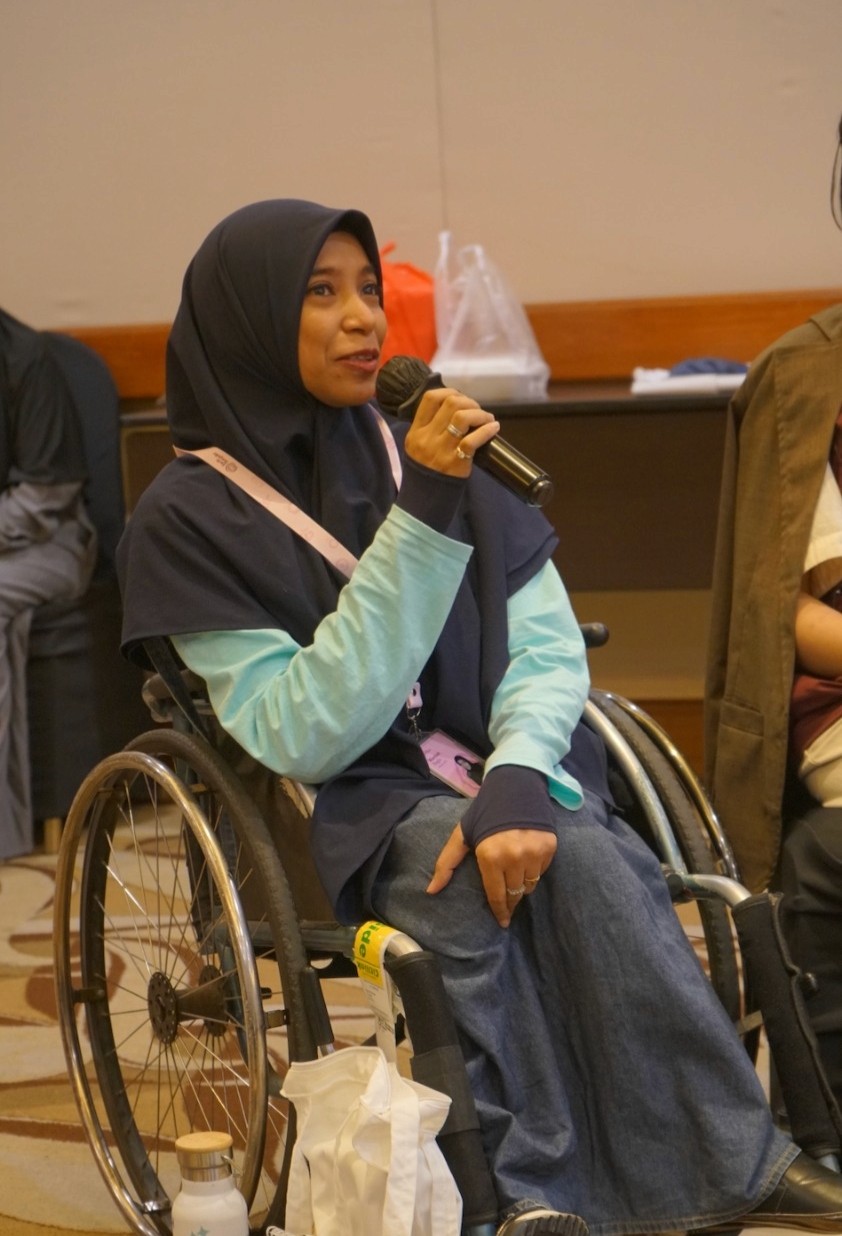
From the city of Mataram, Wardah Bagis brings a rarely discussed perspective: disability. She is a member of the Indonesian Association of Women with Disabilities (HWDI), the ASEAN Youth Disability Network, and the Indonesian Spina Bifida Community (KSBI). She is also studying law at Universitas 45 Mataram to understand government regulations and strengthen her advocacy.
For Wardah, the climate crisis is deeply intertwined with the lives of persons with disabilities, because being "equal" does not necessarily mean being "just." Persons with disabilities are almost never involved in climate-related decision-making. She cites the example of energy transition campaigns that promote the use of public transportation without considering whether the transport is accessible, especially in areas like Mataram.
A similar situation occurs in evacuation shelters during disasters. The government focuses on distributing staple goods but overlooks basic facilities like accessible toilets. According to her, this cycle continues because disability groups are often positioned as passive beneficiaries, rather than active participants in shaping their own destinies.
Driven by this concern, Wardah took action. Together with the ASEAN Youth Disability Network, she developed a plain-language climate crisis learning module for friends with autism. This module is scheduled to be launched at a conference in Manila, Philippines, in December. On August 28, 2023, she also took to the streets of Jakarta with the People's Alliance for Climate Justice (ARUKI) and met with Member of the Indonesian Parliament (DPR RI) Rieke Diah Pitaloka to urge the passage of the Climate Justice Bill. For Wardah, the presence of persons with disabilities on the streets and at the discussion tables is part of the same struggle.
She joined this fellowship to bring the disability perspective into broader climate conversations. Because Madani and Sebumi are not disability-focused organizations, she views this as an opportunity to educate the public that climate adaptation, mitigation, and resilience are closely tied to the safety and survival of persons with disabilities.
From Storytelling to Creative Action
Wardah feels she is not particularly adept at storytelling. Because of this, she hopes to craft compelling and targeted narratives after returning from this program. She also has a major plan for Mataram. Armed with her background in visual arts and the support of her university lecturers, she wants to hold a mixed-media exhibition addressing climate issues and disability rights. Her work will not be painted on regular canvases but on repurposed materials like patchwork fabric, plastic, and cardboard, serving as a unique medium to convey her concerns.
Insights from the Experts

During the program, participants were also mentored by experts. Nadia Hadad from Madani Berkelanjutan emphasized that women must no longer be positioned merely as objects or victims of the climate crisis, but rather as leaders and frontliners in saving the earth. Their primary weapon is the power of storytelling, as stories told from the heart can inherit a better future for coming generations.
Ahmad Arif, through his session on Critical and Systemic Thinking, invited participants to view the climate crisis as a systemic issue rooted in broken governance, not just weather phenomena, and to uncover these realities through data-driven narrative journalism. Shahnaz Soehartono, in the Finding Your Voice and Your "Why" session, highlighted empathy, honesty, and the courage to find one's authentic voice. Anggalia Putri, in the Climate Justice & Gender Equality session, pointed out that the climate crisis is inherently a crisis of gender and social inequality, emphasizing the double burden experienced by grassroots women.

The journeys of Wahyu and Wardah demonstrate that the climate crisis has many faces. It looks like mothers in the hinterlands of Aceh defending their living spaces from mining expansion, and friends with disabilities in NTB demanding basic rights amid climate disasters. By equipping grassroots women with storytelling skills, we are not only documenting an ecological footprint but also weaving a more just, resilient, and inclusive future for all. Because change often begins with something simple: someone willing to tell a story, and someone willing to listen. (***)


