
From the ISF: A Promise Not to Clear Forests for Rice Fields
At the Indonesia Sustainability Forum (ISF) 2026 in Jakarta on Tuesday (10/06), Special Presidential Envoy of the Republic of Indonesia for Energy and Climate Hashim Djojohadikusumo stated that the government no longer sees a need to expand rice fields into forest areas because rice self-sufficiency has been achieved. At the same event, Special Presidential Envoy for International Trade and Multilateral Cooperation Mari Elka Pangestu added that future food and biofuel production will be directed toward degraded land.
Yet following the same event, Coordinating Minister for Food Affairs Zulkifli Hasan stated that the E20 target necessitates opening new sugarcane plantations. Previously, on September 16, he mentioned that the government is preparing approximately 2 million hectares of sugarcane land across Kalimantan, Sumatra, Java, and Papua.
MADANI Berkelanjutan responded to this contradiction through a press release on October 12, 2026, demanding that the degraded land commitment must also apply to the energy sector.
At the Investor Daily Summit: B100 from "Degraded Forests", E20 to E50
A day after the ISF 2026, the same trajectory was reaffirmed before investors. At the Investor Daily Summit 2026, themed Indonesia's New Economic Model, in Jakarta on Wednesday (10/07), Coordinating Minister for Downstreaming and Energy Transition as well as Minister of Energy and Mineral Resources (ESDM) Bahlil Lahadalia cited the success of B50 as a stepping stone for ethanol. “Regarding ethanol, per the President’s directive, in 2027–2028 we will institute a 20% mandate, and looking ahead, we will implement E50,” he stated. The raw materials, Bahlil noted, would come from cassava, corn, and sugarcane, utilizing existing terrestrial potential.
Speaking in the subsequent session, Hashim Djojohadikusumo followed up directly. “The biofuels mentioned earlier by Pak Bahlil, B50 to B100, will be sourced from degraded forests, not primary forests,” he said. According to the Ministry of Forestry, Hashim continued, there are 12.7 million hectares of degraded forests. “It is forest, but there is no timber left. It has been felled, it is now scrubland.” He referred to those areas as a source of forest and land fires (karhutla). However, Hashim did not explain the location, legal status, or land utilization schemes involved.
On the same panel, Pertamina outlined plans to develop palm-based biogasoline to be tested at two of its refineries, alongside bioethanol from sugarcane molasses to meet a 5% ethanol mandate across several regions in Java by 2027.
Degraded Forests According to Whom?

Customary land belonging to the Yei Indigenous community in Jagebob District, Merauke, South Papua, encroached upon by PT Murni Nusantara Mandiri for land clearing as part of a consortium developing the sugarcane National Strategic Project (PSN) in September 2025. Photo: Yayasan Pusaka Bentala Rakyat
The label “degraded forest, not primary forest” sounds like a safeguard. Yet the primary question is: degraded according to whom?
Until now, “degraded forests” and “critical lands” have been determined purely through a biophysical and geospatial lens namely vegetation cover, slope inclination, erosion rates, and land productivity. These metrics fail to account for who relies on and lives off that land.
MADANI Berkelanjutan notes five fundamental concerns regarding this discourse.
First, land that appears “degraded” on maps is not necessarily vacant. Scrubland, secondary forest, fallow fields rested within rotational farming systems, sago groves, and mixed gardens are frequently classified as low-cover lands, despite serving as essential sources of food, livelihoods, and living spaces for Indigenous peoples and local communities.
MADANI Berkelanjutan’s spatial review of critical land data (November 2024) reveals that the largest land cover category within it is secondary dryland agriculture, encompassing 5.34 million hectares. Approximately 819 thousand hectares are situated in areas with existing Social Forestry Decrees (SK Perhutanan Sosial), and 1.76 million hectares are included in the Indicative Map of Social Forestry Areas (PIAPS). Furthermore, 917 thousand hectares of natural forests and 301 thousand hectares of peatland ecosystems are also classified under the critical land designation.
The Ministry of Forestry's own data indicates that 7.09 million hectares of critical land are located within state forest areas, which should properly be restored alongside local communities rather than converted into monoculture plantations. Therefore, identifying “degraded forests” must start by recognizing community rights and land utilization on the ground, not solely by relying on satellite imagery. Without that foundation, converting these lands into oil palm, sugarcane, or cassava plantations effectively shifts the burden of the energy transition onto the shoulders of local communities.
Second, the cited figure does not reflect data on “degraded forests.” The same spatial review by MADANI Berkelanjutan reveals that the 12.7-million-hectare figure originates from maps of critical land and severely critical land from the Ministry of Environment and Forestry, covering an area of 12,774,532 hectares, with 5.29 million hectares situated outside state forest areas.
More recent data from the Decree of the Minister of Forestry (Kepmenhut) Number 406 of 2025 recorded critical land in 2024 at 12.29 million hectares. While that ministerial decree is accompanied by distribution maps and provincial breakdowns, the map is drawn at a national scale of 1:7,000,000 far too coarse to pinpoint ground-level locations.
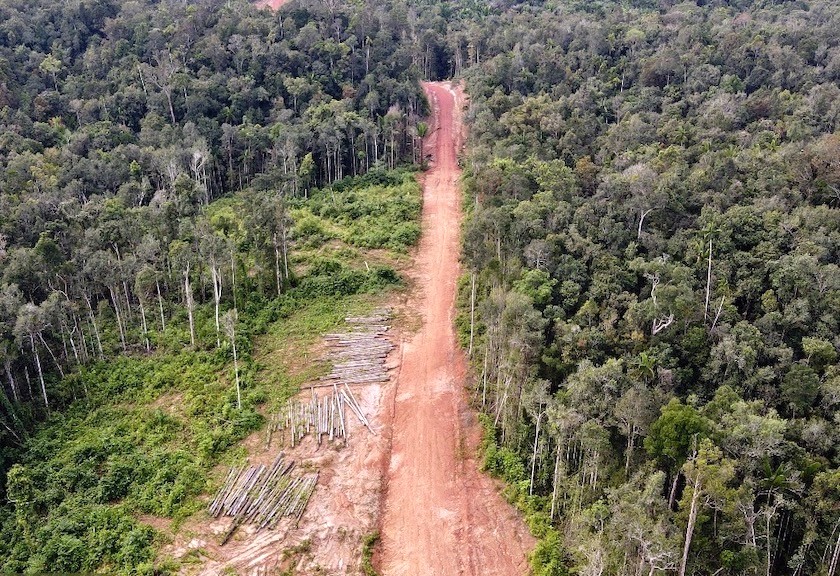
An aerial photograph shows a forest area cleared by a company without a Cultivation Rights Title (HGU) in Jari District, Boven Digoel Regency, South Papua. Photo: Yayasan Pusaka Bentala Rakyat
The breakdown also demonstrates that critical land is not an empty expanse awaiting cultivation. Around 1.77 million hectares are located on the island of Java, three-quarters of which lie outside state forest areas. All provinces across Papua account for only about 548 thousand hectares, with South Papua recording merely 47,014 hectares. In reality, 486,939 hectares of customary forests in that province have already been released for national food and energy self-sufficiency projects. This indicates that the expansion in South Papua is not taking place on critical land. To date, the government has yet to clarify which portions of the 12.7 million hectares are targeted for conversion into biofuel plantations.
Third, this exact same figure was previously pledged for reforestation. At the Indonesian Pavilion during COP29 in Baku, Azerbaijan, in November 2024, Hashim stated that President Prabowo had approved massive reforestation across these 12.7 million hectares. At the Indonesia Economic Summit in February 2026, he reaffirmed that this reforestation commitment was “not empty talk” (bukan omon-omon).
From the outset, MADANI Berkelanjutan warned that this reforestation corridor is deeply entangled with other competing interests: 29.55%, or 3.77 million hectares, of critical land falls within existing permits and concessions for oil palm, mineral and coal mining, oil and gas, and Forest Utilization Business Licenses (PBPH), including 925 thousand hectares inside palm oil permits. Meanwhile, 67%, or 8.59 million hectares, has not been incorporated into either the Indicative Map for the Moratorium on New Concessions (PIPPIB) or the Indicative Map of Social Forestry Areas (PIAPS), leaving it unresolved as to who will be responsible for restoring it.
Even at the ISF 2026 event, Mari Pangestu still tied degraded land to afforestation, reforestation, and revegetation programs. Now, the very same land is being pitched as a feedstock source for biofuels.
Energy crops can indeed be part of land rehabilitation. MADANI Berkelanjutan’s study titled Measuring Ambition and Reality: The Future of Indonesian Biofuels within a Just Energy Transition Framework identified the dual potential of biofuels to produce energy while supporting ecosystem restoration and carbon sequestration on the condition that they are planted to rehabilitate land functions, managed collaboratively with communities, and do not compromise community land-use rights. What cannot be classified as restoration is replacing land promised for reforestation with large-scale monoculture plantations of oil palm, sugarcane, or cassava. MADANI Berkelanjutan maintains that a “degraded” status must not automatically serve as a green light for land conversion.
Fourth, opening new land is a choice, not a necessity. The study Measuring Ambition and Reality: The Future of Indonesian Biofuels within a Just Energy Transition Framework, launched by MADANI Berkelanjutan on September 29, 2026, which incorporated findings from the Environmental Carrying Capacity and Assimilative Capacity (D3TLH) assessment, set an upper threshold for oil palm plantations at 18.15 million hectares, whereas existing oil palm coverage had already reached 17.8 million hectares in 2024.

Forest clearing for the food estate project in Merauke, South Papua. Photo: Yayasan Pusaka Bentala Rakyat
Satya Bumi (2024) estimates that B50 alone requires an additional approximately 5.36 million hectares through 2039, with a potential deforestation footprint of 1.5 million hectares. In reality, a palm oil yield enhancement study released by WWF Indonesia in 2023 noted that smallholder oil palm productivity stands at only around 3.43 tons of CPO per hectare per year less than half its full potential. Through productivity improvements and the replanting of around 7 million hectares of aging plantations, domestic demand, export needs, and biodiesel blending mandates could be met without clearing new land.
Fifth, this discourse risks providing incentives for actors who allow forests to burn. A position paper by Pantau Gambut (2026) recorded that only about 1–3% of peatlands burned between 2015 and 2019 reverted to forest, while the remainder turned into scrubland and monoculture oil palm plantations. From a sample of burned peatlands in concession areas in 2023, only 1% returned to forested cover, with the rest dominated by scrubland and dryland crops, including oil palm and acacia.
If burned areas are instead treated as feedstock reserves for biofuels, this policy sends a dangerous message: forests destroyed today become the energy plantations of tomorrow. Amid forest and land fires (karhutla) once again sweeping through Sumatra, Kalimantan, and Papua, this risk cannot be ignored.
“The question is not merely how many hectares are degraded, but degraded according to whom. Land that appears critical on maps may well be community gardens, agricultural plots, or sago groves. The state’s obligation is to restore it alongside these communities, not convert it into large-scale monoculture energy plantations. The 12.7 million hectares once pledged for reforestation are now being pitched to investors as biofuel feedstock, without location details and without carrying capacity assessments. Bioenergy must not be pursued without limits: every blending target must first be tested against environmental carrying capacity before being translated into land area,” said Riza Egi Arizona, Community-Based Energy Transition Program Lead at MADANI Berkelanjutan.
Halt Biofuel Expansion into Forests and Customary Territories

Yayasan Pusaka found that sugarcane company PT Murni Nusantara Mandiri carried out the clearing and bulldozing of natural forest in the Nalkin area, Jagebob District, South Papua Province. Photo: Yayasan Pusaka Bentala Rakyat
To date, the commitment to degraded land remains confined to verbal statements in public forums, while legally binding decisions are moving in the opposite direction. Through the Decree of the Minister of Forestry Number 591 of 2025, the government reclassified 486,939 hectares of customary forest in South Papua into non-forest zones for the National Food, Energy, and Water Self-Sufficiency Area. That ministerial decree is currently being challenged by Indigenous communities and civil society organizations at the Jakarta State Administrative Court (PTUN Jakarta). Satellite data from Mighty Earth records that more than 50,000 hectares have already been cleared for sugarcane and rice in Merauke since 2024, and to date there is no certainty that land clearing in that region will be halted.
Therefore, MADANI Berkelanjutan once again urges the government to:
Review the B50, B100, E20, and E50 targets based on environmental carrying capacity, and prioritize productivity improvements and the replanting of smallholder oil palm plantations over opening new land.
Disclose spatial data on critical and degraded lands at a scale verifiable on the ground (at least 1:50,000, in accordance with the One Map Policy), complete with area legal status, vegetation cover, Environmental Services Index scores, the presence of customary territories, and utilization plans, while involving local communities in determining whether an area is truly degraded. And if it is, whether the land should be restored or can be utilized as community-managed plantations.
Establish in binding regulations that burned forest areas and lands cannot be converted into plantations.
Revoke the Decree of the Minister of Forestry Number 591 of 2025 and halt further land clearing within the South Papua National Strategic Project (PSN) area, including for sugarcane and bioethanol.
Formulate an inclusive biofuel roadmap by engaging affected communities and diverse stakeholders.


