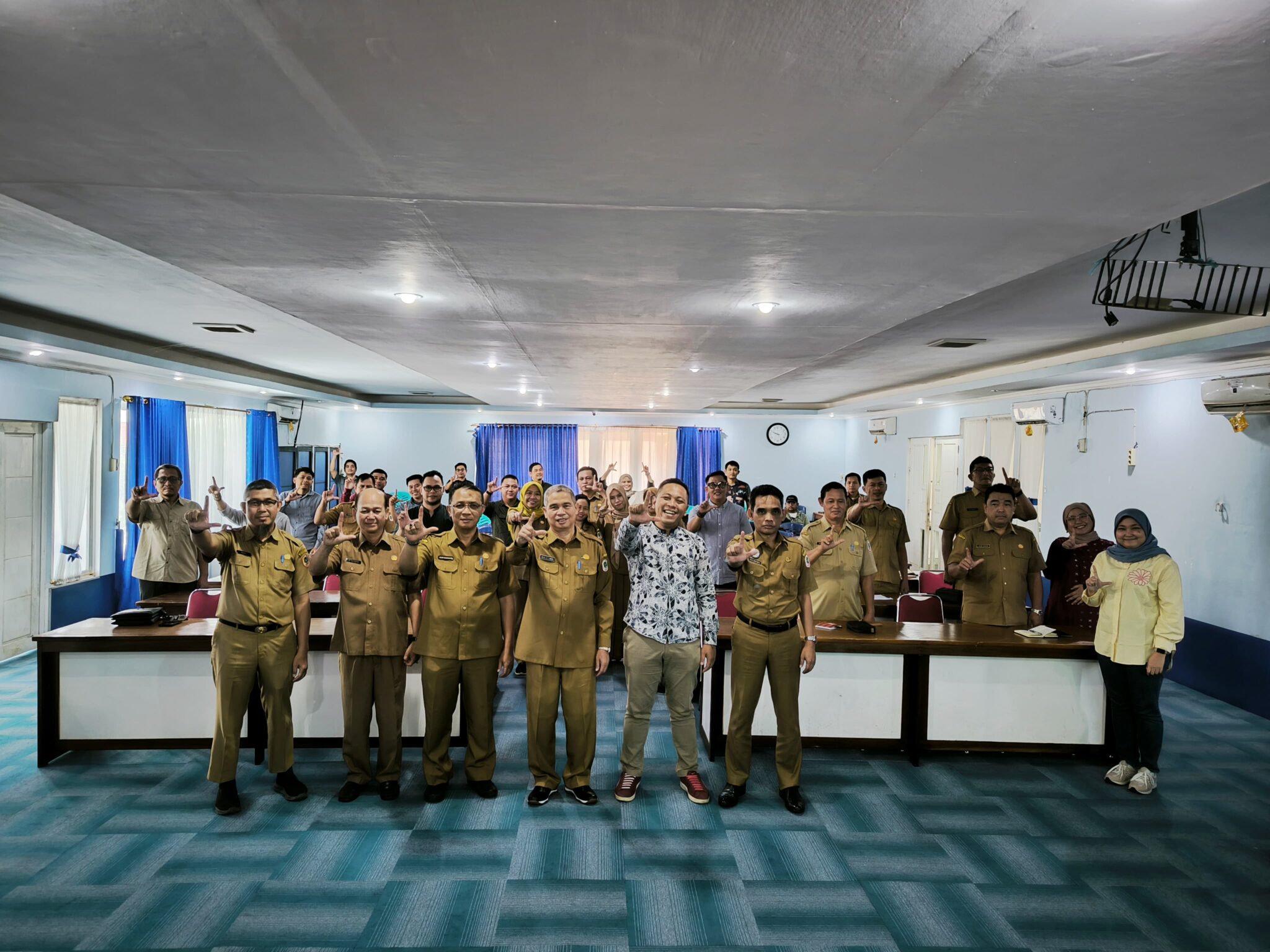
On Tuesday, February 25, 2025, at the BAPPEDA Hall of Kapuas Hulu Regency, West Kalimantan Province, MADANI Berkelanjutan held a public presentation titled “Presentation of Natural Forest Mapping Results in Kapuas Hulu” and a “Discussion on Sustainable Investment Potential.” The event was opened by Drs. H. Iwan Setiawan, M.Si., Assistant for Government and Social Welfare at BAPPEDA Kapuas Hulu, and attended by representatives from Regional Government Organizations (OPD) of Kapuas Hulu Regency, the Forest Management Unit (KPH), and members of the Civil Society Organizations Forum (FORMASI) of Kapuas Hulu.
In his remarks, Drs. H. Iwan Setiawan, M.Si. expressed appreciation for MADANI Berkelanjutan, which—although only beginning its work in Kapuas Hulu in 2023—has demonstrated strong commitment to collaboration and coordination with OPDs and other development partners. This collective initiative in sustainable forest and commodity management is expected to drive inclusive and sustainable green development.
This event was part of the presentation of MADANI Berkelanjutan’s one-year achievements in Kapuas Hulu through the KOLEKTIF initiative (Sustainable Forest and Commodity Management for Inclusive Green Development). The initiative focuses on climate change mitigation, forest ecosystem protection, strengthening the capacity and sustainability of local priority commodity supply chains, developing community-based bioenergy, and reinforcing local policies aligned with climate commitments.
After one year, the KOLEKTIF initiative has produced various outcomes that can support local government and communities in achieving sustainable development goals in Kapuas Hulu. These include mapping the potential for community-based biofuels and identifying technical assistance needs for OPDs to enhance sustainable forest management through green investment.
With growing attention from the business sector toward ESG (Environmental, Social, and Governance) standards, Kapuas Hulu has significant potential to attract green investment.
Forest Management Strategy
MADANI Berkelanjutan initiated its forest management strategy by presenting the results of natural forest mapping, recognizing that most sustainable products or commodities with investment potential originate from natural forests. Indigenous peoples and local communities living within and around these forests play a crucial role in their management.
The natural forest mapping was conducted to identify the extent and distribution of forests that can be protected and managed by communities under various management schemes. To date, MADANI has mapped natural forests in six villages across three sub-districts and is working to integrate these findings into the regency’s spatial planning and regional development plans.
Four Sectors of Sustainable Investment Opportunities
To support community welfare in Kapuas Hulu through the development of a Sustainable Investment Portfolio, in 2024 MADANI identified high-economic-value priority commodities, particularly in community-based bioenergy. These include illipe nut (tengkawang), rubber seeds, jatropha, and kratom.
In 2025, the identification of leading commodities continues, expanding into the fisheries, herbal medicine, food, and ecotourism sectors.
Preliminary findings from the assessment of local sustainable investment opportunities in Kapuas Hulu are grouped into four sectors:
Herbal Medicine Sector: Three main commodities identified are pasak bumi (Eurycoma longifolia), kandis (Garcinia xanthochymus), and coconut.
Food Sector: Forest honey, durian, and kratom were identified as key commodities.
Fisheries Sector: Snakehead fish, toman fish, and arowana were identified as promising commodities for development.
Ecotourism Sector: Potential sites include Melemba Village, Sungai Utik Village, and Tanjung Lasa Village.
These initial findings from focused group discussions provide a strong foundation for MADANI to continue supporting the local government in opening pathways for sustainable investment.
Toward a Sustainability-Based Investment Portfolio
Giorgio Budi Indrarto, Deputy Director of MADANI Berkelanjutan, stated that MADANI is committed to exploring existing potentials and transforming them into tangible investment products through comprehensive and well-structured planning.
“MADANI hopes that all mapped sectors can be documented on an online platform, enabling investors—both domestic and international—to explore Kapuas Hulu’s potential. With this approach, sustainable investment can become a key driver of regional economic growth without compromising environmental sustainability,” said Giorgio.
With a clear strategy and multi-stakeholder support, Kapuas Hulu has strong potential to become a model for green investment that can be replicated in other regions of Indonesia.