
The launch of the Indonesian Biodiversity Strategy and Action Plan (IBSAP) 2025–2045 in August 2024 marked Indonesia's renewed commitment to safeguarding biodiversity[1]. This document serves not only as a long-term strategic framework but also embodies grand ambitions: maintaining ecological balance, integrating biodiversity into cultural identity, and ensuring that environmental protection goes hand in hand with economic growth and community welfare.
The year 2025 became a crucial phase as it marked the start of full IBSAP implementation, replacing its previous version (2015–2020).[2] During this year, the government officially adopted the IBSAP document, which had been aligned with the global Kunming Montreal Global Biodiversity Framework (KM-GBF). One of its core agendas is the ambitious 30×30 target namely to protect 30 percent of Indonesia's land and 30 percent of its oceans by 2045.[3] Furthermore, the policy direction emphasizes the vital importance of ecosystem restoration, particularly on critical lands, mangroves, and peatlands, as part of the climate change mitigation strategy.
The integration of the IBSAP into the 2025–2029 National Medium Term Development Plan (RPJMN) marked another significant milestone. Biodiversity is no longer positioned merely as an environmental issue, but as the foundation of the national bioeconomy. The government began pushing for the implementation of green performance indicators for regional heads to ensure that biodiversity protection is implemented down to the provincial and regency levels.
Transition into Action: The 2026 Implementation Phase
Entering 2026, the IBSAP has moved beyond the planning stage. The government has begun moving toward a more concrete phase of implementation and reporting. In February 2026, the government finalized the Seventh National Report to the Convention on Biological Diversity (7th National Report or NATREP-7 CBD). This report serves as an initial reflection following the launch of the IBSAP, as well as an essential instrument to assess how well Indonesia's national targets align with the global Kunming-Montreal Global Biodiversity Framework (KM-GBF). More than just a report, NATREP-7 will form the basis for evaluating policy effectiveness, governance, and future conservation funding needs.[4]
At the same time, the structure of the IBSAP 2025–2045 has begun to be operationalized. The document outlines a grand vision of “living in harmony with nature toward Indonesia Emas 2045,” which is broken down into three main goals, thirteen strategies, and twenty national targets. However, this ambition comes with substantial financial requirements. It is estimated that approximately IDR 33 trillion per year is needed to achieve these targets. This condition has driven the government to seek innovative financing schemes to bridge the still significant funding gap.
Strengthening the monitoring system has also become a priority in 2026. The government has begun promoting the use of the Biodiversity Management Index (IPK) as a performance measurement tool at the regional level, alongside expanding cross sectoral collaboration. In this context, the involvement of Indigenous Peoples and Local Communities (IPLCs) is becoming increasingly vital not just as beneficiaries, but as key actors in data collection and area based biodiversity management.
The Core Challenge: Regulations vs. Ecological Reality
Yet, amidst an increasingly comprehensive policy framework, a fundamental question persists: are the protected regions truly the ones that are most ecologically significant?
To answer this, we need to reexamine Indonesia’s conservation landscape through two distinct yet equally important approaches:
Protected and Conservation Areas (KLK): Regions administratively designated and legally protected by the state.
Key Biodiversity Areas (KBAs): Regions scientifically identified as having globally significant values for the persistence of biodiversity.
The two do not always overlap and that is exactly where the policy challenge arises.
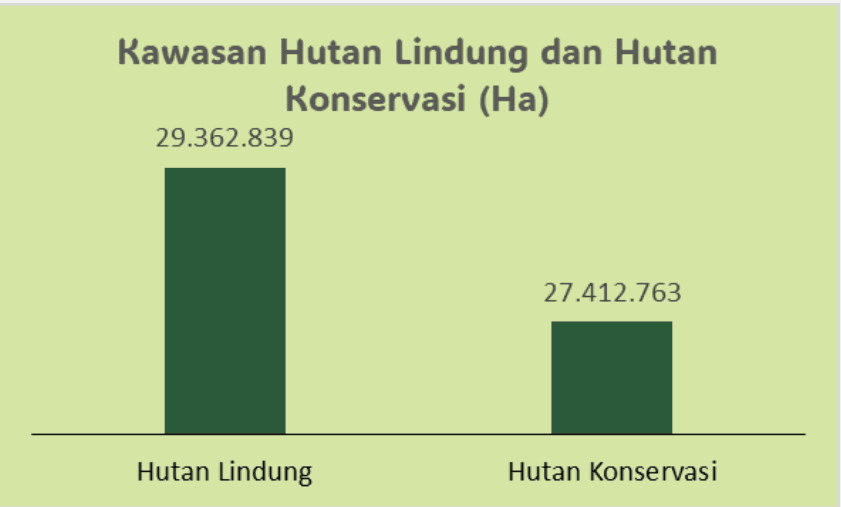
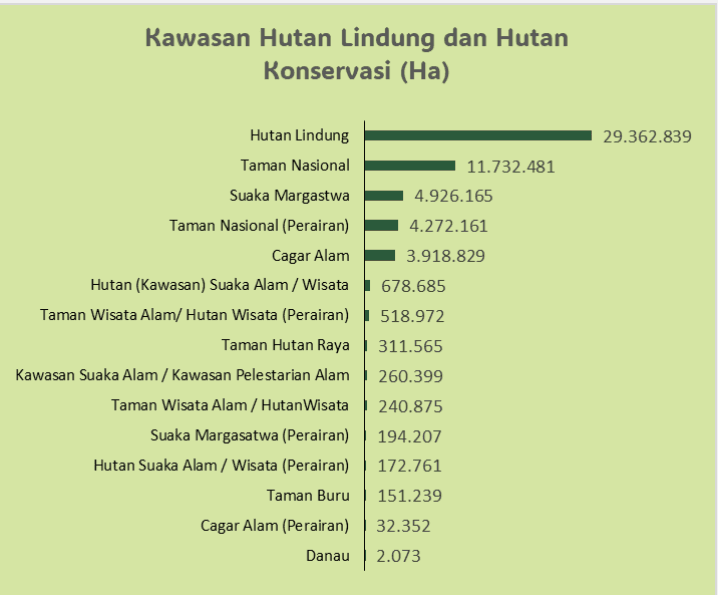
Overall, Indonesia possesses around 56.7 million hectares of protected and conservation areas, comprising 29.36 million hectares of protection forests and 27.41 million hectares of conservation forests. These areas are distributed across land and waters, with the highest concentration located in Eastern Indonesia. Central Papua Province is recorded as the region with the largest KLK, spanning 3.91 million hectares, while at the regency level, Kapuas Hulu in West Kalimantan stands as the largest with an area of 1.76 million hectares.
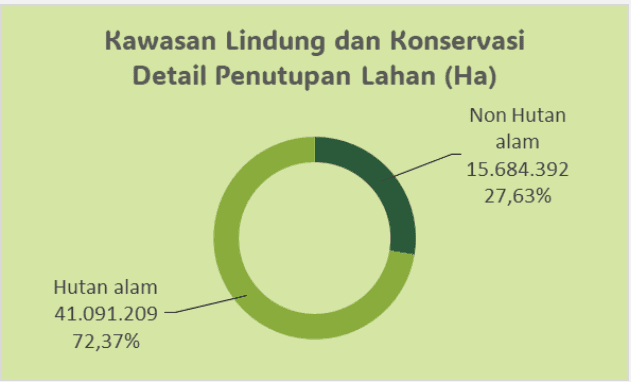
From a land cover perspective, this region still holds significant ecological strength. Around 72.37 percent, equivalent to 41 million hectares of KLK (Protected and Conservation Areas), is still natural forest. This shows that until now, conservation areas remain the primary stronghold in safeguarding Indonesia's remaining natural forests. However, this strength is not entirely free from pressure. Around 8.5 percent, or 4.82 million hectares of the KLK area, is located within peatland ecosystem functions, parts of which have experienced degradation. Additionally, around 5.42 percent, or 3 million hectares, already falls into the critical land category, and 5.61 percent, or 3.18 million hectares, sits within overlapping permits and concessions, including the oil and gas, mining, and plantation sectors. This fact reinforces that administrative protection does not fully guarantee ecological protection.
Policy wise, KLK (Protected and Conservation Areas) indeed looks strong. Around 90.41 percent or 51.32 million hectares of this zone are included in the Indicative Map for the Moratorium on the Issuance of New Permits (PIPPIB). However, the fact that pressures persist demonstrates that administrative protection status is not yet fully effective on the ground. In other words, protection on a map does not necessarily translate directly into protection in the field.
On the other hand, Key Biodiversity Areas (KBAs) present a more ecologically precise perspective. Spanning an area of 33.46 million hectares, KBAs represent territories scientifically identified as key areas for the persistence of biodiversity. Their distribution does not always follow the administrative boundaries of conservation areas. West Kalimantan is the province with the largest KBA, reaching 2.06 million hectares, while Malinau Regency in North Kalimantan tops the list at the regency level with an area of 1.03 million hectares.
Severe Ecological Challenges inside KBAs
However, the ecological condition of KBAs reveals a far more serious challenge. Only 58.22 percent or approximately 19.48 million hectares still consist of natural forest. This means that nearly half of the regions with high biodiversity value have experienced land cover changes. In terms of policy protection, only 46.62 percent or 15.6 million hectares of KBAs are covered under the PIPPIB moratorium. Consequently, more than half of this ecologically vital zone lies outside the moratorium protection scheme.
Pressure on KBAs is also more intense from a spatial utilization standpoint. Around 17.66 percent or 5.91 million hectares overlap with permits and concessions, dominated by Forest Utilization Business Permits (PBPH) and oil and gas concessions. Furthermore, around 4.33 percent or 1.44 million hectares have fallen into the critical land category. In fact, more than 2 million hectares of KBAs are recorded within food and energy reserve areas, showing that zones with high biodiversity value remain the targets of land-based development policies.
The Misalignment of Two Parallel Approaches
When these two approaches are brought together, the emerging gap becomes highly visible. Only about 18.61 million hectares of territory truly overlap between KLK and KBA. Beyond that, there are around 38.15 million hectares of conservation areas that are not included in KBAs. Conversely, around 14.86 million hectares of KBAs sit entirely outside protected and conservation areas.
This discrepancy reflects two parallel approaches that have not yet been integrated. KLK represents an administrative approach based on state policy, while KBA reflects an ecological approach based on science. When the two are misaligned, a fundamental risk arises: protected areas are not necessarily the most ecologically vital, and the most vital areas remain unprotected.
This situation becomes increasingly complex when linked to other policies, such as the FOLU Net Sink, food and energy reserves, as well as permit-based expansion. While parts of the conservation areas and KBAs have been included in the FOLU operational plans primarily within protection and deforestation reduction efforts pressures from various sectoral policies continue simultaneously. This indicates that protection and utilization approaches still run side-by-side without robust integration.
Peatland Ecosystems and Rehabilitation Mismatches
Peatland ecosystems serve as the most tangible illustration of this complexity. Despite partially sitting within conservation zones and KBAs, peatland conditions in many regions continue to suffer from degradation. This reinforces that protection based on area status alone is insufficient to safeguard deeper ecological functions, particularly in the context of climate change mitigation.
It is within this context that evaluating policy integration under the IBSAP framework becomes critical, especially regarding peatland ecosystem sustainability and the rehabilitation of critical lands. Data indicates that within both KLKs and KBAs, peatland ecosystems still face considerably high rates of damage. This persists despite the fact that the IBSAP explicitly positions peat restoration as a priority within climate change mitigation and ecosystem recovery strategies.
The lack of synchronization between area status and biodiversity value also directly impacts the effectiveness of critical land rehabilitation. Areas that are administratively protected are not necessarily prioritized for restoration based on ecological value, while degraded KBA territories do not always receive adequate policy interventions. As a result, rehabilitation efforts often run partially and are not grounded in the most urgent ecological needs.
Resolving Spatial Conflicts Through IBSAP 2025–2045
Furthermore, this lack of cohesion triggers land-use conflicts. Overlaps between industrial permits, conservation zones, and areas of high biodiversity value show that spatial governance is still not fully integrated. In many cases, territories that should be prioritized for protection are instead left open for exploitation, while some protected areas do not necessarily hold equivalent ecological value.
Through the comparison of KLK and KBA data, the urgency to align the legal status of areas with their biodiversity value becomes increasingly clear. This integration is vital not only to enhance protection effectiveness but also to minimize the land-use conflicts that frequently arise due to overlapping policies.
Within the framework of the IBSAP 2025–2045, merging these two approaches should be a key strategy. The administrative approach needs to be reinforced with a scientific basis, while the scientific approach must be translated into policies that hold legal power. By doing so, protection will not just be numerically expansive on paper, but ecologically well-targeted.
In an increasingly evident biodiversity crisis, Indonesia's success will be measured not only by the size of its protected areas, but by the courage to correct policy directions aligning policy, data, and implementation on the ground. Without such integration, conservation will continue to run on two separate tracks: administratively strong, but ecologically weak.
Ultimately, assessing Indonesia's conservation policy is not just a matter of how vast the protected areas are, but how precisely targeted those protections are. As the IBSAP enters its implementation phase, the main challenge is to ensure that administrative and scientific approaches no longer operate in isolation, but instead reinforce one another.
Three Concrete Steps to Forward
To remedy this, three concrete actions must be taken immediately:
The 14.86 million hectares of KBAs currently lying outside KLK must be incorporated into the next revision agenda of the PIPPIB moratorium.
The operationalization of Other Effective Area-based Conservation Measures (OECM) schemes must be accelerated as an instrument to explicitly bridge KLKs and community-based KBAs without requiring changes to area status.
The strengthening of the Biodiversity Management Index (IPK) as a regional performance indicator must be accompanied by an open and accessible KBA spatial database for regional governments.
Without these three steps, Indonesia risks maintaining a conservation system that is strong in numbers, but weak ecologically. [ ]
Footnotes
[1] Ministry of Environment and Forestry (KLHK), IBSAP 2025–2045.
[2] KLHK & Bappenas, Integration of IBSAP into the RPJMN 2025–2029.
[3] Convention on Biological Diversity (CBD), Kunming-Montreal Global Biodiversity Framework, 2022.
[4] Ministry of Environment/BPLH, 7th National Report to the CBD (NATREP-7), 2026.


