Renewable Energy is More Than Just Giant Solar Panels
When we talk about the energy transition, we usually picture massive solar farms, electric vehicles, or international climate pacts signed in Glasgow.
Yet, in many Indonesian villages, renewable energy has long thrived in far humbler ways: from seeds gathered by grandparents, from discarded coffee grounds, and even from weeds clogging up a lake.
This is the story of energy born from the grassroots. And hidden within it lies the answer to a massive, frequently overlooked question:
"How can Indonesia’s energy transition be just, and not just clean?"
In Article #1, we explored the concept of community-based energy transitions, and in Article #2, we unpacked the data on electricity inequality. This time, we travel across the Archipelago from Aceh to Papua to meet the people who were practicing energy justice long before the term became a buzzword.

Aceh: There is Wasted “Fuel” in Every Cup of Coffee
The Gayo highlands are one of the hearts of Indonesian coffee. Arabica and robusta thrive in Central Aceh, Bener Meriah, and Gayo Lues. The area of Gayo arabica alone reaches 103,495 hectares, supporting around 80,003 farming families, and its quality is capable of competing with Brazil and Vietnam.
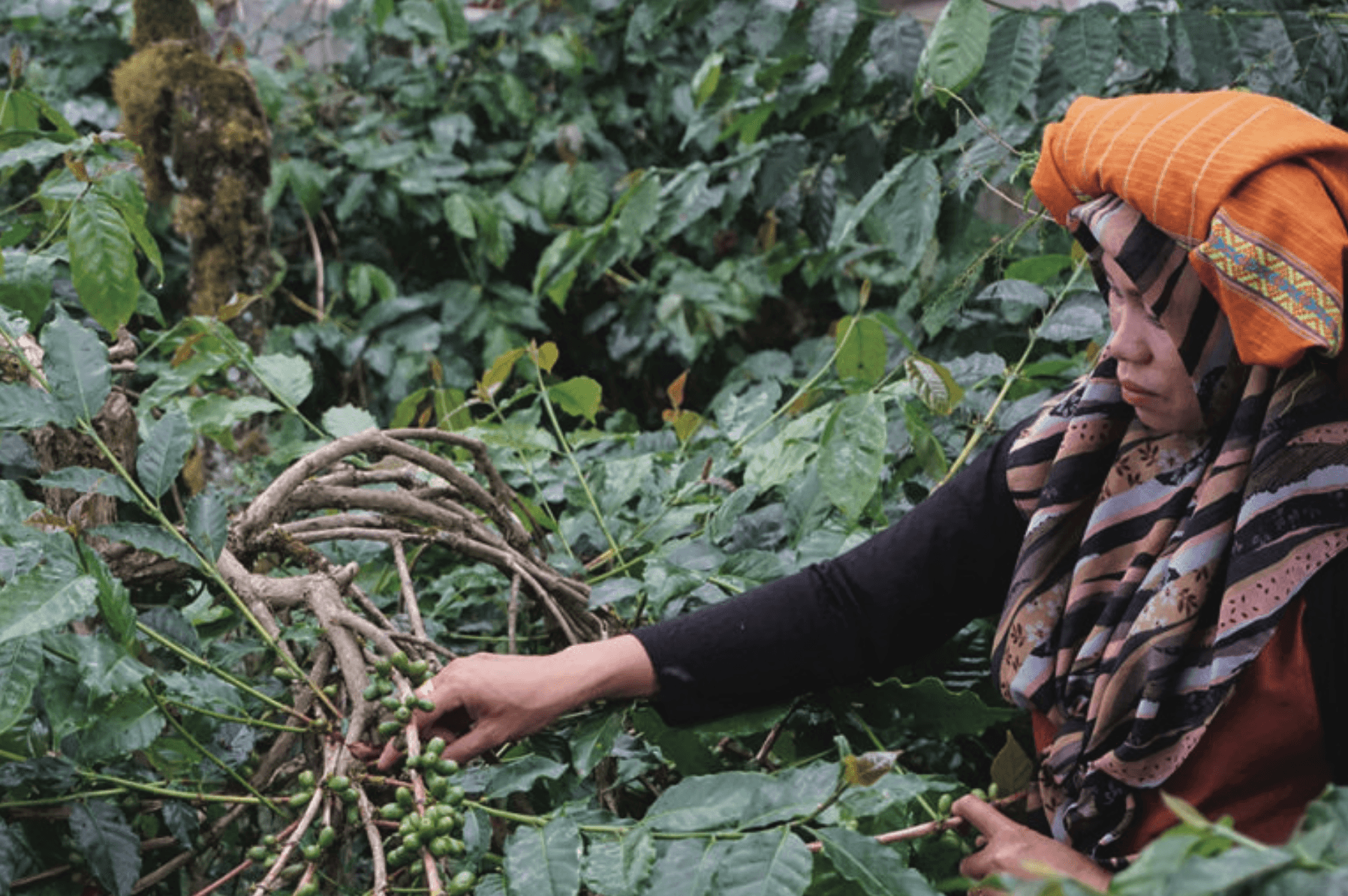
Aceh possesses coffee potential cultivated in the Gayo highlands, specifically the arabica and robusta varieties. Photo: Ariel Kahhari
But there is one thing that almost always ends up in the trash: the grounds.
In fact, from 10 kilograms of coffee grounds, about 2 liters of biodiesel can be produced, as the grounds contain 11–20% vegetable oil, equivalent to standard biodiesel raw materials. Yusya’ Abubakar, an academic from Syiah Kuala University and Secretary of the Expert Team of the Aceh Coffee Council, mentioned that coffee husks (parchment) and grounds can be processed into both briquettes and biodiesel.
"Due to the lack of research and markets, a lot of coffee husks and grounds are simply discarded."
— Yusya’ Abubakar, Secretary of the Expert Team of the Aceh Coffee Council
This is the first portrait of delayed energy justice: the value is already in the hands of the people, but without research and a market, it simply vanishes.
Purworejo: A 70 Year Old Grandmother Harvesting Energy from the Forest
Every morning, Rubiah (70) pedals her old bicycle five kilometers toward the nyamplung forest on the coast of Jetis Beach, Purworejo. From morning till evening, she gathers fallen seeds, filling half to a full sack, and then sells them for IDR 2,500 per kilogram.
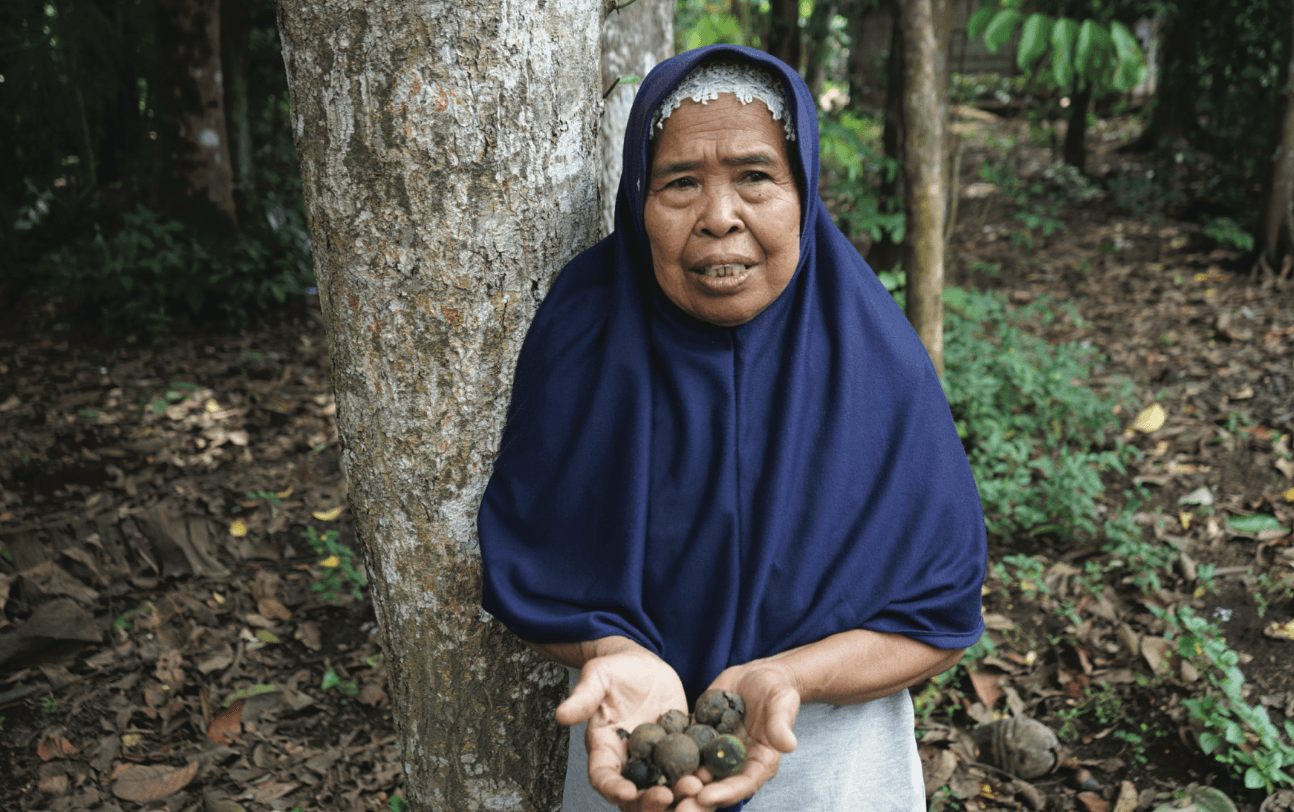
Rubiah (70), a nyamplung seed collector in Grabag District, Purworejo Regency, Central Java. Photo: Farida Indriastuti
"I'm already old, what else is there to do? Rather than sitting idle, I look for nyamplung seeds."
— Rubiah, nyamplung seed collector, Grabag, Purworejo
Not far from there, Warijo (79), a landless farm laborer, also gathers and even breeds nyamplung seedlings to sell for IDR 5,000–IDR 15,000 per stalk. “A small person like me only has small needs, as long as it's enough to eat,” he says. Meanwhile, Sabar (65) has been guarding the forest for nearly 12 years, completely unpaid.
The seeds eventually culminate in a bamboo warehouse owned by Barino (49). From there, he processes nyamplung into crude oil up to 1,000 liters per day with a daily turnover that can reach IDR 7 million.
What makes Barino special is not his production capacity, but his way of sharing. Since the farmers harvest on Perhutani (state forestry company) land, he sets aside IDR 500 per kilogram to give back to Perhutani, and he never has the heart to cut the wages of the elderly collectors. The added value circulates back to the local community rather than being sucked upward. Unfortunately, he admits to being left behind: there has been no further capital support or mentorship since the government's initial machinery grant.
Their scientific mentor, Prof. Budi Leksono from the Ministry of Environment and Forestry (KLHK) Research and Development Agency, has been studying nyamplung for more than 20 years. His data is highly intriguing High Productivity: Nyamplung yields 20 tons per hectare per year, far exceeding jatropha (5 tons) and oil palm (6 tons);Excellent Yield: Its oil yield reaches 40–73%;Non-Competitive: It thrives on critical, degraded lands without competing with food crops.
Yet, he notes, nyamplung remains "sidelined" in national energy policies.
It is no wonder that some of its pioneers have given up. Samino, a nyamplung biofuel trailblazer from Kroya, Cilacap, has finally retired. “My machines are just sitting idle,” he says quietly.
Gorontalo: When Disruptive Weeds Become Fuel
Gorontalo is widely known as the corn province. What people rarely realize is that corn cob waste can be converted into bio-charcoal briquettes, bioethanol, and gas. This is energy harvested from crop residues, completely bypassing the need to clear new land.
But the most fascinating story actually stems from a major ecological problem. In Lake Limboto, water hyacinth grows so rapidly that it covers 70% of the waters, plunging it into a critically endangered status. For the longest time, this weed has been seen strictly as an enemy.
Research by the State University of Gorontalo flips the script: water hyacinth can be transformed into bioethanol and biogas. Clean the lake, harvest the energy one task, two benefits. This is the concrete face of ecological justice, even if its large-scale development in Gorontalo has not yet truly taken off.
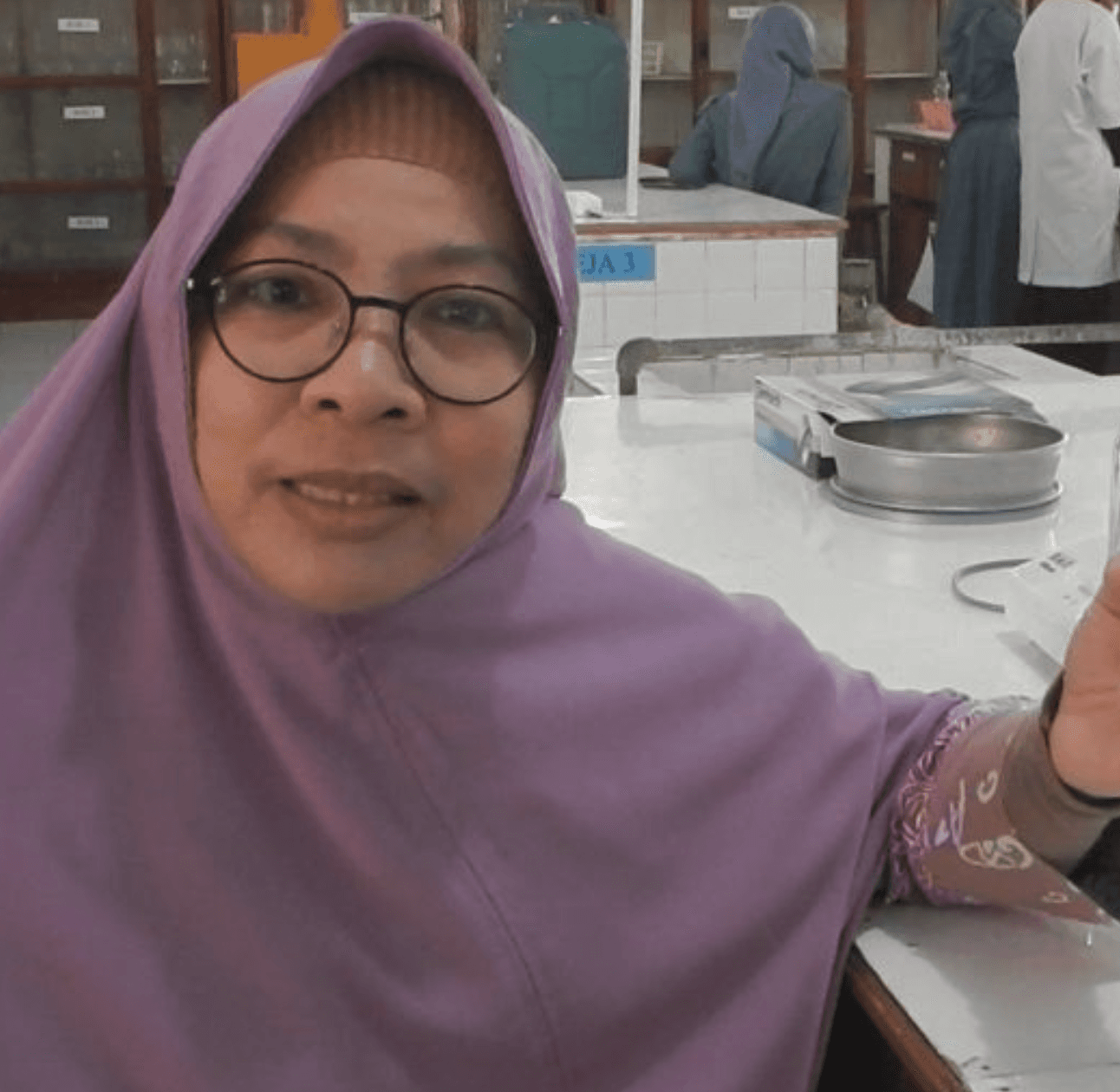
Yuzda Salimi, Chemistry Lecturer at the Faculty of Mathematics and Natural Sciences, State University of Gorontalo [UNG], shows the results of her research on bioethanol derived from water hyacinth processing. Photo: Department of Chemistry, FMIPA UNG
South Sumatra: The Village Factory That Once Exported to Germany
Not all stories have a happy ending, and it is precisely from failure that we learn the most.
On December 14, 2008, President Susilo Bambang Yudhoyono inaugurated the first jatropha biodiesel factory in South Sumatra, located in South Kota Batu Village, East OKU. The program was ambitious and entirely top-down: residents across 20 sub-districts were required to plant jatropha, a cooperative was formed, and heavy subsidies were poured in. At its peak, this factory even exported biodiesel to Germany.
Then in 2012, the machines ground to a halt. Why?
First, the economics simply didn't make sense for the locals. Producing 1 liter of jatropha biodiesel cost around IDR 9,000, while conventional diesel at the time was only IDR 4,500. Naturally, farmers switched to other commodities. Second, the program was entirely dependent on subsidies; once the subsidies stopped, the whole supply chain collapsed. Of the dozens of technicians who once worked there, only a handful remain today like Brory, who keeps the memory of the factory alive.
"East OKU was once capable of achieving independent diesel energy. But unfortunately, the market share was difficult."
— Herman Deru, former Regent of East OKU (currently Governor of South Sumatra)
Compare this to Barino in Purworejo, who actually survived because his initiative grew from the grassroots, supported by a market and institutional structure he built himself. The lesson is sharp: sustainability is not born from grand inaugurations, but from a genuine sense of ownership.
Papua: Sago, the Food Guardian That Can Also Fuel Energy
Indonesian food is not just about rice. In Papua and Maluku, there is sago and Indonesia holds 85% of the world's sago land, most of which is located in Papua.
Mochamad Hasjim Bintoro, a Professor at IPB University widely known as a national sago expert, calls sago the “symbol of Indonesia's food sovereignty.” Remarkably, sago grows naturally in swamps and peatlands, tolerates acidic soils, can be harvested at any time after 8–10 years, requires almost zero maintenance, and unlike palm oil plantations sago forests actually preserve wildlife habitats.
What makes it highly relevant for energy is that sago waste can be processed into biomass, in addition to being used for animal feed and fertilizer. Taufik Hidayat from BRIN highlights sago as a local commodity with immense potential for both food security and industrial raw materials, provided that downstream development is backed by research and partnerships.
Sago perfectly concludes a recurring pattern across all these stories: Indonesia's best energy alternatives are precisely those that thrive in wetlands, critical lands, or come from waste, rather than those that demand clearing forests.
Distribution Map of Community Energy Across the Archipelago
Region | Raw Material | Practice / Story | Notes |
Aceh (Gayo) | Coffee grounds | Coffee waste turned into briquettes & biodiesel | Potential, untapped |
Purworejo, Central Java | Nyamplung | Fair community-based gathering & processing | Active, minimal support |
Gorontalo | Corn cobs & water hyacinth | Waste & weeds converted into energy | UNG research, not yet scaled up |
East OKU, South Sumatra | Jatropha | First factory in South Sumatra, exported to Germany | Collapsed (2012) |
Papua & Maluku | Sago | Food + biomass from wetlands | 85% of the world's sago land |
Kapuas Hulu, West Kalimantan | Rubber seeds | Community crude oil from smallholder plantation waste | MADANI prototype |
Source: Menggapai Asa (MADANI & Mongabay, 2022); Mongabay Indonesia (2026); MADANI Kapuas Hulu Study.
And this is just a fraction. The stories above are merely the tip of the iceberg. Through its own spatial analysis, MADANI found approximately 2.27 million hectares of "clean and clear" land that can be cultivated for biofuel raw materials other than palm oil. Meanwhile, a CIFOR study notes that Indonesia possesses 16.8 million hectares of degraded land, most of which could be transformed into energy buffers instead of being left in a critical state.
Once the list is opened, the diversity is astonishing, ranging from forest seeds and factory waste to kitchen scraps and fish markets:
Raw Material | Type / Origin | Potential | Research Source |
Rubber seeds | Smallholder plantation waste (Kapuas Hulu) | 40–50% yield, thousands of tons/year | MADANI |
Nyamplung | Non-food forest plant | 40–73% yield, suitable for 5.7 million ha of degraded land | MADANI; CIFOR |
Jatropha | Dryland plant in 3T (frontier, outermost, remote) regions | NTT 18,306 ha (65% national); Papua 5% | MADANI |
Kemiri sunan, malapari, kaliandra, gamal | Degraded land plants | Grows on critical lands, non-food | MADANI (Synthesis Report) |
Used cooking oil (Minyak jelantah) | Household, food stall, and MSME waste | 715 kilotons/year, only 20–40% currently collected | ICCT (2021) |
Waste fish oil (Air cucian ikan) | Port & fish auction market waste | ±97 million liters of biodiesel/year | MADANI; ICCT |
Palm oil mill effluent (POME)/Palm sludge, animal fats, tall oil | Palm industry & livestock waste | Combined waste of ±4.6 billion liters/year | ICCT |
Sugarcane, sugar palm, areca nut, coconut, cassava | Crops on clean & clear land | Bioethanol & biodiesel | MADANI; Traction Energy Asia |
Tengkawang, kratom, elephant grass, coconut shells | Local potential in Kapuas Hulu | Diverse, forest- and waste-based | MADANI |
Source: Community-Based Bioenergy Development Study & MADANI Biofuel Diversification Series; ICCT (2021); CIFOR. Yield (Rendemen) = percentage of oil produced.
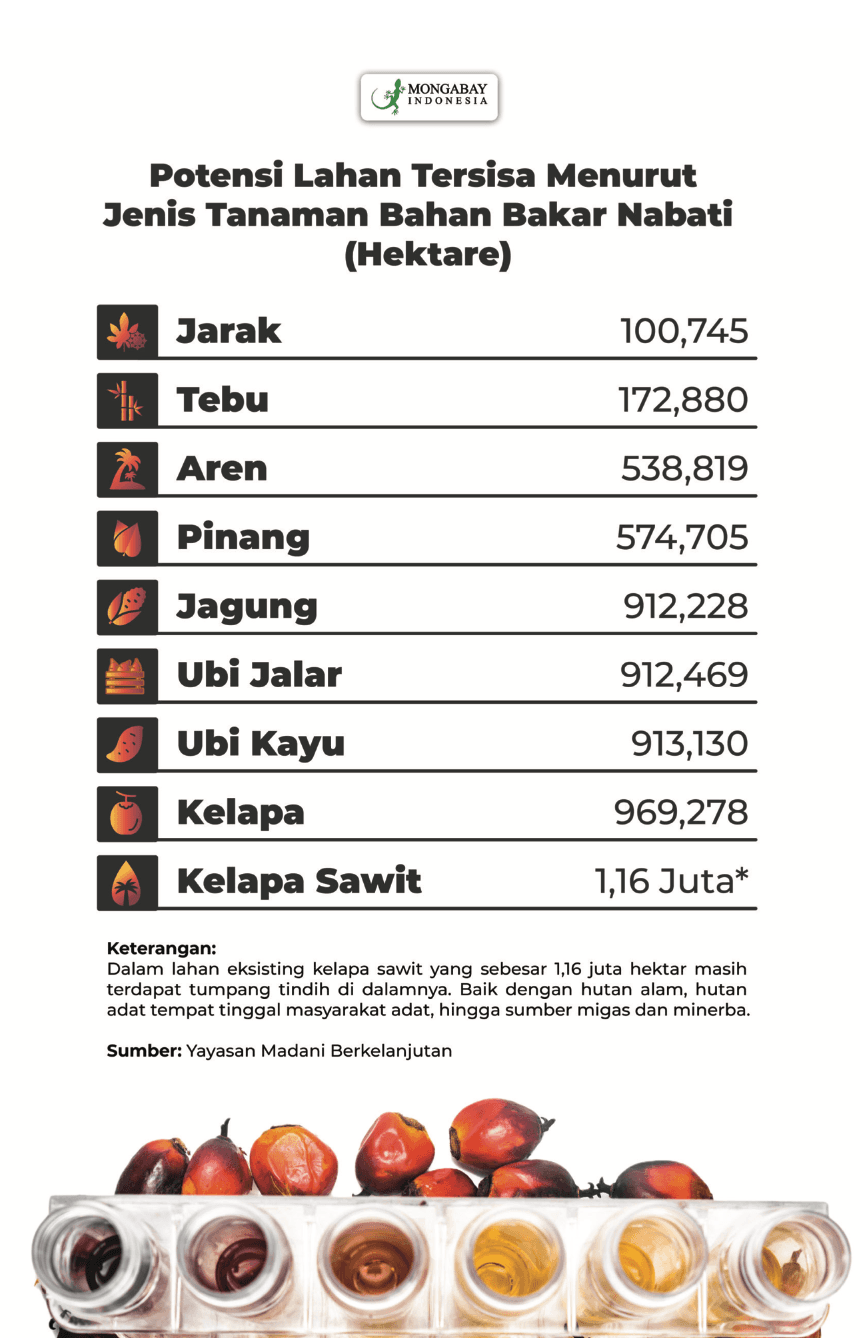
Remaining Land Potential by Biofuel Crop Type: If Local Energy is More Just, Why Are We Still Chasing Palm Oil?
This is a fair question. If coffee grounds, nyamplung, and sago are more just and environmentally friendly, why does the national biodiesel policy rely heavier and heavier on palm oil?
Indonesia is currently the world’s largest biodiesel producer, and almost all of it comes from palm oil. The government mandated a minimum biodiesel blend of 30% (B30), then raised it to 50% (B50) in 2025. With increasing vehicle demands, biofuel production must surge. The problem is, this surge is estimated to require the clearing of around 1.2 million hectares of land nearly a quarter of Indonesia’s current oil palm plantation area.
This is where the math flips. In theory, biofuels reduce emissions because plants absorb carbon as they grow. But once forests are logged to open plantations, the story changes completely.
According to an analysis by the Royal Academy of Engineering, palm biodiesel that involves land-use change can release around 125 grams of CO2 per megajoule (g CO2/MJ) making it dirtier than fossil diesel, which emits about 84 grams. Without land-use change, that number drops significantly to around 30 grams.
The Bottom Line: What truly matters is not whether we use palm oil or something else, but whether forests are being cleared or left standing.
Biofuel Source | With Land-Use Change | Without Land-Use Change |
Soybean | 180 g CO2/MJ | 45 g CO2/MJ |
Palm Oil | 125 g CO2/MJ | 30 g CO2/MJ |
Corn | 75 g CO2/MJ | 60 g CO2/MJ |
Sugarcane | 65 g CO2/MJ | 25 g CO2/MJ |
(Comparison: Fossil Diesel) | 84 g CO2/MJ | 84 g CO2/MJ |
*Source: Royal Academy of Engineering (2017), via BBC. Average of 20+ studies per fuel type.
The world has already moved to address this. Germany stopped producing biodiesel from palm oil in 2023 due to deforestation concerns, the European Union tightened its regulations, while Brazil and Thailand have curbed their biofuel production rates. Global Forest Watch even notes that there are 50–60 crops that are more environmentally friendly than palm oil, including candlenut and coconut, which are abundant in Indonesia.
The government has a counter-argument that isn't entirely wrong: palm oil is indeed highly land-efficient, requiring less land to produce the same volume of oil compared to soybean or sunflower. However, land efficiency is not a cure for deforestation. And that is exactly where village-based raw materials from nyamplung, coffee, and corn to sago growing in wetlands and critical lands offer a long-ignored way out.
So, What Makes Energy Truly Just?
From Aceh to Papua, these grassroots stories point to the exact same four principles. These are not abstract theories, but real lessons from the field:
Utilize waste and degraded land, not forests. Coffee grounds, corn cobs, water hyacinth, nyamplung in peatlands, and sago in swamps all generate energy without cutting down trees, and they even help restore ecosystems.
Ensure the value circulates in the hands of the locals. Barino’s way of sharing wages fairly is the village version of economic justice. As long as downstream sectors are controlled by a select few, those who cultivate the land will remain poor.
Grow from the grassroots, don't just drop from the top. Purworejo’s nyamplung survived because it was driven by the residents; East OKU’s jatropha factory failed because it was entirely top-down and dependent on subsidies.
Provide research, market, and institutional mentorship. Coffee grounds go to waste "due to a lack of research and markets," Samino’s machines sit idle, and factories collapse without buyers. Without continuous mentorship, even the greatest potential will die out.
These four principles directly align with the five values of a just energy transition championed by the #BersihkanIndonesia coalition: accountability-transparency-participatory, respect for human rights, ecological justice, economic justice, and transformative change. It also resonates with MADANI's push to lock down diversification under the #NotJustPalmOil (#BukanHanyaSawit) banner within the New and Renewable Energy Bill (RUU EBT).
From Village to the World: An Unfinished Business
The title of this piece is no metaphor. Energy born from Indonesian villages genuinely touches the global stage.
Nyamplung oil is sought after by Japan as aviation jet fuel, and Saudi Arabia has requested thousands of its seedlings to be shipped. Gayo coffee actively competes with Brazil. The East OKU jatropha factory once exported directly to Germany. The potential is undeniable. But the real question of energy justice is not "can we?", but rather "who gets to enjoy the fruits of it?"
As long as that global added value has not returned to Rubiah, Warijo, Barino, and the Gayo coffee farmers, our energy transition cannot be called truly just.
This is the very spirit currently carried forward by MADANI Berkelanjutan through the Community-Based Bioenergy program in Kapuas Hulu, West Kalimantan. They are mapping dozens of local raw materials, from rubber seeds to used cooking oil, and preparing community-based processing using agroforestry models rather than monoculture, ensuring the benefits are shared collectively.
Tomorrow morning, Rubiah will still pedal her old bicycle. Barino will still fire up his machines. They are not mere statistics, nor are they pitiful project beneficiaries. They are the keepers of small lamps who have already shown the way forward if only we stop overlooking the little things.
Frequently Asked Questions
What is energy justice? Energy justice is not just a matter of making electricity or fuel available. It is about who pays, who participates in making decisions, and who actually enjoys its value. A village can have energy infrastructure but still be at a disadvantage if its residents pay high prices, have no voice, and reap no economic benefits.
Is it true that palm biodiesel can be dirtier than conventional diesel? Yes, it can be if its production requires clearing forests. Without land-use change, palm biodiesel yields far lower emissions than conventional diesel. However, when forests are cut down for new plantations, its emissions can skyrocket to around 125 g CO2/MJ, which is higher than fossil diesel (~84 g CO2/MJ). That is why Germany halted palm biodiesel in 2023 and the European Union tightened its rules.
What grassroots energy raw materials are potential besides palm oil? There are many, depending on each region's specific landscape: coffee grounds (Aceh), nyamplung (Purworejo, Selayar), corn cobs and water hyacinth (Gorontalo), sago (Papua and Maluku), rubber seeds and used cooking oil (Kalimantan), as well as rice husks. Most are based on waste or critical lands, meaning they do not demand deforestation or compete with food security.
Why do many village bioenergy programs fail? Generally because they are too top-down and economically unsustainable. For instance, the East OKU jatropha factory failed because its production costs far exceeded conventional diesel prices, causing it to collapse as soon as government subsidies stopped. Conversely, initiatives that grow organically from the grassroots and establish their own local markets, like Purworejo's nyamplung, manage to survive. The key lies in long-term research, market access, and institutional mentorship.
Start here: Recognize the bioenergy potential in your local region, support the diversification of local raw materials, and voice energy justice as a vital national agenda. Explore MADANI’s Community-Based Energy Transition program or subscribe to the MADANI Newsletter to follow the latest updates on Indonesia's energy data and policies.
References
MADANI Berkelanjutan & Mongabay Indonesia (2022). Menggapai Asa Bahan Bakar Nabati Indonesia: Kumpulan Essay Narasi Jurnalistik (stories of Aceh, Purworejo, Gorontalo, South Sumatra).
Mongabay Indonesia (2026). Sagu, Simbol Kedaulatan Pangan Indonesia.
BBC Indonesia. Biodiesel Indonesia: Harapan Mengurangi Emisi yang Justru Mendorong Deforestasi.
Royal Academy of Engineering (2017). Sustainability of Liquid Biofuels (biofuel carbon footprint study).
MADANI Berkelanjutan (2022). Dinamika Diskursus Bahan Bakar Nabati di Indonesia (Synthesis Report).
MADANI Berkelanjutan (2023). Seri Policy Brief Diversifikasi BBN, Series 1–3.
MADANI Berkelanjutan. Pengembangan Bioenergi Berbasis Komunitas (Kapuas Hulu Study, West Kalimantan).
ICCT – Zhou, Y., Searle, S., & Kristiana, T. (2021). Opportunities for Waste Fats and Oils as Feedstocks for Biodiesel and Renewable Diesel in Indonesia.
CIFOR. Kajian Potensi Nyamplung pada Lahan Terdegradasi di Indonesia.
Yanti, R. N., et al. (2022). Karakteristik Limbah Biomassa Kulit Batang Sagu sebagai Bahan Baku Energi Alternatif. Jurnal Hutan Lestari.
#BersihkanIndonesia. Five Values and Principles of a Just and Sustainable Energy Transition.