The Sustainable Madani Foundation summarizes several important events related to the economic and political conditions that occurred in the past week (April 19-26, 2021). Here are the excerpts:
1. Leader Summit on Climate
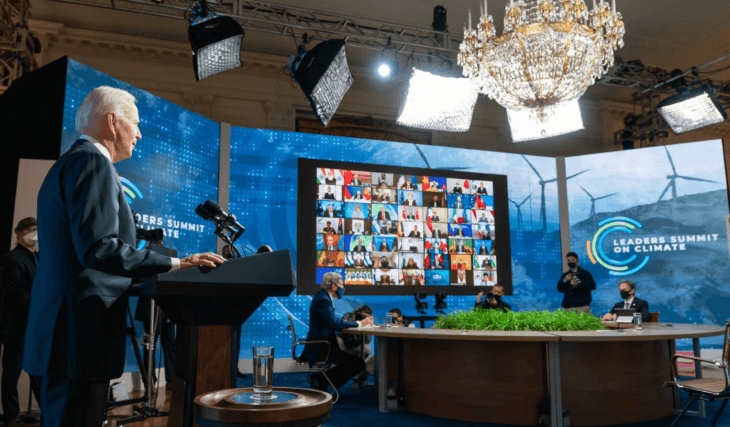
The United States held a two-day Leaders' Summit on Climate on April 22-23, 2021, attended by representatives from 40 countries from around the world. The Leaders' Summit discussed the importance of maintaining the global temperature rise limit of 1.5°C to prevent dangerous damage.
Indonesia, one of the invited countries, also attended the meeting. President Jokowi outlined Indonesia's efforts to address climate change. He stated that Indonesia has successfully halted the conversion of 66 million hectares of natural forests and peatlands and has been able to suppress forest and land fires. He also urged the attending leaders to advance green development. He also mentioned that Indonesia has updated its National Development Planning (NDC) to increase its capacity for climate adaptation and resilience.
Unfortunately, in his speech, unlike several other countries that are targeting net zero emissions in a specific year, President Jokowi did not explicitly state the net zero emission target that Indonesia will achieve.
2. Earth Day Commemoration
Earth Day, which falls on April 22, has drawn criticism regarding the government's commitment to climate change. Wahyu Perdana, Campaign Manager for Food, Water, and Essential Ecosystems at Walhi (Walhi), stated that the government has been unresponsive in several areas.
One example is that the Ministry of Environment and Forestry (KLHK) still adheres to the old standard, which limits temperature rise to 2 degrees Celsius. This is despite the Intergovernmental Panel on Climate Change (IPCC), the UN's climate panel, recommending a maximum average temperature increase of 1.5 degrees Celsius.
The impacts of climate change are already being felt by the public. According to data compiled by the National Disaster Management Agency (BNPB) and the Meteorology, Climatology, and Geophysics Agency (BMKG), there has been an increase in the number of disasters related to climate change in recent years. These disasters include hurricanes, cyclones, and other ecological disasters. The BMKG itself confirmed that one of the factors contributing to tropical cyclones occurring within Indonesia and contributing to these hydrometeorological disasters is global warming.
Echoing Wahyu, Mikhail Gorbachev Dom, Director of the Environment for the Indonesian Solidarity Party, stated that recent natural disasters are also a result of human policies and behavior in managing nature. The 2021 Global Climate Risk Index ranks Indonesia third in the world for disaster risk. Therefore, Gorbachev believes that it is highly inappropriate for the Ministry of Environment and Forestry to issue a 2070 target for Indonesia to achieve zero emissions in its Long-Term Strategy on Low Carbon and Climate Resilience Indonesia (LTS LCCR).
3. ASEAN Summit on Myanmar
The ASEAN Summit to discuss the Myanmar crisis was held in Jakarta on Saturday (24/4) and was attended by high-ranking ASEAN leaders, including Myanmar Military Junta Leader General Min Aung Hlaing.
The conference reached five consensuses: an immediate end to the violence in Myanmar, constructive dialogue to find a peaceful solution, ASEAN facilitating mediation, providing humanitarian assistance through the AHA Centre, and a special ASEAN envoy to Myanmar. Regarding the meeting, the opposition to the Myanmar military junta, the NUG, a civilian government opposed to the military junta, declared the ASEAN Summit a failure. According to the NUG, the points of the agreement favored the military junta, which had committed human rights violations.
The summit also drew global and domestic attention due to its attendance by Myanmar's coup leader, General Min Aung Hlaing. In Indonesia, several non-governmental organizations, members of the Civil Society Coalition, also rejected the military junta's presence. The coalition includes KontraS, Amnesty International Indonesia, FORUM ASIA, AJAR, Milk Tea Alliance Indonesia, the Human Rights Teachers Union, the Human Rights Working Group, Migrant CARE, the Asia Democracy Network, the Kurawal Foundation, and SAFEnet. Amnesty International Indonesia's Executive Director, Usman Hamid, also believes ASEAN's decision to invite Aung Hlaing will hinder the Southeast Asian bloc's relationship with the people of Myanmar.