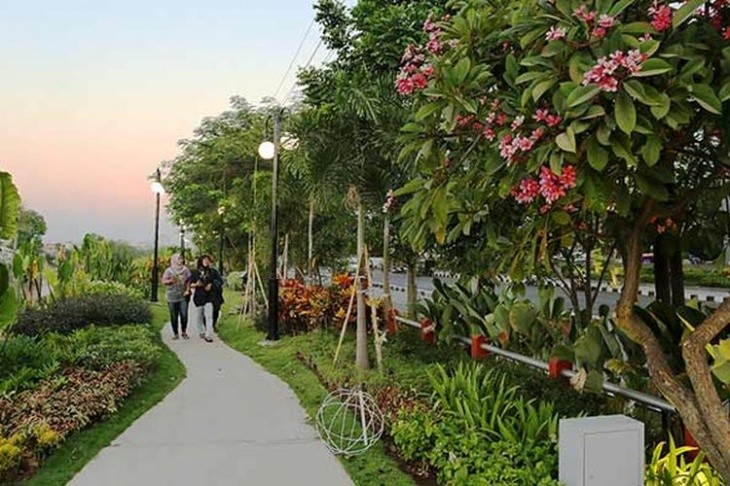
The lyrics of this song by the band Surfaces , " Feeling good, like I should, " went viral on social media some time ago. Not only because of its easy listening , but also because it served as the backdrop for a video featuring fresh, green scenery with a beautiful mountain backdrop in Ranu Manduro, Mojokerto. After going viral, the impromptu tourist attraction was flooded with tourists seeking its beauty and comparing it to New Zealand-style scenery.
If you look at it, it becomes interesting why people are willing to come from far away places to queue in traffic jams to be able to visit the area, or why on weekends, the Puncak route, Bogor is always crowded with tourists from Jakarta and its surroundings, or why they have to go on holiday to Raja Ampat and Bali to be able to enjoy the green and pristine natural scenery.
A 2018 study from the University of Warwick and the University of Sheffield sheds some light on this, stating that human interaction with the natural environment can create a sense of well-being, leading to improved mental health. Escaping the hustle and bustle of the city and heading to the suburbs is the answer, as large cities are now filled with high-rise buildings, residential areas, and offices, with a lack of green open space.
Challenges in Providing Green Open Space
Data from the Ministry of Public Works and Public Housing (PUPR) shows that, to date, only 13 of 174 cities in Indonesia have participated in the Green City Program and have a green open space portion of 30% or more. This is despite the provisions of Law Number 26 of 2007 clearly specifying the proportion for each city, namely at least 30 percent of the city's area.
READ ALSO: Electronic Waste: A Threat We Shouldn't Forget
However, providing green open space amidst the increasing growth of residential and office areas is not as easy as flipping a switch. The first problem lies in the limited remaining green open space. High population growth in an area is inevitably followed by rapid growth in built-up areas, such as residential and office areas. Land conversion is inevitable, resulting in a shortage of green open space.
Second, the difficulty faced by city governments in allocating funds for green open space in urban areas. It's well known that the market price of land per square meter in urban areas like Jakarta is very high, while budget allocations for land acquisition are certainly limited. Furthermore, the land acquisition process itself is time-consuming.
The third issue is the pragmatic reasons landowners have for developing residential or commercial developments because they believe it's more profitable than simply creating green open space, especially if the land is located in a strategic location.
In fact, urban spatial planning is not only for cultivated or built-up areas. Green space is essential for balancing the city's ecological conditions, as trees and plants help absorb carbon dioxide and retain water. Worse still, this function is declining in large cities, and they are increasingly becoming less and less shady. Ultimately, problems and disasters such as flooding, landslides, and drought are becoming more readily felt by city dwellers.
On the other hand, the World Bank's analysis deserves serious attention, projecting that 220 million Indonesians will live in urban areas by 2045. This means that urbanization will continue to increase from 56% to 70% of the total population. This also means that the need for built-up land will increase every year.
Opportunities for Providing Green Open Space
Amidst the increasingly complex challenges of urban issues, there is still a glimmer of hope that can be initiated to explore the possibility of providing Green Open Space. In the author's opinion, there are at least three schemes that can be initiated to provide green open space. First , providing tax incentives for undeveloped or idle land. High tax burdens on idle land often lead landowners to take the shortcut of immediately selling to other parties to become built-up areas. However, if left undeveloped, the city helps maintain the infiltration area from the idle land. Therefore, this incentive is expected to help landowners refrain from converting their land. Through this scheme, the city government will actually be assisted in providing Green Open Space because it does not need to acquire land, but only by providing tax incentives.
READ ALSO: Martabak Economy
Second , a scheme for utilizing idle land for the management of small and medium-sized businesses. While previously, landowners only received tax relief incentives for undeveloped land, under this scheme, landowners gain economic benefits from the land left idle. By collaborating with other parties, such as event organizers, the land can be utilized as a location for non-permanent MSME centers while still devoting a significant portion of the land to open space. This practice is commonly found at night markets or impromptu morning markets, where landowners profit from renting land from business tenants.
Third , developing ecotourism potential. While the previous two schemes utilized open space on idle land only temporarily, this scheme allows for sustainable land use. The need for nearby green recreation spaces presents a long-term investment opportunity, especially during the pandemic, when people are still unable to travel far and are still concerned about contracting the virus. Idle land can be developed into an attractive recreational facility. Providing lakes, fruit gardens, mini zoos, labyrinths, and gazebos provides a perfect place to escape the pressures of work and, of course, minimizes the risk of traffic congestion compared to traveling to suburban areas like Puncak.
Ultimately, this urban green open space management scheme becomes an alternative for sustainable economic development while still paying attention to the ecological function of an area and empowering the surrounding community.
By: Muhammad Wahdini
The driving force behind the BangSaku Movement, a Balikpapan resident